Garden Beauty in Full Bloom

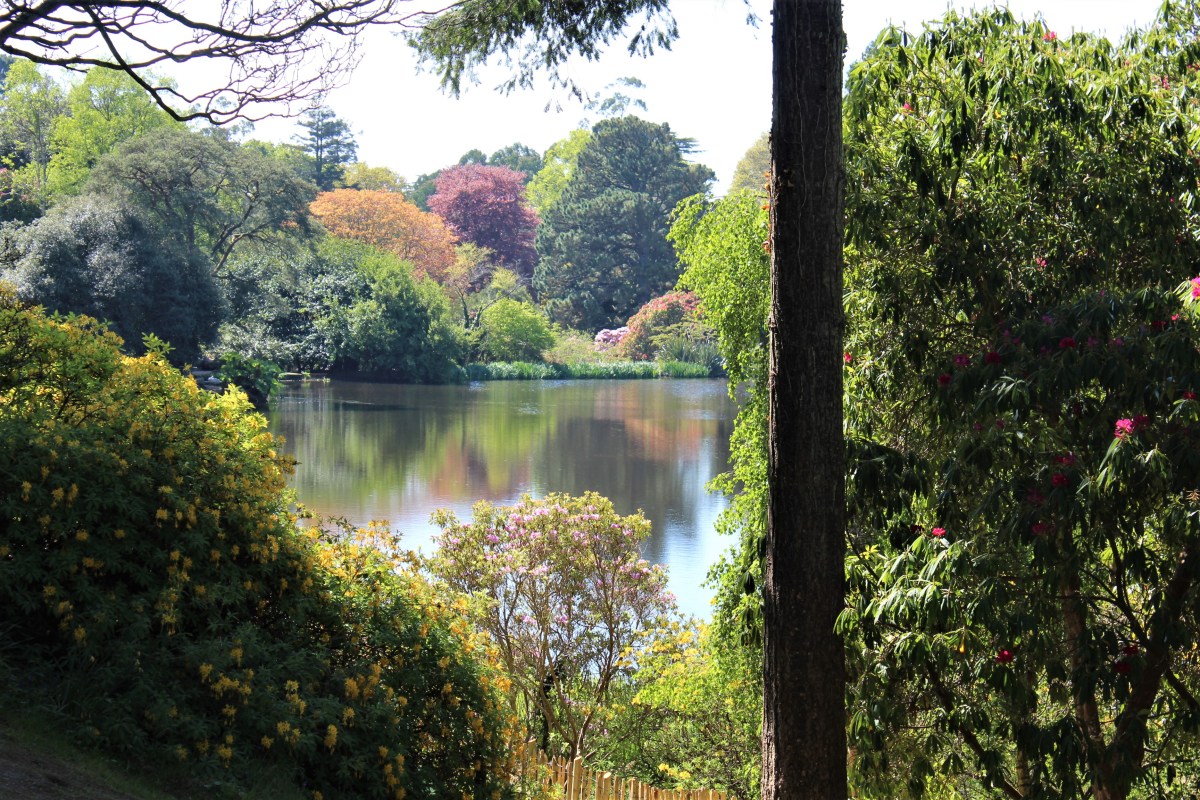
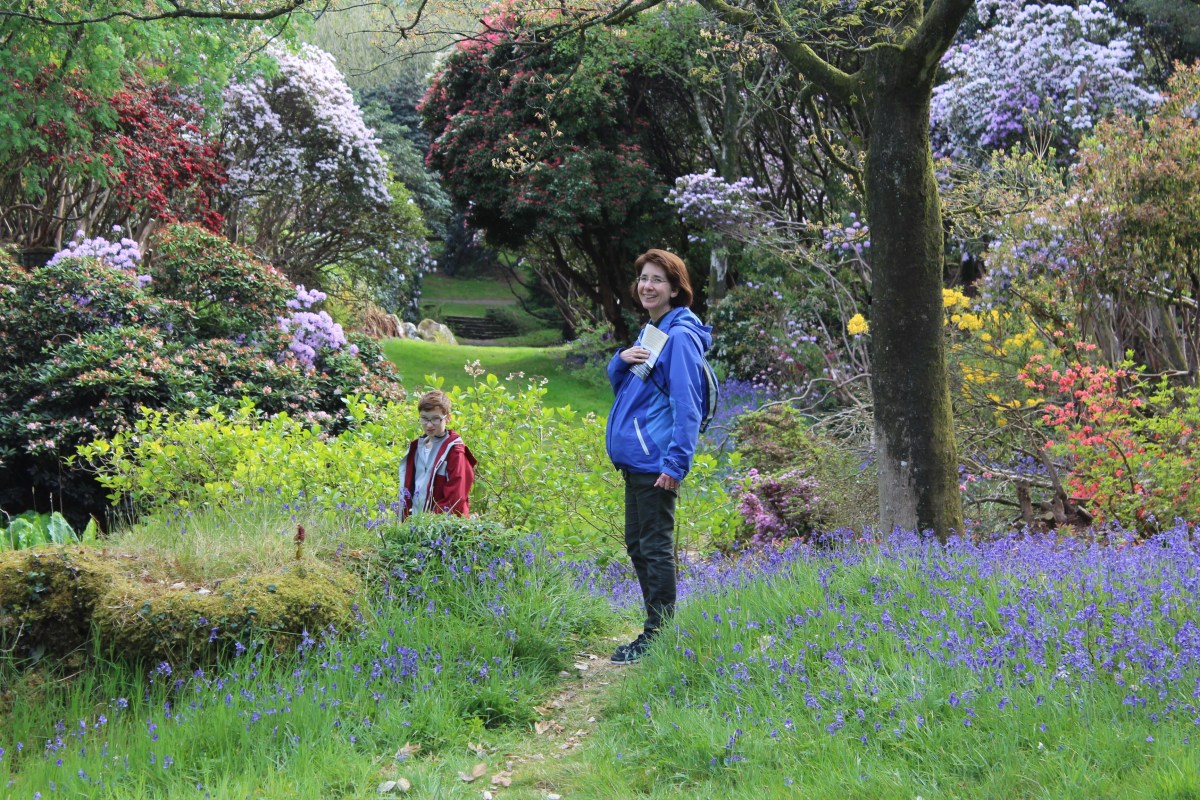
Sun gave way to shadow as the day faded, but the brilliance of the azaleas and rhododendrons in their natural surroundings still shone through. I have been to many gardens, but I think Rowallane Gardens may be my favorite yet.

At the start of the weekend, we had no plans, but the weather was terrific so we had to get out and enjoy the sunshine. And UK Fulbright Scholars are enrolled in the National Trust, which allows free access to sites under its purview.

So free is free, even though it proved easier to hire a car than to figure out how to get a bus for the 15-mile trip to County Down.

The 50-acre property was developed by the Rev. John Moore in the 1860s, then expanded and updated by his nephew Hugh when the property passed into his hands in 1903. Hugh brought in plant species from around the world and cared for the garden until his death, at which time the property became part of the National Trust.

We’re told the crowds were thick earlier in the day, when Rowallane held its annual plant sale. But we mainly had the place to ourselves in the late afternoon/early evening.

The formal gardens were nice, but I really liked the natural areas. There were wide grassy areas trimmed with trees and bushes, mostly in bloom. We walked past the 100-year-old handkerchief tree, which has just started putting on leaves for the year. The Himalayan blue poppies dotted the landscape, adding bits of color along the pathways.

Bees were working feverishly, drinking deeply from the flowering plants. Light and shadow played in the Pleasure Ground, a treed area that Moore planted. The pictures I took there did little to capture the splendor of the light’s interplay with shadows.

We already had plans to visit another famous garden the next day, but Rowallane Gardens would prove tough to beat.

Europe Drives Motorists to Public Transportation Better than in US

Europe beats the US all to hell in terms of transportation. I realize that part of the reason is large parts of Europe are compact, compared to the spread out United States. Still, it’s fairly easy to move from city to city on a train (preferred) or a bus, and then within a city using a subway, tram or bus in Europe.

When traveling, it helps that we plan to stay near the center of these cities to take advantage of the transportation. But even traveling to Potsdam on a day trip from Berlin during a recent vacation was easy and fairly inexpensive. We bought a seven-day Eurorail pass, which allows free transportation on the days we designate. They weren’t cheap, but it’s a relief knowing that most of our major transportation is paid for. Sometimes you have to pay extra to take high-speed trains or book a reservation on a particular train, but those costs are modest.

In Berlin and Amsterdam, we bought tourist passes that included transportation. So in addition to free or reduced admission to certain museums, the buses and trains were included. The Amsterdam passes alone were more than 200 Euro total, but we visited enough museums to more than recoup the cost, not counting the half-dozen subway and tram rides we took.

Cyclists and bikers everywhere

That’s not to mention the bike riding. Many European cities are compact, making it easy to get around by bike or motorbike. Few riders had helmets, but I never saw a crash, even among pothead tourists in Amsterdam. We even saw small children riding with their parents on bikes and tons of kids on Razor scooters.

I believe the reason they’re so popular is the proper infrastructure is in place to support it. Dedicated bike lanes are placed next to sidewalks, separating cars from bikes from people in many instances. Bike parking decks rise several stories next to the central train station. City-supported rental bikes schemes let tourists live like the locals while giving the locals a cheap way to grab a bike and go.

A friend in Antwerp said the local bike scheme is 40 Euro a year for 30 minutes’ bike use at a time. That’s enough time to check a bike out, pedal to the store, check it back in, shop, then rent another bike for the return trip.

I also think it helps that driver education is a much bigger deal in Europe than in the US. Getting one’s license is difficult and takes considerable practice. Many young drivers take the test two times or more before passing. Because those skills are taught for a longer period of time, I think they become more ingrained.

You will find the occasional asshat tearing down our street in Belfast, but for the most part, I see drivers using their turn signals, letting other cars in and observing the pedestrian crossing signs. I was amazed to see rush hour traffic on a motorway in Amsterdam evenly spaced, instead of cars sniffing up the tailpipe of the cars in front.

Getting out of our cars

Governments that truly want to serve constituents should make the necessary investments in transportation infrastructure beyond the car. Bike ridership might be low in your city, but rather than use it as an excuse to build more roads, leaders should explore why it’s low and ways to get people out of their cars.

Atlanta has MARTA, but its track configuration was designed to appease politicians rather than move people from where they live to where they work. Attempts are being made to address this, but those infrastructure improvements will take decades. In the meantime trains run barely frequently enough during rush hour and not nearly often enough otherwise.

Unfortunately, I don’t think America will suddenly lose its love of the passenger car and embrace the train, the bus or the subway anytime soon. But savvy leaders in certain areas are recognizing the importance of transportation infrastructure beyond the car to attract younger workers who increasingly are learning to drive much later—if at all.

They can look to Berlin, to Amsterdam and to Antwerp for examples of how to successfully marry roads, rails and bike lanes for the betterment of all.

Free to Pee, You and Me

I’m visiting your city, seeing your sights, eating in your restaurants and staying in your city’s accommodations (frequently paying a visitor tax). The least you can do is provide me a few free places to piss.

I’m talking to you, Venice, with a visitor tax and seemingly one pay toilet in the entire old part of the city, despite posting 500 signs for it. You can’t provide free toilets on the Venetian island of Murano, yet you can pay someone to collect toilet tolls? I’m talking to you Berlin, which had public facilities where you wanted to charge me 1 euro.

I’m talking to any bus or train station with pay toilets. I’ve paid for my ticket, which helps finance your operations, so give me someplace to go (literally). In Prague, you had to pay to pee even in places you had to pay to enter. We paid the equivalent of 20 euro to climb the Petrin Tower yet had to pay another 10 crowns (about 40 cents) for the pleasure of pissing there.

Toilet.jpgThere also are places that deserve praise for their potty policies. Lyme Regis has free public toilets about every 100 metres along the waterfront. Marilynn said there were no toilet seats in the bathroom, but, hey, it was free. Failing public facilities, many cities have McDonald’s, what I call America’s Pit Stop. But, in Prague, you had to pay 10 crowns there, too.

What is it with the French and public peeing?

It’s no wonder that cities like Paris have a problem with what they delicately call les pipis sauvages, or wild peeing. We didn’t experience this (fortunately), but there apparently are places in the City of Light that stink to high heaven, especially in summer. They’ve installed 400 free, self-contained WCs in Paris that are free, but we also saw a pay one in Prague.

The latest French advance against a tide of urine is the uritrottoir, basically a colorful box over sawdust, straw or woodchips on a public street for people to place “deposits.” When full, the device signals that it needs to be collected, and the bedding is later used as compost in city gardens.

In the 19th century, the French came up with the concept of the pissoir, which you can figure out from the name. We saw several of these between the Olympic stadium subway stop in Berlin and the stadium, basically covered places to take a leak. But since we saw just as many people pissing in the woods along the same route, I’m not sure they are working.

Up-close encounter with les pipis sauvages

I knew this would be a blog topic in the early days of the trip, and I’d written a rough draft on the train from Prague back to Berlin, from where we’d fly back to Belfast. After eating at a great new sushi restaurant and visiting the DDR Museum, which documented life in East Germany under Communist rule, we were walking back to the Alexanderplatz train station along the main avenue at about 9 p.m. Alexanderplatz has wide sidewalks, at least four driving lanes and room for a tram. This ain’t no alley.

And then we saw it—a German punter taking a leak on a small bush along the sidewalk, beer in one hand and I’m not sure what (but have a really good idea) in the other. Fortunately, he had his back to us, but his front was on view to anyone driving by or on the tram. Judging by the fire-hose strength of the stream, this guy really needed to pee.

I can’t remember ever peeing in the street, but I understand the overwhelming urge to go. We will go to great lengths to avoid pay-as-you-go policies. I’d rather stop in a restaurant, order a meal or a drink and partake of their facilities rather than outright pay to pee someplace else. I’ll cross my legs and think dry thoughts for an hour, rather than flip a train station attendant 50 cents to partake of the plumbing.

This must stop. I call for a Urination Declaration, demanding free public toilets for tourists. Because peeing (and pooping, for that matter) are fundamental human rights. We all gotta go sometime, and it oughta be free. Our motto is, “Free to Pee, You and Me.”

Trump Not Going Anywhere, Says The Hill Correspondent

“Barring some cataclysm,” there’s little chance of Donald Trump leaving office before his four-year term is up, says Niall Stanage, White House correspondent for The Hill.

The Belfast native addressed a packed crowd of nearly 200 last week at The Senator George J. Mitchell Institute for Global Peace, Security and Justice at Queen’s University Belfast. The public event occurred during the university’s spring break, making the turnout even more impressive. Stanage has been in America for 17 years, covering four presidents.

Numerous missteps from the nascent politician have left Trump with the lowest approval ratings of any modern president. However, nothing so far has risen to the level of impeachment, an unlikely event given the Republican majority in the US House of Representatives, Stanage said. Removal from office is even less likely because it requires a two-thirds vote in the Senate, a body that is evenly split between Republicans and Democrats.

Americans in the audience (maybe just Marilynn and me) wanted more insight into Trump’s first 100 days and his relationship with the media. Unfortunately, that sort of dirt was lacking for the most part, partly because of The Hill’s decidedly non-partisan stance.

However, Stanage did air some cringeworthy clips of Trump, including the famous interview where he describes the circumstances under which he told Chinese President Xi Jinping about the bombing of Syria (which he mistakenly called Iraq in the clip) while the president was enjoying “the most beautiful chocolate cake you’ve ever seen.” (See Stephen Colbert’s take on the clip here.)

He also described tense situations during press conferences with Press Secretary Sean Spicer. “It’s politically useful sometimes to be annoyed, but Sean Spicer gets personally annoyed.”

Reason for the win

Although Hillary Clinton won the popular contest for president by nearly three million votes, the crucial difference boiled down to 77,000 votes in three pivotal states, according to Stanage.

Stanage explained the concept of the so-called Blue Wall—Wisconsin, Michigan and Pennsylvania—and how the Electoral College turned on those three states. “He won by the rules of the Electoral College,” Stanage said. “The whole thing came down to states in the Blue Wall.”

Trump won Wisconsin by 22,000 votes, a state that last went Republican in 1984; Michigan by 11,000 votes and Pennsylvania by 44,000. Between 1993 and 2017, one-third of US manufacturing jobs disappeared, including many in those three states. Trump’s election success can be pinned on “the loss of jobs (in these areas), and they’re being ignored by Washington politicians,” Stanage said.

Stanage cautioned those who hope Trump is removed for some reason that Vice President Mike Pence is a more orthodox conservative on such issues as gay and women’s rights. Trump’s volatility continues to ignite liberals, which should make the 2020 presidential race very interesting, he noted.

No Place to Poop: Crumlin Road Gaol

For how many years did the Crumlin Road Gaol (Jail) have working toilets in its cells during 150 years of operation? Would you believe none? There was running water in the cells in its early years, but the facilities were taken out because inmates were clogging the lines.

It is unfathomable that inmates in a prison that didn’t close until 1996 were still using slop buckets. It might be OK if you were the only person in a cell designed for one person. But, for much of its history, the 550-cell prison was overcrowded, with nearly 1,400 prisoners being housed in the facility at times.

While I could possibly serve a prison sentence for some criminal offense, I’m not sure I could poop into a bucket while my cellmates watched. That would likely be difficult for even the most hardened criminal.

In later years, there were a few working toilets in each wing for the guards, and prisoners could put their names on a waiting list to use them.

We learned about much more than the scatological details of prison life during our tour yesterday of the Crumlin Road Gaol, listed on TripAdvisor as the most popular tourist destination in Belfast. Although certainly interesting, we remain unsure how the gaol tour earned the top ranking.

Famous ‘guests’

Over its history, men, women and children were housed at the facility. Suffragettes were particularly troublesome for the prison guards because they took turns screaming, which upset everyone. They also were the first hunger-strikers, according to our tour guide. The women were sent home when they became too weak, with directions to come back once they were better. Needless to say, few women returned.

The gaol opened in 1846, a replacement facility for a medieval prison in Carrickfergus, nine miles away. Inmates were marched between facilities at the opening. During the potato famine, people committed crimes so that they would be imprisoned and thus get a roof over their heads and a meal a day. But they also were put to work, in harsh conditions designed to make life outside prison walls more attractive than staying inside.

We learned that sayings we use all the time originated in punishments given to prisoners. “Cat got your tongue” refers to whipping prisoners with a cat o’ nine tails, nine pieces of cotton cord with knots on the end to inflict pain. This was often used on insolent prisoners. “Turning the screw” refers to a hand-cranked device that does absolutely nothing at all. An unruly prisoner would be told to turn the crank of this device 12,000 times a day, and, if the job seemed too easy, a screw on the device would be turned to make it harder. This practice also explains why prison guards are called “screws.”

During the Troubles, the facility housed both republican and loyalist prisoners. The factions generally self-segregated, which caused problems later when bombs were smuggled into the facility that were designed to go off when one group was in a particular place. Famous “guests” included the Rev. Ian Paisley, unionist leader Peter Robinson and republican leader and former IRA commander Martin McGuinness. The latter two helped open the gaol attraction in 2012 as first minister and deputy first minister, respectively. In 2014, they returned to give Queen Elizabeth a tour of the facility.

Meeting one’s maker

The tour of C Wing ended in the execution chambers. Seventeen prisoners were executed at the goal, but the first several were hanged outside, in public spectacles. People often got drunk at public hangings and missed work the next day, the genesis of the word “hangover.”

For executions inside the prison, the inmate was brought to a special double-sized cell two weeks prior and watched 24/7 by two guards there to ensure he did not cheat the hangman’s noose. It was common for guards to talk and play checkers, chess or cards with the condemned man while they bonded. The night before, the inmate was given a last meal, which often included a half-bottle of whiskey.

The morning of the execution, the inmate was offered breakfast but usually decided to spend more time with the clergyman who heard confessions or took final notes to loved ones.

Unknown to the inmate, the death chamber was right beside where he had been living. A bookcase on rails pulls back to reveal the gallows, the noose swinging slightly in the breeze generated by the moving of the bookcase. The noose and support structure are the actual ones used at the gaol.

And that’s where I’ll leave you, looking at the noose and contemplating the last seconds of your life.

Famous (not really) by Association

My wife, Marilynn Richtarik, is a rock star. Admittedly, her rock star world is relatively small, Irish literature, but it’s neat to be near the spotlight and see someone receive the accolades she richly deserves.

Not only are we in Belfast because she won a Fulbright Scholarship, Marilynn has a new book out. She has two radio interviews lined up for next week (one for RTÉ and one for BBC Northern Ireland) in conjunction with “Hopdance,” a semi-autobiographical novel by the late playwright Stewart Parker that she edited for publication.

The guest speaker at the Dublin book launch on May 12 (which also happens to be our wedding anniversary) is actor Stephen Rea. Northern Irish author Glenn Patterson will help Marilynn launch the book at the Linen Hall Library in Belfast on May 23. She’ll also be reading from the novel next week at Belfast’s Crescent Arts Centre as part of a Seamus Heaney Centre Fulbright program.

Finally (for now, at least), she will appear at the Belfast Book Festival on June 10, talking about and reading from the book. And before I forget, a big shout out to David Torrans from No Alibis Bookstore for the great display in his store and for agreeing to sell the book during Marilynn’s Belfast appearances.

Now for a little perspective

The six degrees of separation on this island is more like three. Let me explain. “Hopdance” was written by Parker about the amputation of his cancerous left leg at age 19. He wrote the stylized, vignette-driven novel around the 10th anniversary of the amputation, returning to it during times of great stress or when he had absolutely nothing else to do. After receiving a second cancer diagnosis, he started preparing the manuscript for publication but died in 1988 before advancing very far. However, since the novel is scene-driven and jumps around before, during and after the amputation, it can be viewed as a complete work.

Parker is the subject of Marilynn’s second book, the acclaimed “Stewart Parker: A Life,” published by Oxford University Press in 2012. She’s had a copy of “Hopdance” since the research phase of her second book, and she quoted liberally from it in the biography. Following the publication of the biography, she decided to ask Parker’s executor for permission to prepare “Hopdance” for publication.

Parker’s final play, “Pentecost,” was commissioned by the Field Day Theatre Company, co-founded by Stephen Rea. Field Day was the subject of Marilynn’s first book, and she interviewed Rea for it. When Rea was asked to help launch “Hopdance” in Dublin, he said simply, “Anything for Stewart Parker.”

Marilynn met Glenn Patterson at the 1998 Belfast Festival, where he read and talked about his work. The two hit it off and have kept in contact since. Patterson was a guest in our house when Marilynn helped put together a Belfast issue of the literary journal “Five Points,” which included an interview with Patterson, who came to Atlanta for the launch.

Mary-Louise Muir is the host of “Arts Extra” on BBC Radio Ulster and also appears on TV arts programs. She’s interviewed Marilynn about Parker for the program several times, the last time in 2013 at her home, while Declan and I sat quietly in an adjacent room.

Sinéad Gleeson hosts “The Book Show” on RTÉ Radio 1. Actually, Marilynn hasn’t met her, and this interview was arranged by Marilynn’s publisher, Lilliput Press in Dublin. But I have no doubt the two will become fast friends—it’s just the way things go on this crazy little island.

The More You See, the More It Looks the Same

Eating the local food. Seeing the local sights. Buying the local bangles. Watching the “drunkie cab” pass by. Five European cities in 14 days, and I’m struck by the sameness of a lot of it.

I’m in no way comparing Museum Island in Berlin to the Eiffel Tower in Paris to the Old Jewish Cemetery in Prague or downplaying any of the sites we saw. But I am comparing how tourist destinations draw the same tchotchke place after place, although often with a local twist.

In every place, there is the tourist bus and, if location permits, the tourist boat. We did both on this trip. You’ll find an overabundance of souvenir shops, which we never set foot in except to buy a museum pass in Berlin. You’ll find those designer stores that normal people don’t shop in, charging way too much for weird-looking clothes with huge, gaudy designer labels. Horse-drawn carriages, pedicabs and the drunkie cab, our name for those rolling bars where (at least) half-drunk people pedal their way to further debauchery. And, I almost forgot, something to climb on to look over the city, which we also did.

Marilynn visited Prague in the fall of 1990, just after the people threw off their Communist shackles during the Velvet Revolution. She recalls a very different Prague from what we saw. Of course, most of those changes are positive.

But when did Prague become known for Thai massage parlours, where you can have fish eat the funk off your feet in a storefront window or get a massage in view of passers-by? We spotted nearly a dozen such places, including several that obviously have the same ownership. We saw three wax museums and at least two “museums” of torture.

And I’m not sure what to make of the Museum of Sex Machines, which Declan and I passed on our first morning in Prague. I didn’t want to stop and stare, but I did glimpse what appeared to be dildoes mounted on some sort of rolling contraption, similar to a water wheel.

A friend of ours, during lunch at a local, nonchain restaurant, said that hamburger bars had largely replaced pizza parlours as the tourist eatery of choice. She also told us about the trdelnik, a local “delicacy” of dough dipped in sugar and cinnamon, wound in strips on a cylinder and slow grilled rotisserie-style over a wood fire. We had seen several trdelnik stands in the extended Easter market near our hotel and a couple of storefront locations. She’s been in the Czech Republic since 1995 and had never heard of this dish until very recently.

Declan was determined to try Prague ham, which as far as I could tell, is, well, ham. His father grills pork frequently on his Big Green Egg, to the raves of nearly everyone. But hey, when in Prague…

Running on Empty … and Still Prague to Go

You get to the point in any long vacation where the sameness takes over. This vacation’s unfortunate victim of this phenomenon was Prague, an 11-hour, two train and a bus journey from Paris. But Marilynn received a Fulbright grant to give a talk at Charles University in Prague, so to Prague we went.

We stayed at the university hotel in a huge room on the second floor, with high ceilings, a wood floor and intricate painted beams that date from the Baroque period—and a view of the Thai massage parlour across the street that started early and went late. Old Town is the center of tourist way in Prague, so we had a front-row seat to the crowds, the revelry and the loud stag parties. Fortunately, the room had solid wooden shutters, and our sleeping areas were a good 40 feet from the windows.

The first morning, Declan and I checked out our immediate surroundings while Marilynn gave her talk. In addition to those massage parlours and too many souvenir shops to count, we found a small storefront shop that sold babushka dolls for nearly every professional football team imaginable. English Premier League, lesser English leagues, La Liga, national teams—there had to be hundreds. The store also has nesting dolls for popular movies (Harry Potter) and TV shows like “The Big Bang Theory.” It was a breath of fresh air amid the stale sameness.

Time to head home

After lunch with Marilynn and her university hosts, we walked to the Old Town Hall to watch the medieval astronomical clock chime the top of the hour. The clock, installed in 1410, is the oldest working clock in existence. At the top of the hour, Death chimes in, while the Apostles pass through two windows above the clock face and rats look on from the edges. Other dial faces show the sun, moon and astronomical details, while the third marks months. It attracts large crowds, so you have to jockey for a good look. Since we were staying close, Marilynn nipped out that night for another look when the crowds had lessened.

We also climbed the Petrin Tower, a one-fifth size replica of the Eiffel Tower that sits atop a steep hill. The tower and surrounding park are served by a funicular (think Incline Railway in Chattanooga) using timed tickets that also work on the city’s tram/bus/subway system. The tower affords impressive views of the city both at the midway point and at the top of 299-step structure. Disabled folks (and the wimpy) can take an elevator to the top, but that’s just cheating if you are able-bodied.

The Charles Bridge, dating from the 14th century and begun by King Charles IV, is another Prague highlight. It’s closed to vehicular traffic, giving people plenty of opportunity to peruse the 30 replica statues that line the sides and watch the Vltava River flow by (or take selfies). Three impressive bridge towers “protect” the structure.

This Bud is true

At a Chinese restaurant that was doing a booming business among the Asian tourist trade, Marilynn and I tried our first Budweisers, the original Budweiser beer that predates American Budweiser by nearly a century. All of the Czech beers we tried were delicious, but Budweiser stands out because it is so much better than the US version, which I use only for grill marinades.

Declan and Marilynn visited the Old Jewish Cemetery, the largest in Europe, that last accepted interments in 1786. Declan particularly liked the twisted grave markers and the realization of how old the cemetery is. They also toured three decommissioned synagogues, including the “really cool” Spanish synagogue, Declan says. They took lots of pictures for me, and Declan kept his commemorative yarmulke.

We tried to visit Prague Castle, the 9th century castle considered the largest in the world, but there simply were too many people. On the last day in the last city before starting the return trip, it was too much to attempt. Instead, we circumnavigated the castle walls, saw what we could see, and called it a day.

Pastry Aplenty in Paris, But Where’s My Tea?

Who do I have to @#$% to get a decent-sized cup of tea in this town? Hell, I’ll settle for some hot water because I have my own teabags.

I’ll admit to being a tea snob, primarily because I can’t drink coffee anymore and need my caffeine. Too many mornings drinking a half-pot of coffee followed by a Coke at work and an extra-strong cup of coffee with the wire editor after the first edition messed up my stomach at some point. Fortunately I met Marilynn just in time to discover the joys of Irish tea.

At least in Ireland and England, I know my tea needs will be met. In Berlin, we stayed in a hotel with free breakfast and two coffee machines with hot water. It was heaven. In Amsterdam, there was a kettle and decent-sized cups. In Antwerp there was a kettle and teensy cups in the room. We were too cheap to buy hotel breakfast, so off to McDonald’s we went. A smallish cup of tea was nearly two euro, and they wanted another two euro for hot water in the cup I just bought.

So I was hopeful that Paris would be better, but I was wrong. The hotel had no tea-making facilities, only a machine in the lobby that spit out four ounces of water in a flimsy, disposable cup for a euro. Patisseries, while fantastic for croissants, breads and other baked goodies, were crap for tea. The first one we visited served no hot drinks. The second served coffee, but no tea.

The second morning, we took our wee hotel cups to the second patisserie and asked for hot water. They wanted to microwave them. I didn’t know the French word best describing the molten, watery mess zapping those cups would leave in their microwave, so we gave up.

Even where tea was offered, it was outrageously expensive for what it is—hot water and a teabag. I can buy my beloved Barry’s tea direct from Ireland and have it shipped to the US for 10 cents a bag. I’m not gonna pay three euro for a cup of tea. Until I really want it, like when enjoying second pastry breakfast while waiting for Sainte-Chappell to open. And at Starbucks at the train station. That one was actually four euro, but it was tanker-sized and required two teabags to fill it.

I’m not sure what awaits in Prague, but that honkin’ big Starbucks cup made the two-train, one bus, 11-hour journey from Paris. And I’ve got plenty of teabags to go with it.