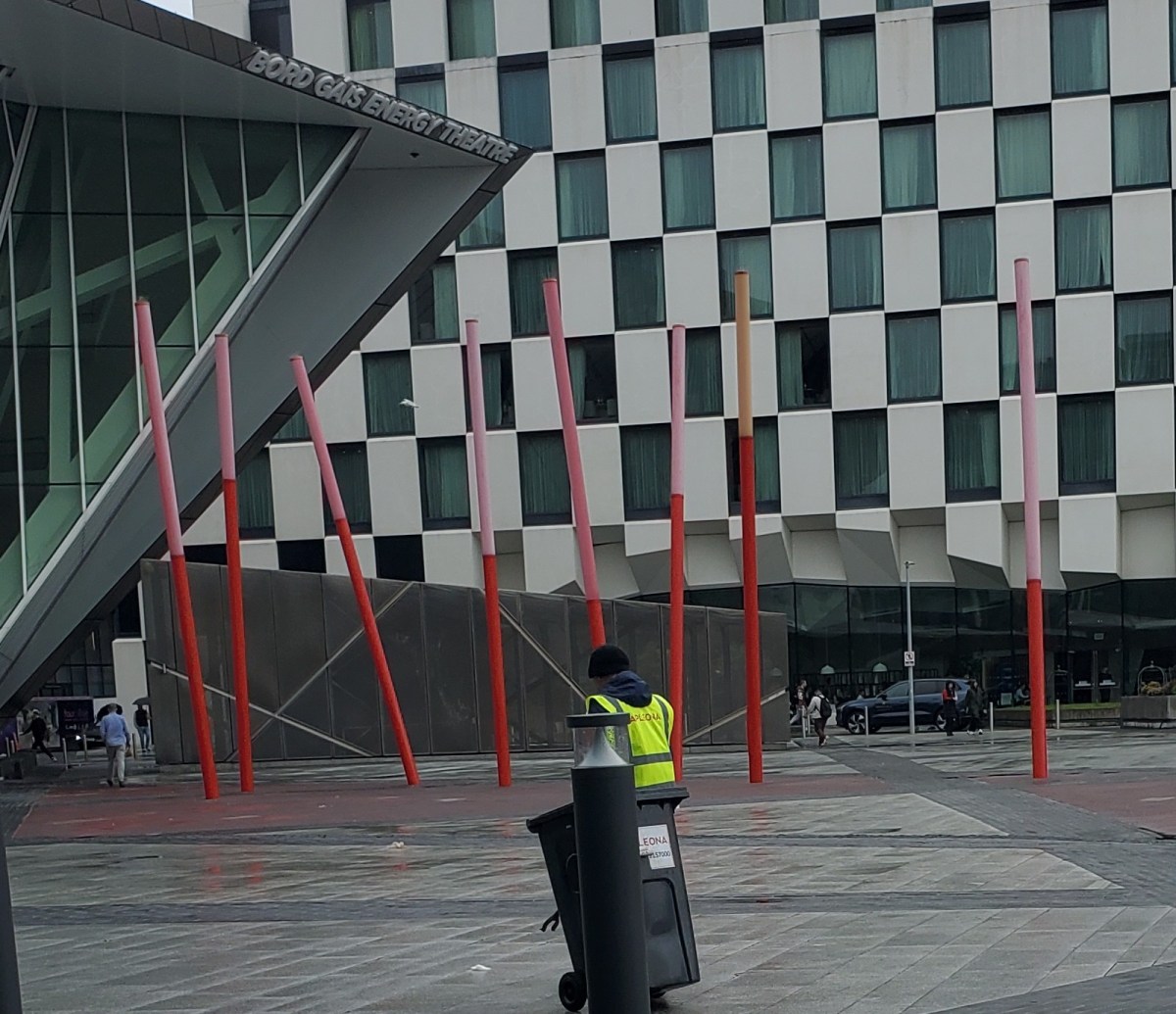
Although not written about Dublin, the song “Dirty Old Town” was made famous by The Dubliners in the late 1960s and by The Pogues in the mid-’80s, so it’s certainly Dublin-adjacent.
I thought often about this song after hearing comments about how dirty the city was during our last trip, the first by a study abroad student of Marilynn’s and the second set by a pair of travelers on a train between Dublin and Galway.
I’ve always considered Dublin one of the cleanest cities I’ve ever been in. Despite the constant crush of tourists, I always see maintenance workers emptying bins, picking up trash or leaves and using a Zamboni-like machine on the sidewalks and in the bicycle lanes. When was the last time you saw that happening on the streets of your city?
Marilynn’s student has lived in many places around the world, and I respect her opinion. But as a Georgia State University student, has she never been to downtown Atlanta? The streets are filthy, with overflowing trash cans and waves of unhoused people congregating in Woodruff Park that lend an air of squalor to the middle of an increasingly nice GSU campus. I’ve never seen anything remotely like that in Dublin. And don’t get me started on the dirty old MARTA stations, the floors of which look like they haven’t been mopped since the Atlanta Olympics.
In our own upscale suburban neighborhood of Decatur, I’ve seen public trash cans overflowing with dog waste bags for days before they’re emptied.
Marilynn and I shared a train table with the Galway-bound travelers who were complaining about Dublin. They were chatty and easily overheard, so I know they were from South Africa and Germany.
Although I’ve never been to South Africa, I can’t help but wonder whether that woman’s unease was related to the sheer diversity of tourists who come to Dublin. As for the German woman, I have been to her country a couple of times and have first-hand knowledge of it.
OK, in Decatur I have seen a man take a leak against the Decatur Library in broad daylight. But in Berlin, Marilynn, Declan and I had a front-row seat to what the French call les pipis sauvages, or wild peeing. We visited Berlin in 2017, part of a two-week swing through Europe.
It was a Saturday evening along the main avenue near the Alexanderplatz train station when we saw a guy with his back to us taking a forceful pee against a bush and in full view of the major roadway and tramway.
I’ve been to Ireland more times than I can reasonably remember, and I’ve never seen anything like that, either.
Looking online, it seems that whatever tiny town in the most remote region of Ireland you find yourself in, you can take a day trip to the Cliffs of Moher. I’m kidding, but just barely.
It makes perfect sense, because the Cliffs certainly provide a breathtaking backdrop (literally, if you’re not careful) to any trip to West Ireland. This summer, Marilynn and I met Atlanta friends for a weekend in the West. We spent that week in Galway: Marilynn in the University of Galway library and me in the university swimming pool. A two-hour bus ride along some of the tiniest roads on the Island brought us to Lisdoonvarna, where we stayed at the Rathbaun Hotel, which we highly recommend.
The hotelier told us about the free seasonal shuttle the Cliffs operates to relieve vehicular congestion around the site, which includes free admission. Our friends drove from their accommodations in a nearby town and parked free in Lisdoonvarna, then we all piled onto the shuttle, which saved us $55-plus in total.
Regardless of the time of day, time of year, pissing rain, dense fog, locusts or whatever else Mother Natures throws your way, the Cliffs of Moher will likely be the highlight of your Ireland trip. This time the weather was clear and the grass along the top as green as I’ve ever seen it in three total visits (see contrasting photo from our 2017 visit). The views are dramatic and well worth the effort required to get there.
Two slight quibbles from a veteran visitor, however. One, the paths in either direction along the Cliffs have been severely reduced, which corrals visitors into an ever-smaller space. The reasoning is solid, because two people fell to their deaths in 2024, and longer paths were closed until trails could be made safer. Formerly, one could walk from Doolin along the Cliffs all the way to the visitor center, a hike but worth it to those who didn’t want to pay the entrance fee.
As a result of the safety concerns, bollards and appropriate signage have been put up in certain places to deter visitors from straying close to the cliff edge. My second quibble concerned the idiots who ignored the signs and crossed over, along with those who ignored the signs about not flying drones in the area.
Let’s respect the rules, everyone.
Hill of Tara Amid the Raindrops
No problems with crowds on our package day trip to the Hill of Tara and thereabouts in County Meath, about an hour drive north of Dublin. The site dates from the Neolithic to the Iron Age and includes a ceremonial avenue, burial mounds, round towers, a passage tomb (Mound of the Hostages) and a standing stone believed to designate a true king of Ireland.
(Left: Not a few you’ll get.)
I discovered the Hill of Tara in a small book in the sitting room at the Rathbaun Hotel and was particularly taken by the aerial photographs of the site. To my disappointment, walking the grounds does nothing to reveal the topography, much like walking through a corn maze does not reveal its larger pattern. However, Marilynn and I enjoyed the day, despite wet fields and the constant threat of rain.
It wouldn’t seem phallic if not for that head.Church of St. FechinTrim Castle
The views from the top were obscured by low-lying clouds, so we’ll have to take the word of our tour guide that one can see for miles in any direction. Marilynn had a go at the Lia Fáil (Stone of Destiny), and it’s no surprise that it didn’t cry out for her as a true king.
Other sites of the day trip included:
Trim Castle, a preserved Anglo-Norman castle best known for its role in “Braveheart.”
Loughcrew Cairns, Neolithic passage tombs that date to 3,000 B.C.
Fore Abbey, where St. Fechin founded a Christian monastery in the 7th century. The ruins include St. Fechin’s church, which dates to about 900.
Our first week, in Ulster, was the prelude to the main event — two weeks in Dublin. For Marilynn, that meant going to the National Library of Ireland from 9-5 on weekdays (plus one Saturday morning) and conducting archival research on the Brian Friel play “Faith Healer.”
My days were filled with grocery shopping, occasional work, laundry, general housekeeping and finding a gym. The first gym I researched wanted 100 Euro for a month. The gym recommended by our host was in a hoity-toity hotel that made the 150 Euro offer they made me for two weeks sound like a great deal. On my own, I found a gym at a nearby Clayton Hotel, which features a clean and uncrowded five-lane pool, a steam room, sauna, whirlpool and a large gym with machine and free weights, exercise bikes and other workout gear.
For those over 55 (and yes, I qualify — barely, he says with a straight face), it was only 46 Euro a month. What’s more, that was prorated to the 5th of the month, so it was only 25. I went every day except for a particularly blustery Saturday morning, making my daily outlay less than I’d pay for a cup of tea.
All good trips in Dublin start with a train trip!
2.5 Degrees of Separation — Tops
But Marilynn’s work schedule still allowed for a bit of fun. On the first Sunday, we dropped our bags at our flat near Grand Canal Dock and hopped a train to Dún Laoghaire to see a Rough Magic/Gate Theatre production of “The Loved Ones” by Erica Murray.
While trying to find the theatre, we heard someone calling Marilynn’s name (it happens so often here, I’m no longer surprised). An American academic from a liberal arts school in Virginia had brought a Maymester class to see the show, which included a pre-show talk by the playwright and the director, and she recognized Marilynn. Of course, we were invited to the talk. After 25 years of visiting the island, I’ve learned that the 6 degrees of separation we’re familiar with in the U.S. is more like 2.5 degrees in Ireland, especially if you’re married to an Irish literature scholar.
We also caught up with Lynne Parker, co-founder and longtime artistic director of Rough Magic. She’s the niece of the late Belfast playwright Stewart Parker (Marilynn’s second book was a critical biography of him) and a great friend. In fact, she was the first person connected with Marilynn’s research I ever met, in spring 2000 in Washington, D.C., when Rough Magic brought a production of Parker’s “Pentecost” to the Kennedy Center.
Rough Magic is at the forefront of bringing new plays to the stage and mentoring emerging talent across theater disciplines. The company commissioned the play, and the director honed his skills with the company.
Dublin Castle
Dublin Castle, EPIC, and the Custom House
To be honest, we didn’t get out much, a combination of Marilynn’s work and our familiarity with Dublin. Most of the things we wanted to see we’ve already seen. We ate out more than we should have, especially at Yoi Ramen, a block from our flat. We also found a new local at Slattery’s, which serves beautiful pints amid a friendly, welcoming atmosphere.
On a dank Saturday afternoon, we toured Dublin Castle, first constructed in the 13th century and long the headquarters of English and British administration in Ireland. It’s not a castle in the traditional sense, but large public buildings that have been in constant use for centuries.
A guided tour grants access to the underground areas of the expansive building. The confluence of the Poddle and Liffey rivers formed Dubh Linn, or “black pool,” where Dublin later derived its name. The Poddle flows north to south, mainly underground, and was once part of an expansive moat that surrounded Dublin Castle.
One of the more famous employees of Dublin Castle was Bram Stoker, best known for his Gothic novel “Dracula.” His first published book, “The Duties of Clerks of the Petty Sessions of Ireland,” was based on his experiences as a civil servant there. Even he admitted that one was boring.
Visitors on the guided tour also see the Chapel Royal, a small Gothic Revival church opened in 1814 and designed by Francis Johnston, who also designed the General Post Office. Over its history, it has been both a Protestant and Catholic worship space, but it has been deconsecrated and now hosts community events and concerts.
The tour also visits the State Apartments, open to the public. Highlights include Saint Patrick’s Hall, where Ireland’s presidents are inaugurated, and the James Connolly Room, where the injured and near-death leader of the Irish rebellion in 1916 spent his last days (the building was a hospital then) before being taken to Kilmainham Gaol and executed.
I also visited EPIC, The Irish Emigration Museum founded by Neville Isdell, a former chairman and CEO of The Coca-Cola Company – so it does have an Atlanta connection. The basic premise is that Irish people are everywhere.
Maybe it’s the extensive travel we’ve done in Ireland or the lack of actual exhibits, but EPIC doesn’t do it for me. However, I may be in the minority — the venue was supposedly rated Europe’s top tourist attraction between 2019-2021, and it has a 4.8 rating on Tripadvisor. I do appreciate that there are free public toilets in the center where EPIC is housed, however.
I also had a peek inside the Custom House Visitor Centre (top photo). At the time of our trip, tickets were free within 48 hours of visiting Dublin Castle or heavily discounted with a receipt from EPIC. If you’re an architecture buff, the Custom House should be near the top of your to-visit list. Designed by James Gandon in 1791, it served as the import/export portal for Dublin for over 100 years. The building was heavily damaged by fire in 1921 during the Irish War of Independence but later mostly rebuilt. Exhibits in the center encompass the building’s history and presentations related to the war of independence.
If time is limited, you can certainly glimpse the grandeur of the building for free. Pay close attention to the 14 figurines carved into the building’s keystones. They represent Ireland’s rivers. You can also see where the dome is differently colored from the rest of the building. The dome was rebuilt after the war, using local stone instead of the Portland stone used during initial construction.
Following the conclusion of the Dublin leg of our journey, our adventures next take us to Germany and France.
I’ve been to Ireland so many times that I’ve lost track. Tough problem to have, I know, but there always seems to be something new to see or do.
This year, during Georgia State University’s spring break, I had the pleasure of accompanying Marilynn and 12 undergrads for five intensive days in Dublin on a James Joyce’s Dublin study abroad program. They had read “Dubliners,” “A Portrait of the Artist as a Young Man,” and two episodes of “Ulysses.” My unofficial job was mainly to count heads and make sure everyone was walking in the right direction or got on the right luas (tram).
For me, this experience recalled the first time we brought our sons to Ireland, although 12 times more intense. About half the students had never been out of the country, and none of them had been to Ireland.
Dublin is fairly compact, with a great interconnected bus/tram/train system that makes travel simple—especially if you have a transportation pass, which we all did. Jitters and general unease among the students about navigating a foreign city quickly gave way to groups of students shopping, attending a drag show, visiting bookstores, and shopping. Yes, shopping is mentioned twice, because that’s what most of them did during their free day.
Here’s a sampling of what we did:
Guided tour of the GPO Museum, headquarters of the Easter Rising in 1916. By the way, it still serves as a Post Office.
Literary and musical pub crawls (because, why not?)
Dined like locals in the café at Dunne’s department store and by grabbing meal deals (sandwich, snack and drink for about $6) at Tesco
Attended a play (that’s best not mentioned further)
The culminating event of the week was a visit to the Martello tower in Sandycove where Joyce “lived” for six days in 1904. He hated it so much he left in the middle of the night and walked back to Dublin, leaving the country within a month. He only returned to Ireland twice after that, the last time in 1912. He wrote “Ulysses” from memories of Dublin and answers to the pestering questions he sent to friends. The James Joyce Tower is one of a series of towers the British built along the Irish coast in the early 19th century to defend against invasion.
For those who haven’t read “Ulysses,” a scene in the tower opens the book.
Lessons Learned
I learned that students today (especially this group) don’t do much drinking, which suited chaperone Marilynn just fine. She and I definitely downed more pints than the rest of them combined, and a second beer is a big night for either of us. I also learned how to make a Girlie Guinness by adding blackcurrant liqueur to counteract the bitterness of the stout. (Don’t hate on me for the name—that’s what the barman called it).
Unfortunately, the students missed out on two of my favorite parts of being in Ireland: the splendor of the full Irish breakfast that’s only served in fine B&Bs (they could have made their own at the breakfast buffet, but it’s just not the same) and the Irish countryside, which features at least 10 colors of green you won’t find anywhere else.
But they took away fond memories of James Joyce’s Dublin, discovered the thrill of travel, and made friends that will last a lifetime. For Marilynn, it was the culmination of much planning and nearly flawless execution. And for me, hope for the future knowing that the world will soon be in the hands of students like these. While it was the first time visiting Dublin for the students, it won’t be the last time for many of them.
My wife, Marilynn Richtarik, and I will always remember what we were doing for our 16th wedding anniversary—launching her book in Dublin and talking football with Northern Irish actor Stephen Rea.
People younger than we are may not be familiar with Rea, who earned an Oscar nomination in 1992 for his role in “The Crying Game.” He’s a prolific and highly regarded actor on both stage and screen who agreed to read from the Stewart Parker novel that Marilynn edited, “Hopdance,” because he and Parker had been good friends and moved in the same theatrical circles. More about that later.
Scenes from ‘Hopdance’
In a strong yet understated performance, Rea nailed the reading of four scenes from “Hopdance,” a vignette-driven, semi-autobiographical work about the amputation of his left leg at age 19 that Parker first completed in the early 1970s but never published during his lifetime.
The final vignette, a crowd favorite, described the protagonist, Tosh, listening in as several other amputees chat in the waiting room at the limb-fitter’s shop. One man, a welder, tells of how his artificial leg gave way on the job and was patched by a riveter, who the welder said “done a right fine job” of repairing the leg, much to the consternation of the limb-fitter.
The four dozen or so gathered at the Workman’s Club for the launch were mesmerized during the reading. Marilynn is a fine reader, but the final passage Rea read requires the right accents and a man’s touch to create magic out of a tale of several blokes sitting around in their underpants waiting for their artificial legs to be fitted.
Talking Arsenal football
Marilynn knew from her past dealings with Rea that he supports the English Premier League team Arsenal, the team Declan and I also support. For the occasion, Declan wore one of his many Arsenal jerseys, which immediately caught Rea’s eye. When we asked for a picture with the family, he readily agreed “as long as the Arsenal supporter is in it.” And, as you can see, we all were there.
We told Rea about watching Arsenal play rival Manchester City to a tie at the Emirates in April, and he said he had tickets to the FA Cup final between Arsenal and Chelsea later this month. We also talked about embattled manager Arsene Wenger, who Declan and I both wish would quit after 20 years (including 13 years without a league title). However, Rea believes he should be allowed to stay beyond his current contract.
Anyway, who’s to argue with a celebrity?
A little history, please
Nearly 40 years ago, Rea and the late Northern Irish playwright Brian Friel founded the Field Day Theatre Company that aimed to bring plays and literary works to both sides of the sectarian divide during the Troubles. Field Day was the subject of Marilynn’s first book, and she interviewed Rea for it.
Stewart Parker, who died of stomach cancer at the age of 47 in 1988, wrote his final play, “Pentecost,” for Field Day, which it produced in fall 1987 with Rea in a starring role. Marilynn didn’t become familiar with Parker’s work until 1989 but spent the next 20 years researching his life and work for her 2012 book, “Stewart Parker: A Life.”
Stephen Rea and Northern Irish actor Frances Tomelty, who appeared in several TV films that Parker wrote the scripts for, hosted a public event that was part of a conference at Queen’s University Belfast that commemorated the 20th anniversary of Parker’s death.
When Marilynn’s publisher, The Lilliput Press, was working with Rea to find a date, he picked May 12, our anniversary. Again, who’s to argue with a celebrity who’s giving freely of his time? So that’s how Stephen Rea came to help us celebrate our 16th wedding anniversary.