A Palace for Every King

In earlier times, Germany was ruled, in at least the summer, from Potsdam. Each succession of rulers felt compelled to build ever-bigger palaces, and we wanted to glimpse at least a few of them on our final day in Berlin.

The tourist passes we purchased included free transportation, so we hightailed it to the Potsdam rail station to catch a palace tour. We signed up for a guided tour, but, since most of the tourists were German, the few tourists who primarily spoke English were put on a special bus—which never left the station because of a technical glitch.

So after a few quips about the technological prowess of Germans and a partial refund of our money, we were put on one of those hop on, listen to a tour through headphones kinda bus. The commentary, while interesting, was cheesy in both diction and tone. In the audio, a man was showing a woman the city’s sights, but her grasp of English—not to mention timing—was horrible. The man’s wasn’t much better.

Just out of the station, the commentator extolled Potsdam for its film production prowess. Unfortunately, the tour operators did not avail themselves of this homegrown talent to produce their audio. Marilynn and I could have done a much better job.

Meanwhile, back on the tour

But, as I said, the tour itself was interesting. Along with the palaces, the tour included other fascinating parts of Potsdam’s history, including the “mosque” that was built to hide the steam pump for the city’s fountains. The city’s Dutch quarter was built to attract (who else?) Dutch engineers to fix the city’s water woes. Apparently not many Dutch relocated, but enough did to get the job done.

When the Russians gifted the city a Siberian choir as a reward, special accommodations were constructed to make the choir feel at home, with faux log exteriors and plenty of open space to resemble their native land.

Throughout our visit, it was hard to get our heads around the idea that reunification of East and West Germany occurred less than 30 years ago. The city appears to operate seamlessly, and construction cranes dominate portions of the city’s skyline.

That point was driven home during a ride through the former Forbidden City in Potsdam, where Soviet intelligence personnel lived after throwing out the area’s inhabitants. In less than 25 years since the Forbidden City homes were turned back over to the owners (more likely, heirs), one could not tell there ever had been an incursion here.

And that’s the best way to end a trip to Berlin, remembering that the city has done a remarkable job of recovering from five decades of division.

Berlin Museums a World Apart

I’m a huge fan of museums. Art, science, animals (dead or alive), archaeology, geology, history, a man and his crap—you name it, and I’ll visit it. But I’ve discovered that there are few truly great museums. The British Museum qualifies, as do the Field Museum in Chicago and the Museum of Natural History in New York.

There are plenty of others I haven’t yet visited, but I can now scratch the Pergamonmuseum from that list. The Pergamon is part of Berlin’s Museum Island, a World Heritage Site since 1999. Even though the namesake Pergamon Altar and the north hall are currently closed for renovation, the remainder of the museum is quite impressive indeed.

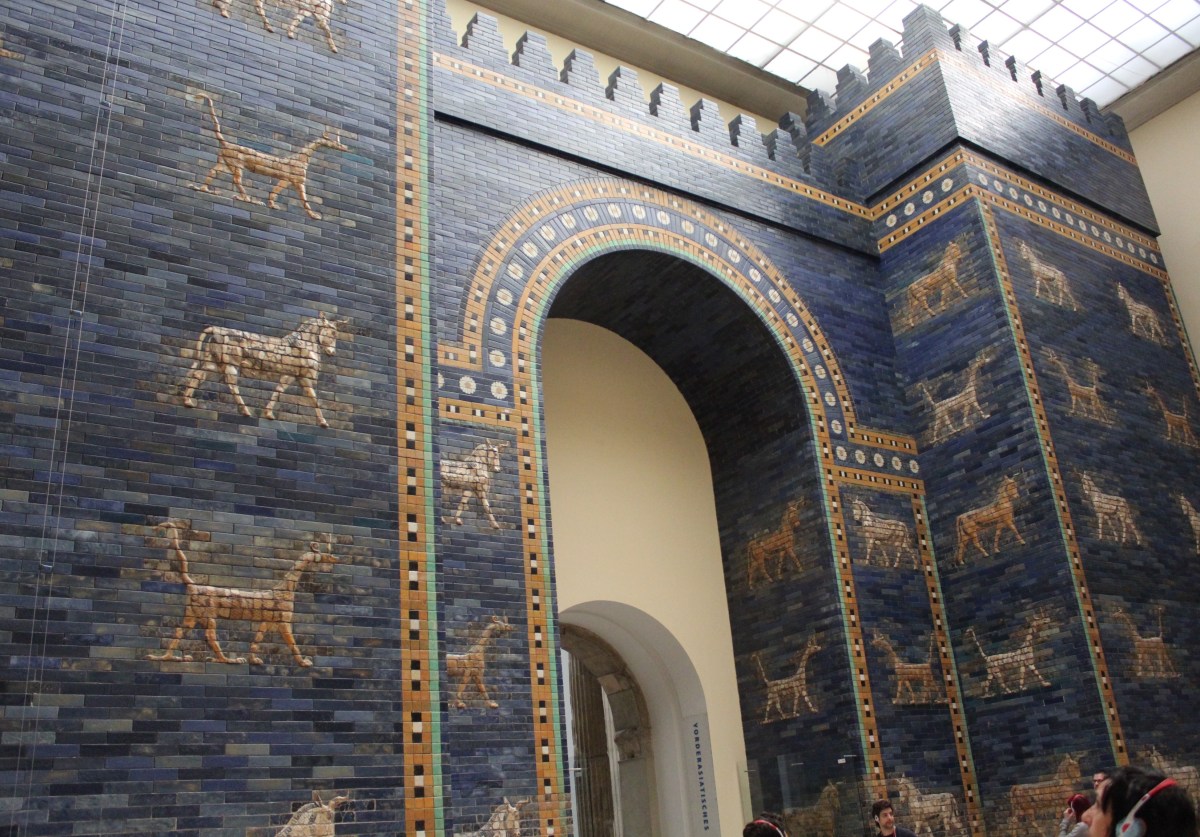
The museum was built during a time when men dreamed big and then stole bodaciously. Elgin liberating the figures ringing the Parthenon, now on display at the British Museum, was bodacious. But taking the Ishtar Gate of Babylon, coupled with the processional way? One needs a new vocabulary to cope with taking on that scale.

The first Pergamon had to be demolished because the foundations weren’t up to the task of supporting the massive stone and brick facades that are the Pergamon’s stock in trade. In addition to the Pergamon Altar and Ishtar Gate, the Market Gate of Miletus dates from AD 100 and features two stories of columns and artwork. There’s even a room from Aleppo, which, given the fierce fighting in Syria recently, makes its acquisition seem prescient instead of possibly illegal. We also wanted to see the Alhambra Dome, taken from the palace we saw during our 2015 trip to Spain. Thinking back to the Alhambra, I don’t think that dome was missed.

Because of the renovation, entrance to the museum is limited. We hadn’t booked in advance, so we waited in line for about 30 minutes until a sufficient number of people left the building. But visiting the Pergamon was well worth the wait, and the scale of it means that even capacity crowds don’t feel that way.

Experiences of Egypt and beyond

Das Neues Museum (New Museum) is adjacent to the Pergamon. Built in the mid-19th century and  badly damaged during the Second World War, it was extensively refurbished during the 1990s. The New Museum features artifacts from the Egyptian Museum and Papyrus Collection, the Museum of Prehistory and Early History and the Collection of Classical Antiquities.

After waiting in line and taking in the Pergamon, I admit that we probably gave New Museum short shrift. But we did hit the highlights, including the extensive Egyptian artifacts that Declan likes. While the artifacts were impressive, I thought the lighting in the Egyptian section did the artifacts no justice. It was rather harsh and threw glare across the glass encasing many objects.

The curators did a much better job displaying two of its must-see pieces: the Golden Hat and the bust of Nefertiti. The Golden Hat, the use of which remains unknown, was in a darkly lit room with soft lighting making the hat shine. The bust of Nefertiti was in a room by itself, her glassy-eyed gaze still penetrating after so many centuries.

On a future trip, I’d make sure to see the Altes (old) Museum, with its collection of ancient Greek utensils and Etruscan art, and the Alte Nationalgalerie (Old National Gallery), with its collection of impressionist paintings, both of which are closed on Monday.

But those will need to wait for another visit.

Chalk One Up for the Americans in Berlin

A German American scored the winning goal Sunday as the hometown Hertha BSC snapped a three-game losing streak to win 2-0 over FC Augsburg at Berlin’s Olympic stadium.

It’s no secret that Declan loves everything football, so we booked an ass crack-of-dawn flight from Belfast International to Berlin in order to make this match on time. Seeing the Olympic stadium where Jesse Owens triumphed over racial hatred and Nazis in 1936 was one of the few requests Declan made of us when planning the Belfast trip, so it was great to be able to fulfill it.

After visiting The Emirates, home to our favorite English Premier League team Arsenal, last week, Olympiastadion certainly is a throwback, but in a good way.

When reading about the match and John Brooks’ goal the next day, I saw that Hertha plans to build a new stadium by 2025. Although I loved the feel of Olympic stadium, I understand the team’s point. There was only one permanent set of bathrooms on our end of the stadium. They were supplemented by what I call “piss shacks,” outside facilities where Marilynn refuses to set foot (or bum, for that matter). The concession facilities also were sparse and supplemented with pop-up vendors outside the main stadium.

But I hope the facility continues to get good use following Hertha’s move. It’s well-situated to transit, providing an easy walk to the stadium. And we absolutely loved the fact that our tickets gave us free transport for five hours before the match until 3 a.m. the following morning. Can you imagine getting that for a Falcons’ game? How cool would that be?

But there’s no mistaking the grandeur and history of the stadium. The Olympic rings are still displayed in front of the stadium, and inside you can see where the Olympic cauldron was located and where Hitler watched the competitions. It still brings a smile to imagine Hitler’s reaction when watching Jesse Owens win his race.

It also brings a smile to see a number of Pissoirs along the route, little shacks where one pees. None of us went in one so I’m not sure exactly what goes on in there. But the presence of pissoirs didn’t stop many men, children and even a few women from taking what the French and cyclists everywhere call natural breaks among the foliage between subway and stadium.

More than football, really

Our early flight meant we had plenty of time to drop our bags and check out the city beforehand. We were conveniently located near the Brandenburg Gate and Checkpoint Charlie, places that featured prominently during the East German/West German divide during the Cold War years.

You can find a large section of preserved wall in front of the Topography of Terror Museum, an exhibition documenting the rise of Hitler and the Nazis and following the latter through the post-war years. Declan also had his first taste of currywurst, cut-up sausage with ketchup on top. I had a more traditional hot dog, although the dog far exceeded the length of the bun, and pomme frites with paprika on them. Apparently, paprika is the bad-for-you food seasoning of choice in Germany because it prominently features in both fries and crisps.

So we managed a full day, with two more to go.

My Wife, Breaking the Law

Cue the theme song from “Cops” because Marilynn got picked up on Friday by the Irish po po, the Garda.

Anyone who knows my wife surely must be thinking this is impossible. English professors who are representing their countries internationally as Fulbright Scholars surely don’t merit police scrutiny.

So was Marilynn smuggling contraband crisps to Dublin or perhaps running guns for the Real IRA? No, she was visiting her publisher in Dublin and didn’t bring her passport. She had her BRP (biometric residence permit) from the UK, but that wasn’t enough for the Garda who stopped the Belfast-Dublin bus she was riding in Friday morning just over the border. They also picked up a Chilean national who is married to a UK citizen and speaks fluent English with a strong Belfast accent, who was on his way to the Chilean embassy to apply for a replacement passport.

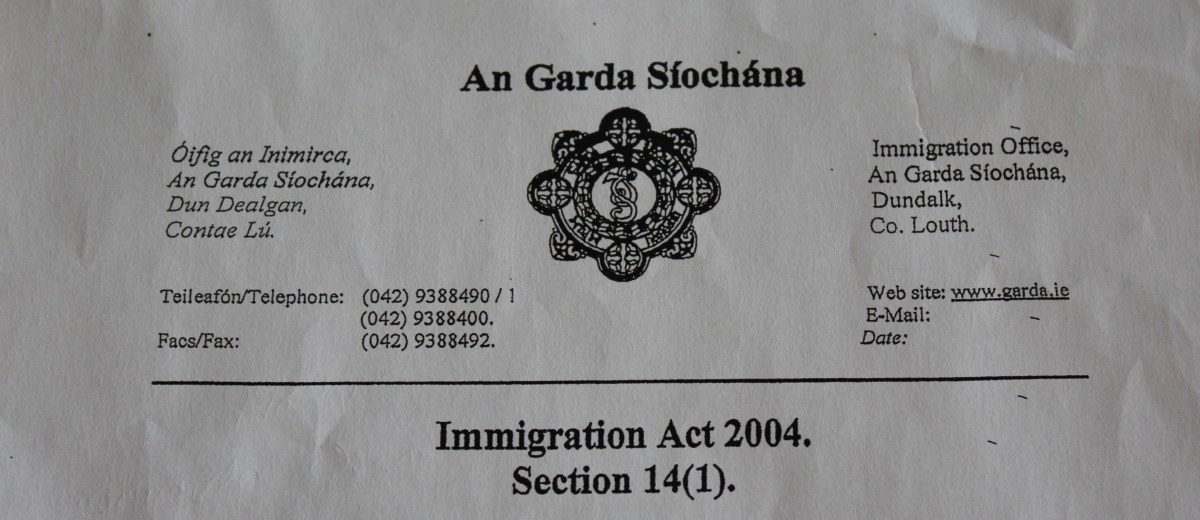
The passport-less scofflaws were taken in a squad car to the police station in Dundalk, photographed, given letters denying them entry to Ireland (and then letters allowing them to come into the country for the day) and taken to the train station, where the Irish government paid for their fare to Dublin.

If you haven’t traveled to Ireland before, you may not realize how significant Friday’s incident actually is. This level of scrutiny has not been seen since the Troubles, which ended in 1998 with the Good Friday Agreement. Marilynn readily recalls security forces boarding a bus or train during the Troubles but not after. I certainly haven’t experienced this in the half-dozen or so times we’ve crossed that border on previous trips.

More fallout from Brexit

We blame UK Prime Minister Teresa May, who last week triggered Article 50 to leave the European Union following last summer’s Brexit vote. The EU supposedly recognizes the unique relationship between the countries on this island (and the 30-year conflict where more than 3,600 people died), as evidenced by the response to May’s Brexit letter late last month.

I’ll let Marilynn pick up the story, from her email to the American consul in Northern Ireland:

“The garda told us that ‘the European Union’ had demanded that they start treating the Northern Irish border as an ‘international border’ and that they had been receiving extra training. Much, apparently, is left to the discretion of individual officers. This one gave each of us a letter saying that we were forbidden permission to enter the Irish state because we did not have a valid passport with us, and then gave each of us another letter saying that, at his discretion as an immigration officer, he was giving us permission to enter just for the day (luckily I was only planning to go for the day, anyway).

“He took our photos and made a record of the incident, and then put us both on the train to Dublin (courtesy of the Irish state). He kept saying, however, that some of his colleagues would have been happy to send us straight back to Belfast, and he expressed relief that his sergeant wasn’t around when we got to the station, since he probably would have taken a harder line.

“I knew, in the back of my mind, that I was supposed to carry my passport in the Republic, but I can’t remember being asked for it since at least 1998. I had gotten a bit blase about it, as (I’m sure) have many foreign nationals living in Northern Ireland. So I thought I’d better let you know about this so you can spread the word to other Americans living here to be sure and bring their passports with them when going to the Republic, even on day trips to Dublin!”

And I can’t stop singing the Beavis & Butthead version of the Judas Priest song “Breaking the Law.”

What the Hell Is That? A Visit to the Tate Modern

One of my favorite “Saturday Night Live” skits features Steve Martin and Bill Murray as tourists looking at something off-screen. After several back and forths consisting of basically “What the hell is that?”, Steve Martin says, “Well … get a photo of me with it anyway.”

Welcome to the Tate Modern, a wild ride of a museum just across London’s Millennium Bridge on the south side of the Thames.

A man and his crap

Earlier Saturday, we visited the Sir John Soane’s Museum, what I call a museum of a man and his crap, much like the Barnes Foundation in Philadelphia or Mercer Museum in Doylestown, Pa. Soane was a famous 19th century architect, who assembled an impressive collection of artifacts in an equally impressive building, which he molded to suit his architectural acumen and his tastes. The house and its contents were donated to the city upon Soane’s death, primarily to deprive his deadbeat son of an inheritance.

It doesn’t take long to visit the Soane’s Museum, so with only Harrod’s on the calendar for the rest of the day, I used the lure of afternoon snacks to persuade Declan to visit the Tate Modern. I like a lot of modern art that looks like, well … art. Mark Rothko painted mainly colored squares next to squares of a nearly identical colour, but I kinda like them. Alexander Calder mobile? Great! Andy Warhol pop art? Bring it on!

Of pallets and couscous castles

A pallet that looks like it was rolled off the loading dock at Wal-mart to the floor of a museum? WTF?!? One reviewer wrote: “Tony Cragg’s impressive Stack, a square of pallets and objects like a cube-shaped sandwich, is fascinating.” This person obviously hasn’t seen a bale of cardboard roll out “like a cube-shaped sandwich” from the compactor in the storeroom of any big box retailer.

Here’s another gem: “… visitors were fascinated by Kader Attia’s sculpture made entirely of couscous, resembling a Star Wars-style desert dwelling …” The sculpture (?) is called Untitled (Ghardaïa) and is a scale model of the ancient city Ghardaïa in the M’zab Valley in Algeria. Couscous, the Tate website explains, is a staple food of North Africa. I just call it Couscous Castle.

However, Declan and I did quite like Babel, Cildo Meireles’s gargantuan tower of mostly working radios that dominates the room it’s in.

But I had a hard time explaining Fountain, “by” Marcel Duchamp. In 1917, Duchamp purchased a urinal, put it on its side, painted “R.Mutt 1917” on it and entered it in an exhibition, where it was promptly rejected. The original was lost, but Duchamp “commissioned” 17 “replicas” in the 1960s. I can’t imagine where the original wound up, perhaps in a men’s room?

I recognize that art is in the eye of the beholder, and one person’s masterpiece is another’s piece of crap. I may not appreciate all the art—the car bumpers hanging by ropes, the contractor’s levels lined up on one wall, the what-the-hell-is that sitting on a table—but I do admire the balls of the artists who can explain some of this shit and make art out of it.

I wonder, how much is talent and how much is chutzpah? I may not know what it is, and I may not like it, but please take my photo with it anyway.

‘Brilliant’ Afternoon at Emirates Stadium

How do you describe a perfect afternoon? “Brilliant,” was all Declan said when asked to describe our experience Sunday at the Emirates Stadium watching The Arsenal take on Manchester City. Billed as one of the top matches of the year, Manchester City continues to play good football, while our beloved Arsenal has stumbled of late, dropping four of their last five matches and dropping out of the top four in the English Premier League.

We got there nearly two hours before kickoff, to take in the atmosphere both inside and outside the stadium. The stadium is in a residential neighborhood you walk through from the Arsenal tube stop. Vendors of all sorts lined the street selling merchandise, sweets and street food such as hot dogs, hamburgers and BBQ. It looked tasty, although we’d already eaten. Declan bought a scarf commemorating the match that was half blue and half red.

Friends in the right places

We had club level tickets, thanks to my Arsenal friend Jan, who I met in San Antonio in the fall. She was with a group of UK and Irish people on a week-long tour of Texas. We kept in touch, and she offered us her tickets for this match because she was spending the Easter holiday in the States.

That’s the beauty of football. Even with people who support teams other than ours, a team jersey can create a common bond and spark a lively discussion. The cabbie who brought us home last night was a Liverpool man and repeatedly tried to get Declan to convert during the trip. There’s no chance of that, however.

Our tickets were fantastic, just beyond one of the goals. The grass glowed in the afternoon sunshine, razor sharp criss-crosses where the grass was mowed in different directions. We watched officials check the goal line technology of the balls before retreating to the club lounge to watch TV and watch the fans make their way toward the stadium.

We returned for warmups, with Arsenal right below us and Man City in the distance. The practiced fans know when to show up, because half empty turned into nearly full during the last 10 minutes before kickoff.

Header past the goalkeeper

Although the Gunners fell behind a goal early, they clawed an equalizer as halftime neared, only to concede a second goal right before the interval. Fortunately, the home team scored the tying goal in the 53rd minute, a smart header by Mustafi that snuck past the outstretched hands of the goalkeeper. That moment, and the ensuing celebration, was Declan’s favorite part of the match, which ended in a 2-2 draw.

The entire match was intense, with the head official waving five yellow cards (and he could have waved more). In person, you can much better see the flow of the game as momentum shifts from one side to another. From our vantage point at one end, you could see plays develop much better than you can see on TV, the ball quickly moving from player to player.

Following the match, it was back to the club lounge to watch the crush of fans flow over the bridge back to the tube station and watch pundits discuss the match on TV. Although we waited 30 minutes after the match ended to start home, there remained a decent crowd at the tube station, but we were quickly on our way.

Our thanks again to Jan for the great tickets and to the stewards and club staff who made our visit so enjoyable. It was a perfect afternoon, indeed.

So Many Crisps…

People in the UK like crisps, lots and lots of crisps. They play a central role in the sandwich meal deal, which you can find in grocery stores, newsagents, department stores and drug stores. For $4-$6 US, you get a packaged sandwich, drink and either crisps or a dessert. It’s great for grab-and-go meals or for packing lunch during a train or bus trip.

But there are so many crisp varieties to choose from. I always try to find the oddest crisp I can, within the limits of our allergies. Between my onion allergy and Marilynn’s prawn allergy, it eliminates a lot of crisps. But, fortunately, there are plenty more. Read on for my take on the oddest dozen I could find.

Brannigans Smoked Ham & Pickle crisps—They taste exactly as billed, with a rich ham flavour and an undercurrent of pickle. One of Declan’s favorites.

Brannigans Roast Beef & Mustard crisps—Another winner, with a hint of mustard you can smell as you bring the crisp to your mouth, then a commingling of the two that is quite satisfying.

Brannigans Roast Lamb & Mint crisps—Upon tasting one of these, Declan shuddered involuntarily—twice. Marilynn said she liked the mint flavour. But that leaves the taste of sheep, very old and very gamey sheep. I will admit that they taste just as advertised, but the premise is so, so wrong. There’s a reason the British Corner Shop carries the other two types but not this one.

Roysters T-Bone Steak bubbled chips—They look like the blighted potatoes with an awful skin disease and taste like beef bouillon cubes. Don’t like the mouth feel and definitely don’t like the taste.

Scampi Flavour Fries—These technically aren’t crisps because they are made from corn and bread crumbs. But I didn’t notice until I read the package carefully. My compliments to the chemist because they taste exactly like scampi.

Bacon Flavour Fries—See just above for the specifics, but I like them, I really like them.

Hula Hoops (various flavours)—You can’t eat a bag of Hula Hoops without putting them on the fingers of at least one hand, like one does with Bugles. They are super fun to eat. In addition to regular flavour, they come in salt and vinegar, cheese and onion, BBQ beef and others. There are also Big Hoops. If you can put Hula Hoops on your fingers, I shudder to think what Big Hoops are affixed to before eating. “Look, lover! No hands!”

Tayto crisps (various flavours)—Tayto crisps are made (where else?) at Tayto Castle, about 30 miles from the flat. The company is proudly Northern Irish. I just wish I liked their crisps. They’re OK, but the crisps aren’t hefty enough for me, and the tastes are bland. They also make puffed corn “chips” that remind one of eating packing peanuts.

Hunky Dorys Buffalo Crisps—You couldn’t make these in the US, because you’d have to call them Buffalo Chips! Big Ruffles-like ridges, great taste. Another winner.

Space Raiders Beef Flavour Cosmic Corn Snacks—There’s an alien right on the package, so you know these are gonna be %^&*-ed up. And they are. Taste like beef bouillon packing peanuts, in the shape of alien heads. But hey, they’re only 20 pence, so get your munchies on for cheap!

Golden Wonder Saucy BBQ Flavour Transform-a-Snack—You can actually build what the package calls “out of this world vehicles.” Declan said these were “really good,” but again, they’re puffed corn (see packing peanut references above).

Hot Lips Nice ‘n’ Spicy Flavour Maize Snacks—Weird logos on weird packaging. I had no idea what they were or what flavour. And it was a big package, so if they tasted like crap, I would have wasted my money. I should have just shut up and bought them because they are delicious. Not hot in the least. Instead, they have a smooth, smoky flavor that makes you want another (and another).

Just like books, you apparently can’t judge a crisp by its package. Unless it contains lamb flavouring, of course.

Living the Life, One Chore at a Time

A friend once told me I’d make somebody a good wife someday. My mother taught all of her children how to cook and clean for themselves, and I happen to like a clean house (book and magazine clutter aside), so I take that as a compliment.

But in Belfast the concept of the house husband is coming to the fore, the result of circumstances. Marilynn is teaching two classes and working on her next book project, so she goes to her office five days a week. In America, she does most of the shopping and probably 60%-70% of the cooking. I cut the coupons, do the dishes, take care of the house and yard and cook/grill as directed.

With a car and grocery store flyers, Marilynn prepares a week’s menu based on what’s on sale that week, going to Publix for most items and filling in with purchases from Kroger and Aldi. Here, with no car and a tiny refrigerator, that paradigm is turned on its head.

Most days, we have no idea what we’re having for dinner. So off I go to Tesco, cloth grocery bags in hand, rain (mostly) or shine, to see either what’s been discounted or what looks good. More complex recipes often require ingredients we’ll not use through during our time here, so we try and keep it simple. But it requires grocery shopping nearly every day.

Good friends from England who recently spent a semester in Georgia complained about the high grocery prices compared with prices at home. And after several months in Belfast, I see where UK prices are better across the board. They don’t really do weekly flyers, but they do discount certain items for certain periods of time. But I already know that one of the kinds of yogurt I like will be on special whenever I shop, so one still can ferret out bargains.

Take the meal pictured at top, the same type of meal I’d prepare in the States, with steak, baked potatoes and broccoli. The price here, under $9 US. I’d pay that easy for just the steaks in America.

Shillings for the heat, lights

I remember watching British period dramas where the young single women or young families living in urban flats put shillings in a meter to heat water for a bath or turn on the lights or stove. We have the modern day equivalent to that—plastic top-up cards for the gas and the electricity. It makes it easy for the university (our landlord) because it doesn’t have to worry about getting left with unpaid bills amid the turnover in staff housing.

When you need to put money on the meter, you take the card to a participating news agent, tell the clerk how much you need to put on the card and pay for it. Then at home, insert the card into the gas meter to transfer your payment or punch in the confirmation number for the electricity.

The top-up option is available to homeowners, too, but according to a couple people I spoke with, topping up a card is more expensive than paying your bill monthly.

That’s what radiators are for

Not many homes have clothes dryers, so we’re left with an oversized drying rack, two retractable lines that run the length of the shower—and six beautiful radiators. When the heat is on, a radiator can dry a towel in 30 minutes. It’s too hot for the radiators at present, and I’m not sure this one big towel I put on the drying rack will ever get dry.

It can be an engineering challenge, however, to figure out what might air dry, what’s better suited to the radiator and what must never go on the radiator. A pair of jeans, for example, needs to be turned on the radiator at least once. So that’s what I do when taking a break from work, turn clothes on the radiator that aren’t dry, fold what is, and transfer items from the drying rack to a radiator to speed the process along.

Yes, it’s all in a day’s work for this house husband.

Conferences, Book Launches and Pilgrimages, Oh My

Marilynn left for the states this morning, Kansas City to be precise, for the American Conference for Irish Studies. Which leaves Declan and me on our own until Monday. Heh, heh, heh.

She is a plenary speaker for the conference, which is academic-speak for Really Big Deal. Business folks would be more familiar with the term keynote speaker, and the rest of us would have no clue.

Academic conferences are full of panel discussions and similar papers on a theme because institutions are more likely to reimburse a professor attending the conference if she is giving a paper. That means there are usually several tracks running at the same time, cutting the audience size for each panel. So a plenary is a single-track talk, with an undivided audience in attendance.

Despite being an excellent speaker, Marilynn was nervous about this, which underscores the Really Big Deal aspect. But I know she will knock it out of the park, like she always does.

Book launch events coming up

Marilynn edited an uncompleted but still powerful novel that her playwright Stewart Parker wrote about the amputation of his left leg when he was a 19-year-old student at Queen’s University Belfast. He sketched out the story a few years later, in a style reminiscent of James Joyce (but the readable James Joyce).

Stewart would pull out “Hopdance” during times of personal turmoil, tweaking the dialog, reordering scenes and writing new ones. He returned to it a final time in the months preceding his death from cancer in 1988 but never completed it. Marilynn took his original manuscript, much of it hand-written, typed it up and then went through it with a graduate assistant word-for-word at least twice, standardizing the spelling and punctuation while retaining Stewart’s writing quirks whenever possible.

It’s a labor of love and a great read. I’ve read it twice and look forward to hearing what the critics and the reading public think.

But it also means book launches in Belfast and Derry, either in late April or early May. Details aren’t final, but Marilynn, her agent and publisher hope to attract some high-powered help in launching the book in both cities. Fingers crossed that they succeed, but it’ll be a blast in any event.

Worshipping at the Emirates

So what will the boys be up to while Marilynn’s at her conference? By a happy coincidence, we’ll be in London this weekend, seeing our first competitive English Premier League match, our beloved Arsenal vs. Manchester City (boo hiss!).

Declan became an Arsenal fan in 2013 for reasons he still can’t articulate. But I got dragged into it, too, and became a fan of “real” football. This is one of the top matches of the year, and we were very lucky to score tickets from an Arsenal season ticket holder I met in the strangest of places.

But that’s a story for another day, which will be next week.

About the photo: We toured the “glorious” Emirates Stadium in 2014 while Marilynn was giving a talk in London. The certificates we received after the tour touted the stadium as “glorious,” and it stuck.