My Wife, Breaking the Law

Cue the theme song from “Cops” because Marilynn got picked up on Friday by the Irish po po, the Garda.

Anyone who knows my wife surely must be thinking this is impossible. English professors who are representing their countries internationally as Fulbright Scholars surely don’t merit police scrutiny.

So was Marilynn smuggling contraband crisps to Dublin or perhaps running guns for the Real IRA? No, she was visiting her publisher in Dublin and didn’t bring her passport. She had her BRP (biometric residence permit) from the UK, but that wasn’t enough for the Garda who stopped the Belfast-Dublin bus she was riding in Friday morning just over the border. They also picked up a Chilean national who is married to a UK citizen and speaks fluent English with a strong Belfast accent, who was on his way to the Chilean embassy to apply for a replacement passport.

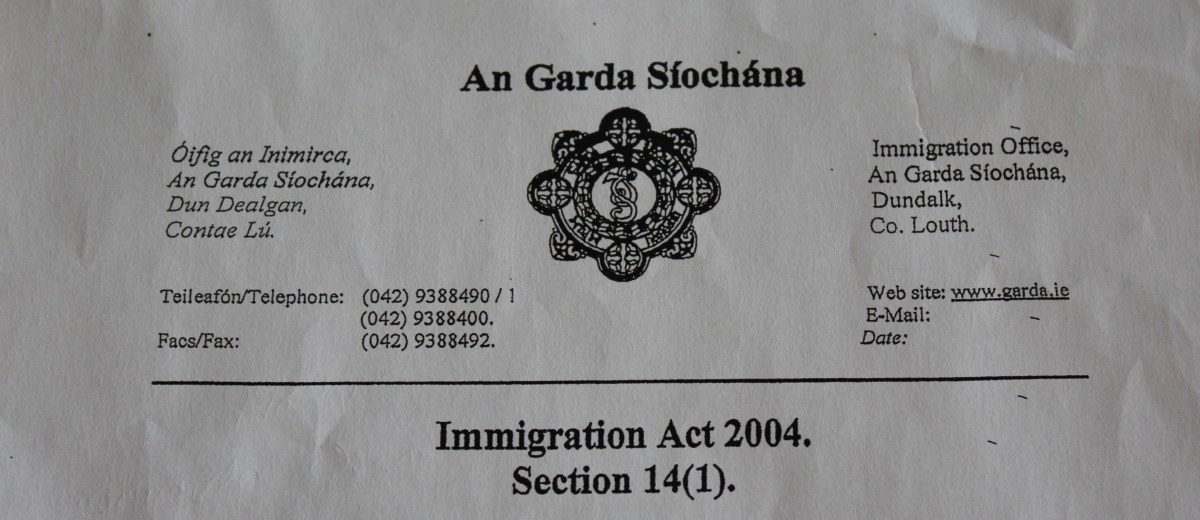
The passport-less scofflaws were taken in a squad car to the police station in Dundalk, photographed, given letters denying them entry to Ireland (and then letters allowing them to come into the country for the day) and taken to the train station, where the Irish government paid for their fare to Dublin.

If you haven’t traveled to Ireland before, you may not realize how significant Friday’s incident actually is. This level of scrutiny has not been seen since the Troubles, which ended in 1998 with the Good Friday Agreement. Marilynn readily recalls security forces boarding a bus or train during the Troubles but not after. I certainly haven’t experienced this in the half-dozen or so times we’ve crossed that border on previous trips.

More fallout from Brexit

We blame UK Prime Minister Teresa May, who last week triggered Article 50 to leave the European Union following last summer’s Brexit vote. The EU supposedly recognizes the unique relationship between the countries on this island (and the 30-year conflict where more than 3,600 people died), as evidenced by the response to May’s Brexit letter late last month.

I’ll let Marilynn pick up the story, from her email to the American consul in Northern Ireland:

“The garda told us that ‘the European Union’ had demanded that they start treating the Northern Irish border as an ‘international border’ and that they had been receiving extra training. Much, apparently, is left to the discretion of individual officers. This one gave each of us a letter saying that we were forbidden permission to enter the Irish state because we did not have a valid passport with us, and then gave each of us another letter saying that, at his discretion as an immigration officer, he was giving us permission to enter just for the day (luckily I was only planning to go for the day, anyway).

“He took our photos and made a record of the incident, and then put us both on the train to Dublin (courtesy of the Irish state). He kept saying, however, that some of his colleagues would have been happy to send us straight back to Belfast, and he expressed relief that his sergeant wasn’t around when we got to the station, since he probably would have taken a harder line.

“I knew, in the back of my mind, that I was supposed to carry my passport in the Republic, but I can’t remember being asked for it since at least 1998. I had gotten a bit blase about it, as (I’m sure) have many foreign nationals living in Northern Ireland. So I thought I’d better let you know about this so you can spread the word to other Americans living here to be sure and bring their passports with them when going to the Republic, even on day trips to Dublin!”

And I can’t stop singing the Beavis & Butthead version of the Judas Priest song “Breaking the Law.”

What the Hell Is That? A Visit to the Tate Modern

One of my favorite “Saturday Night Live” skits features Steve Martin and Bill Murray as tourists looking at something off-screen. After several back and forths consisting of basically “What the hell is that?”, Steve Martin says, “Well … get a photo of me with it anyway.”

Welcome to the Tate Modern, a wild ride of a museum just across London’s Millennium Bridge on the south side of the Thames.

A man and his crap

Earlier Saturday, we visited the Sir John Soane’s Museum, what I call a museum of a man and his crap, much like the Barnes Foundation in Philadelphia or Mercer Museum in Doylestown, Pa. Soane was a famous 19th century architect, who assembled an impressive collection of artifacts in an equally impressive building, which he molded to suit his architectural acumen and his tastes. The house and its contents were donated to the city upon Soane’s death, primarily to deprive his deadbeat son of an inheritance.

It doesn’t take long to visit the Soane’s Museum, so with only Harrod’s on the calendar for the rest of the day, I used the lure of afternoon snacks to persuade Declan to visit the Tate Modern. I like a lot of modern art that looks like, well … art. Mark Rothko painted mainly colored squares next to squares of a nearly identical colour, but I kinda like them. Alexander Calder mobile? Great! Andy Warhol pop art? Bring it on!

Of pallets and couscous castles

A pallet that looks like it was rolled off the loading dock at Wal-mart to the floor of a museum? WTF?!? One reviewer wrote: “Tony Cragg’s impressive Stack, a square of pallets and objects like a cube-shaped sandwich, is fascinating.” This person obviously hasn’t seen a bale of cardboard roll out “like a cube-shaped sandwich” from the compactor in the storeroom of any big box retailer.

Here’s another gem: “… visitors were fascinated by Kader Attia’s sculpture made entirely of couscous, resembling a Star Wars-style desert dwelling …” The sculpture (?) is called Untitled (Ghardaïa) and is a scale model of the ancient city Ghardaïa in the M’zab Valley in Algeria. Couscous, the Tate website explains, is a staple food of North Africa. I just call it Couscous Castle.

However, Declan and I did quite like Babel, Cildo Meireles’s gargantuan tower of mostly working radios that dominates the room it’s in.

But I had a hard time explaining Fountain, “by” Marcel Duchamp. In 1917, Duchamp purchased a urinal, put it on its side, painted “R.Mutt 1917” on it and entered it in an exhibition, where it was promptly rejected. The original was lost, but Duchamp “commissioned” 17 “replicas” in the 1960s. I can’t imagine where the original wound up, perhaps in a men’s room?

I recognize that art is in the eye of the beholder, and one person’s masterpiece is another’s piece of crap. I may not appreciate all the art—the car bumpers hanging by ropes, the contractor’s levels lined up on one wall, the what-the-hell-is that sitting on a table—but I do admire the balls of the artists who can explain some of this shit and make art out of it.

I wonder, how much is talent and how much is chutzpah? I may not know what it is, and I may not like it, but please take my photo with it anyway.

‘Brilliant’ Afternoon at Emirates Stadium

How do you describe a perfect afternoon? “Brilliant,” was all Declan said when asked to describe our experience Sunday at the Emirates Stadium watching The Arsenal take on Manchester City. Billed as one of the top matches of the year, Manchester City continues to play good football, while our beloved Arsenal has stumbled of late, dropping four of their last five matches and dropping out of the top four in the English Premier League.

We got there nearly two hours before kickoff, to take in the atmosphere both inside and outside the stadium. The stadium is in a residential neighborhood you walk through from the Arsenal tube stop. Vendors of all sorts lined the street selling merchandise, sweets and street food such as hot dogs, hamburgers and BBQ. It looked tasty, although we’d already eaten. Declan bought a scarf commemorating the match that was half blue and half red.

Friends in the right places

We had club level tickets, thanks to my Arsenal friend Jan, who I met in San Antonio in the fall. She was with a group of UK and Irish people on a week-long tour of Texas. We kept in touch, and she offered us her tickets for this match because she was spending the Easter holiday in the States.

That’s the beauty of football. Even with people who support teams other than ours, a team jersey can create a common bond and spark a lively discussion. The cabbie who brought us home last night was a Liverpool man and repeatedly tried to get Declan to convert during the trip. There’s no chance of that, however.

Our tickets were fantastic, just beyond one of the goals. The grass glowed in the afternoon sunshine, razor sharp criss-crosses where the grass was mowed in different directions. We watched officials check the goal line technology of the balls before retreating to the club lounge to watch TV and watch the fans make their way toward the stadium.

We returned for warmups, with Arsenal right below us and Man City in the distance. The practiced fans know when to show up, because half empty turned into nearly full during the last 10 minutes before kickoff.

Header past the goalkeeper

Although the Gunners fell behind a goal early, they clawed an equalizer as halftime neared, only to concede a second goal right before the interval. Fortunately, the home team scored the tying goal in the 53rd minute, a smart header by Mustafi that snuck past the outstretched hands of the goalkeeper. That moment, and the ensuing celebration, was Declan’s favorite part of the match, which ended in a 2-2 draw.

The entire match was intense, with the head official waving five yellow cards (and he could have waved more). In person, you can much better see the flow of the game as momentum shifts from one side to another. From our vantage point at one end, you could see plays develop much better than you can see on TV, the ball quickly moving from player to player.

Following the match, it was back to the club lounge to watch the crush of fans flow over the bridge back to the tube station and watch pundits discuss the match on TV. Although we waited 30 minutes after the match ended to start home, there remained a decent crowd at the tube station, but we were quickly on our way.

Our thanks again to Jan for the great tickets and to the stewards and club staff who made our visit so enjoyable. It was a perfect afternoon, indeed.

So Many Crisps…

People in the UK like crisps, lots and lots of crisps. They play a central role in the sandwich meal deal, which you can find in grocery stores, newsagents, department stores and drug stores. For $4-$6 US, you get a packaged sandwich, drink and either crisps or a dessert. It’s great for grab-and-go meals or for packing lunch during a train or bus trip.

But there are so many crisp varieties to choose from. I always try to find the oddest crisp I can, within the limits of our allergies. Between my onion allergy and Marilynn’s prawn allergy, it eliminates a lot of crisps. But, fortunately, there are plenty more. Read on for my take on the oddest dozen I could find.

Brannigans Smoked Ham & Pickle crisps—They taste exactly as billed, with a rich ham flavour and an undercurrent of pickle. One of Declan’s favorites.

Brannigans Roast Beef & Mustard crisps—Another winner, with a hint of mustard you can smell as you bring the crisp to your mouth, then a commingling of the two that is quite satisfying.

Brannigans Roast Lamb & Mint crisps—Upon tasting one of these, Declan shuddered involuntarily—twice. Marilynn said she liked the mint flavour. But that leaves the taste of sheep, very old and very gamey sheep. I will admit that they taste just as advertised, but the premise is so, so wrong. There’s a reason the British Corner Shop carries the other two types but not this one.

Roysters T-Bone Steak bubbled chips—They look like the blighted potatoes with an awful skin disease and taste like beef bouillon cubes. Don’t like the mouth feel and definitely don’t like the taste.

Scampi Flavour Fries—These technically aren’t crisps because they are made from corn and bread crumbs. But I didn’t notice until I read the package carefully. My compliments to the chemist because they taste exactly like scampi.

Bacon Flavour Fries—See just above for the specifics, but I like them, I really like them.

Hula Hoops (various flavours)—You can’t eat a bag of Hula Hoops without putting them on the fingers of at least one hand, like one does with Bugles. They are super fun to eat. In addition to regular flavour, they come in salt and vinegar, cheese and onion, BBQ beef and others. There are also Big Hoops. If you can put Hula Hoops on your fingers, I shudder to think what Big Hoops are affixed to before eating. “Look, lover! No hands!”

Tayto crisps (various flavours)—Tayto crisps are made (where else?) at Tayto Castle, about 30 miles from the flat. The company is proudly Northern Irish. I just wish I liked their crisps. They’re OK, but the crisps aren’t hefty enough for me, and the tastes are bland. They also make puffed corn “chips” that remind one of eating packing peanuts.

Hunky Dorys Buffalo Crisps—You couldn’t make these in the US, because you’d have to call them Buffalo Chips! Big Ruffles-like ridges, great taste. Another winner.

Space Raiders Beef Flavour Cosmic Corn Snacks—There’s an alien right on the package, so you know these are gonna be %^&*-ed up. And they are. Taste like beef bouillon packing peanuts, in the shape of alien heads. But hey, they’re only 20 pence, so get your munchies on for cheap!

Golden Wonder Saucy BBQ Flavour Transform-a-Snack—You can actually build what the package calls “out of this world vehicles.” Declan said these were “really good,” but again, they’re puffed corn (see packing peanut references above).

Hot Lips Nice ‘n’ Spicy Flavour Maize Snacks—Weird logos on weird packaging. I had no idea what they were or what flavour. And it was a big package, so if they tasted like crap, I would have wasted my money. I should have just shut up and bought them because they are delicious. Not hot in the least. Instead, they have a smooth, smoky flavor that makes you want another (and another).

Just like books, you apparently can’t judge a crisp by its package. Unless it contains lamb flavouring, of course.

Living the Life, One Chore at a Time

A friend once told me I’d make somebody a good wife someday. My mother taught all of her children how to cook and clean for themselves, and I happen to like a clean house (book and magazine clutter aside), so I take that as a compliment.

But in Belfast the concept of the house husband is coming to the fore, the result of circumstances. Marilynn is teaching two classes and working on her next book project, so she goes to her office five days a week. In America, she does most of the shopping and probably 60%-70% of the cooking. I cut the coupons, do the dishes, take care of the house and yard and cook/grill as directed.

With a car and grocery store flyers, Marilynn prepares a week’s menu based on what’s on sale that week, going to Publix for most items and filling in with purchases from Kroger and Aldi. Here, with no car and a tiny refrigerator, that paradigm is turned on its head.

Most days, we have no idea what we’re having for dinner. So off I go to Tesco, cloth grocery bags in hand, rain (mostly) or shine, to see either what’s been discounted or what looks good. More complex recipes often require ingredients we’ll not use through during our time here, so we try and keep it simple. But it requires grocery shopping nearly every day.

Good friends from England who recently spent a semester in Georgia complained about the high grocery prices compared with prices at home. And after several months in Belfast, I see where UK prices are better across the board. They don’t really do weekly flyers, but they do discount certain items for certain periods of time. But I already know that one of the kinds of yogurt I like will be on special whenever I shop, so one still can ferret out bargains.

Take the meal pictured at top, the same type of meal I’d prepare in the States, with steak, baked potatoes and broccoli. The price here, under $9 US. I’d pay that easy for just the steaks in America.

Shillings for the heat, lights

I remember watching British period dramas where the young single women or young families living in urban flats put shillings in a meter to heat water for a bath or turn on the lights or stove. We have the modern day equivalent to that—plastic top-up cards for the gas and the electricity. It makes it easy for the university (our landlord) because it doesn’t have to worry about getting left with unpaid bills amid the turnover in staff housing.

When you need to put money on the meter, you take the card to a participating news agent, tell the clerk how much you need to put on the card and pay for it. Then at home, insert the card into the gas meter to transfer your payment or punch in the confirmation number for the electricity.

The top-up option is available to homeowners, too, but according to a couple people I spoke with, topping up a card is more expensive than paying your bill monthly.

That’s what radiators are for

Not many homes have clothes dryers, so we’re left with an oversized drying rack, two retractable lines that run the length of the shower—and six beautiful radiators. When the heat is on, a radiator can dry a towel in 30 minutes. It’s too hot for the radiators at present, and I’m not sure this one big towel I put on the drying rack will ever get dry.

It can be an engineering challenge, however, to figure out what might air dry, what’s better suited to the radiator and what must never go on the radiator. A pair of jeans, for example, needs to be turned on the radiator at least once. So that’s what I do when taking a break from work, turn clothes on the radiator that aren’t dry, fold what is, and transfer items from the drying rack to a radiator to speed the process along.

Yes, it’s all in a day’s work for this house husband.

Conferences, Book Launches and Pilgrimages, Oh My

Marilynn left for the states this morning, Kansas City to be precise, for the American Conference for Irish Studies. Which leaves Declan and me on our own until Monday. Heh, heh, heh.

She is a plenary speaker for the conference, which is academic-speak for Really Big Deal. Business folks would be more familiar with the term keynote speaker, and the rest of us would have no clue.

Academic conferences are full of panel discussions and similar papers on a theme because institutions are more likely to reimburse a professor attending the conference if she is giving a paper. That means there are usually several tracks running at the same time, cutting the audience size for each panel. So a plenary is a single-track talk, with an undivided audience in attendance.

Despite being an excellent speaker, Marilynn was nervous about this, which underscores the Really Big Deal aspect. But I know she will knock it out of the park, like she always does.

Book launch events coming up

Marilynn edited an uncompleted but still powerful novel that her playwright Stewart Parker wrote about the amputation of his left leg when he was a 19-year-old student at Queen’s University Belfast. He sketched out the story a few years later, in a style reminiscent of James Joyce (but the readable James Joyce).

Stewart would pull out “Hopdance” during times of personal turmoil, tweaking the dialog, reordering scenes and writing new ones. He returned to it a final time in the months preceding his death from cancer in 1988 but never completed it. Marilynn took his original manuscript, much of it hand-written, typed it up and then went through it with a graduate assistant word-for-word at least twice, standardizing the spelling and punctuation while retaining Stewart’s writing quirks whenever possible.

It’s a labor of love and a great read. I’ve read it twice and look forward to hearing what the critics and the reading public think.

But it also means book launches in Belfast and Derry, either in late April or early May. Details aren’t final, but Marilynn, her agent and publisher hope to attract some high-powered help in launching the book in both cities. Fingers crossed that they succeed, but it’ll be a blast in any event.

Worshipping at the Emirates

So what will the boys be up to while Marilynn’s at her conference? By a happy coincidence, we’ll be in London this weekend, seeing our first competitive English Premier League match, our beloved Arsenal vs. Manchester City (boo hiss!).

Declan became an Arsenal fan in 2013 for reasons he still can’t articulate. But I got dragged into it, too, and became a fan of “real” football. This is one of the top matches of the year, and we were very lucky to score tickets from an Arsenal season ticket holder I met in the strangest of places.

But that’s a story for another day, which will be next week.

About the photo: We toured the “glorious” Emirates Stadium in 2014 while Marilynn was giving a talk in London. The certificates we received after the tour touted the stadium as “glorious,” and it stuck.

Mother’s Day, Belfast Style

Technically, it was Mothering Sunday, but for the merchants and restaurants, it definitely was Mother’s Day…in the UK.

Mothering Sunday is the fourth Sunday in Lent, a time to visit one’s “mother” church, but, I guess like Black Friday sales, this is another instance where the UK appropriated a so-so American tradition and made it its own. Flowers, cards, chocolates, special meals for mom and much more were on offer this year.

The Wellington Park Hotel down the street from the flat advertised a three-course carvery meal for 23 pounds, but food with any hint of gravy doesn’t work with my onion allergy. So Marilynn opted for Pizza Express, a UK chain that does sell pizza, but not very expressly. I get the feeling she would have been just as happy with a meal at home, although she was the one who started us going to Pizza Express, which she remembered from her grad-school days in Oxford.

Pizza (not so) Express

Pizza Express has been around for 50 years, and folks still go there in droves, so I guess everyone realizes by this time that Express is a suggestion, like hoping the cable guy shows up on the front end of the four-hour service window. During our sojourn in England earlier this month, there was a Pizza Express in every city we visited except for Lyme Regis, which is tiny. St. Ive’s ain’t much bigger, but there was a PE right along the waterfront. Falmouth, too.

Although there is a Pizza Express on the Lisburn Road that’s closer to our flat, we went to a city centre location after seeing “Beauty and the Beast.” Again, Marilynn likely couldn’t be bothered with the movie, but Declan and I wanted to see it.

We ordered, and the food arrived very quickly, possibly because we each ordered thin-crust pies. “Oh, things have changed since past visits,” I think to myself. And then time stood still. Don’t get me wrong, the food was spot-on like it usually is, and we had a great time overall.

But there is a natural flow to the sit-down restaurant experience that this chain violates every time, every location I visit. Not sure where our server got off to, because we suddenly got another server, who we quickly remembered from a visit four years ago—even recalling where we had been sitting in the same restaurant.

He’s been with the restaurant for 10 years and is a credit to the company and the location. I remembered him making a cool paper airplane, and he made a new one for Declan, much to everyone’s delight.

We did order dessert (it was Mother’s Day, after all), but requested the check at the same time, because we could have been there all night.

Just like the rest of the day, however, our visit hit the spot.

Note: My Thanks to Dann Maurno for the reference to Mothering Sunday, which the holiday was still called when he lived in the UK as a child. And it probably wasn’t quite so festive.

It’s a Beautiful Day …

You don’t know it’s spring in Belfast when the daffodils bloom, nor when the trees start to put on buds. It’s not necessarily the temperature, which was an extremely temperate 57 degrees today.

You know it’s spring in Belfast when the restaurants put out their outside tables. I had always thought that the Lisburn Road was really wide, but not so much once Eddie Rocket’s, the Yellow Door deli and the Indian restaurant put out their tables and chairs.

Belfast’s own henge

It was by far the best day, weather-wise, we’ve had in Belfast in nearly three months, so of course we went outside. Our destination was the Giant’s Ring, a local henge that was built 4,700 years ago.

Google Maps said it was a tad over three miles, so we set off down the Malone Road a little past 3. This was a wish-you-had-remembered-your-hat day, because during the first part of the journey the sun was directly in our eyes. But we soon made it to the Lagan River at Shaw’s Bridge, before cutting through National Trust land and to the site.

After seeing Stonehenge and the Avebury Stone Circle last week, the Giant’s Ring was a bit of a letdown, but it still was impressive. An earthen circle that stretches 210 yards was built up around the henge, the remains of a passage tomb comprised of five upright stones and a capstone. Aerial photos show three rings between the ditch and the center, believed to be where posts were set. Archaeologists have found 10 other burial sites and other settings of posts.

We saw many dogs playing in the water, kids on bikes, daffodils in full bloom and lots of birds. An ice cream vendor was parked in the Shaw’s Bridge car park, so Declan and I had to have a cone apiece.

Glimpse of elusive landmark

On the way back, we even saw the twin Harland & Wolff gantries in the distance. My first trip to Belfast was by train, and I first saw Samson and Goliath just before arriving at Central Station. I knew of Belfast’s shipbuilding history, most notably as the birthplace of Titanic, and I’ve always associated the gantries with that part of Belfast’s history.

I so want to include a picture of the gantries in the blog, but I’ve never been stationary long enough to get a clear shot. The good news is that I have another four months to make that happen.

When we got back to the car park, we’d already walked just shy of six miles, so we called a taxi for the return trip. The sunset, as you can see, was a beautiful end to a glorious day in Belfast.

Is US Treatment of Muslims Creating Another Troubles?

With the passing of IRA leader and later Northern Ireland Deputy First Minister Martin McGuinness this week, thoughts naturally turn to the man’s place in history. Should he be remembered as a statesman who helped negotiate the Good Friday Agreement that brought an end to the Troubles? Or as a terrorist who, despite his protestations, is widely believed to have directed and participated in terrorist activities?

His status as a Catholic from the Bogside of Derry played a huge role in his decision to join the IRA. According to the Guardian, after attending technical college, McGuinness was turned down for a job as a mechanic because he was a Catholic. Three years later, in 1968, he joined the IRA after seeing bloody pictures of Gerry Fitt, the Catholic MP for Belfast West, after he was hit by police batons.

McGuinness’s radicalization didn’t turn on a single incident, I’d imagine, but occurred gradually over time as mistreatment piled atop mistreatment until he reached the breaking point.

Marginalizing a class of people

It got me to thinking about what I feel is America’s mean-spirited (not to mention clumsy and likely illegal) recent efforts to ban Muslims from traveling to the US. The latest is the odd ban on electronic devices larger than a cellphone in the cabins of flights originating from most Middle Eastern countries. (Side note: what about those dangerous lithium batteries in laptops in checked baggage? I’m more afraid of exploding lithium batteries than I am of terrorists.)

Maybe there is a compelling security reason, but does taking your shoes off at airport security and leaving your big tube of toothpaste at home make you feel any safer? Logic does not favor the government in these issues. But I digress.

Have you ever been treated unfairly for what you think was no good reason? How did it make you feel? Now take those feelings and multiply it by the 4.3 million Muslims in the US, many of them naturalized citizens, then add in the 178.3 million Muslims in the six countries affected by the travel ban.

Even if I was the straightest-laced Muslim imaginable, I’d be pissed off. Now imagine those already disadvantaged by lack of education or high unemployment where they live, and you begin to see how the seeds of dissent are sown by those who truly want to do harm to Westerners.

Let me be clear: we’re talking about an infinitesimal number of radical idiots in a vast sea of people, nearly all of whom share the same dreams of building a better life for themselves and their children as we do. Americans don’t hold a patent on this idea.

I consider myself a Christian, yet I’m truly appalled at many of the things allegedly done in the Lord’s name in the US and around the world. Conservative Christianity no more reflects my values than radical Islam reflects the values of all but a handful of Muslims.

Martin McGuinness was radicalized after being put down for his religion and seeing people just like him being cast to the sidelines of society time and time again.

But through personal growth and empathy, McGuinness risked his life to negotiate peace and later served admirably in the resulting power-sharing government with former enemies, including rabid unionist Ian Paisley. How will he be remembered? He will be seen both as a terrorist and as a diplomat, I’m sure.

Life must go on, regardless

How many future terrorists is the US risking through its heavy-handed efforts to keep us “safe,” while at the same time decimating the State Department budget that funds outreach to the world and beefing up what’s already the world’s largest military?

These efforts don’t make me feel safe. They just make me embarrassed for the country my family has been a part of since before the Revolutionary War.

Earlier this week, there was a terrorist attack in London. Declan and I are visiting there next weekend, attending a football match with 60,000 other people, visiting the Tower of London, Harrod’s and the British Museum, all top tourist attractions.

And the whole family will be in Antwerp next month, the scene of another incident just yesterday. Oh yeah, and we’ll be in Paris and Berlin on that trip, too.

Like it or not, we all are citizens of the world, and what the US does in the name of “security” has impacts that likely will ripple for years. On this matter, I take my cue from ‘80s pop star Joe Jackson and the title track of his 1986 album, “Big World.”

“It’s a big world – so much to do / And plenty of room for me and you”

About the photo: Sinn Fein President Gerry Adams (left) and Martin McGuinness.