When it rains, it pisses rain

I think southwest Ireland is cursed for me. Fifteen years ago, when Marilynn and I were showing Walker around the island during a driving vacation, I messed my back up so much that we had to stay in one place for several days. What did we miss during the downtime? Driving the Ring of Kerry.

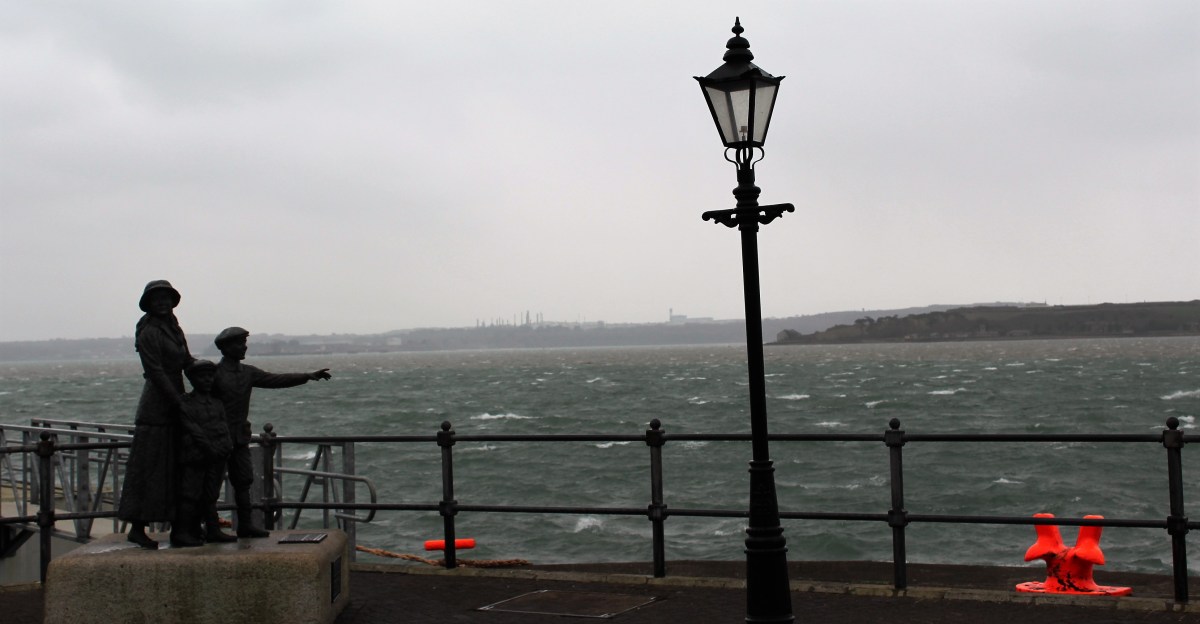
So here we are again, same couple, different kid in Cork, our first foray from Belfast since our arrival three weeks ago. Marilynn was giving a talk at University College Cork, then we are off to see Cobh, Kinsale, the Dingle peninsula and the Cliffs of Moher. That was the plan, anyway, until the 30-plus mph winds and the torrential rains hit.

The first day was OK except for the wind. While Marilynn gave her talk, Declan and I checked out St. Fin Barre’s Cathedral, the city centre, the indoor food hall and the Scout store. For dinner that night, we ate at a college pub where I had a meat pizza that included black pudding. The pizza was OK at best, and the black pudding neither added nor detracted from it.

Titanic’s last port of call

Yesterday, we went to Cobh (pronounced “Cove”) to visit the Cobh Heritage Center, which has a rich maritime history. It was the final port of call for Titanic before it sank in 1912, and many of the survivors of the Lusitania also were housed there. But it should be known for much more than shipwrecks. The city, known as Queensland then, transported indentured servants to America, slaves hither and yon, criminals to Australia and emigrants fleeing the Potato Famine.

The Titanic exhibit is long on pictures, thanks to those of Frank Browne, whose uncle paid for Browne’s journey on Titanic from Southhampton to Queenstown. Browne was an avid photographer and thoroughly documented his relatively short jaunt. A wealthy American couple offered to pay his passage to New York, but when the theological student sought permission from his Jesuit Superior to journey onward, the response was “get off that ship!” Which, of course, proved fortuitous for Browne.

Among the few artifacts is a bottle found near Cork in 1913, bearing a message from Jeremiah Burke, a Burke of Glanmire, Cork, and tossed overboard a day or days before the disaster.

Although the Titanic exhibit in Belfast is vastly superior to this small presentation, the Cobh Heritage Centre proved worth a visit.

Let it rain. Let it rain.

Until the skies let loose, anyway. It had been so windy the previous night that Declan got blown off course a couple of times. Combined with a driving rain, unfamiliar streets and an unfamiliar road layout (left lane! LEFT LANE!!), the drive to Kinsale was nothing short of perilous.

Marilynn wanted to see Charles Fort (place, not person) to get her in the right mind to write about Brian Friel’s play “Making History,” a play about the Earl of Tyrone (Hugh O’Neill) who led Irish and Spanish forces against the English during the 1601 Battle of Kinsale. His troops endured a long trek in crappy weather like we were experiencing, so it did inform her thinking. It was miserable for us, and we had modern rain jackets, a car and the ability to drive into town for lunch. This fort was built 75 years after the battle but is in the same general area.

We decided to bag seeing the fort and drive home when we chanced upon it anyway. However, the rain was slashing diagonally across the windshield, and Declan and I declined to get out. Marilynn took a two-minute peek and high-tailed it back to the car.

Note on Cobh: The town originally was called Cove, before it was renamed Queenstown in 1849 following a visit from (wanna guess?) Queen Victoria. It became Cobh in 1920 when Ireland became an independent state. “Cobh” is a Gaelicized rendering of “Cove” – it has no meaning in Irish.

Nobody knows the Troubles they’ve seen

No trip to Belfast would be complete without learning more about the deep, rich and often painful history of Northern Ireland. It’s a complicated interplay among the North, the Republic of Ireland and England that stretches back centuries.

The story you’ll get depends on who you ask, more specifically, the religion of who you ask. While there are no absolutes in religion or politics (just ask pollsters before the US presidential election), generally Protestants support the union with England and Catholics want Ireland to be one country. There, 350 years of Irish history wrapped up in a bow, just for you.

But you’ll get widely divergent takes on the same historical events by visiting the Museum of Orange Heritage and the Eileen Hickey Irish Republican History Museum, which we did over the past several days.

The origin of ‘hillbilly’

The Museum of Orange Heritage is all about how King William of Orange beat back the Catholics in 1690, how they again were victorious following battles during the early Irish republican rebellion of 1798, how the Orange Lodges got started around the same time, their participation in the first World War and how they came under attack during the Troubles. There’s more to it than that, obviously, but that definitely hits the highlights.

Opened in 2015, the museum was built, in part, through the support of the European Union. We paid 10 pounds for a family ticket, and the museum has regular museum-like hours, Tuesday-Saturday. We were surprised to discover that football great George Best (for whom Belfast City Airport is named) was a member of a junior Orange society when he was a lad.

You can see parts of King William’s saddlecloth, a pair of gloves and a letter he wrote. If you look closely, you can see an American connection—Protestant immigrants to the US were called “King Billy’s Men from the mountains or hills” because, like at home, they celebrated significant Protestant war victories with music. This was later shortened to “hillbillies.”

Prison life detailed

On the other hand, the Irish Republican History Museum is open four hours a day, Tuesday-Saturday, takes no government money and is run by an all-volunteer organization. Admission was free, but we kicked 10 pounds into the donation box to even things out between the Unionists and the Republicans. The museum was founded by (who else?) Eileen Hickey, a Provisional IRA leader who spent more than four years in Armagh Prison between 1973-1977, during a time in which hundreds of people (mostly Republicans) were jailed—often without charge.

After the end of the Troubles, she started collecting artifacts and stories from those who had been imprisoned, along with other Republican history. The museum opened in 2007, one year to the day after her death from lung cancer, in a former social hall (read: drinking establishment).

While there were few visitors at either museum when we visited, the Orange museum seemed rather sterile, artifacts under plexiglass with museum-quality interpretation beside them. Other than the nice woman who took out money, the only other museum person we saw was a maintenance man swabbing down a hallway.

The Republican museum was chock-full of objects, including a fair amount of weaponry and a ton of artifacts made by prisoners. Harps galore, banners, furniture, mirrors, Celtic crosses. These people obviously had a lot of time on their hands.

You can see artifacts from Long Kesh and Armagh prisons, including a recreation of an Armagh cell and Eileen Hickey’s prison card. Hickey’s sister was there on the day we visited, showing obvious enthusiasm for the museum her sister founded as a way to tell the Republican story.

But when Marilynn asked about the current political climate, days after the Republican party Sinn Fein triggered early elections, she was more circumspect. The Troubles impacted the lives and outlooks of an entire generation, but today’s teens are growing up in a time when they know nothing but peace.

And perhaps that’s the best place to leave it, both this column and the Troubles, with wishes for continued peace.

Photos: The one to the left is an example of an Orange arch located outside the Museum of Orange Heritage. The one to the right is a mural of Bobby Sands, a member of the Provisional IRA who died during a hunger strike at the HM Prison Maze in 1981. This mural is just off Falls Road about two blocks from the Republican museum.

10 days before liftoff

Setting up a blog site may not be the best use of one’s time, 10 days before embarking on a seven-month journey to Belfast and beyond. But here it is nonetheless.

My wife is a Fulbright Scholar at Queen’s University Belfast for the spring semester, where she will teach two classes and do research for her next book on literary responses to the peace process in Northern Ireland. Oh yeah, and she’s got another book that she edited coming out this spring with an Irish publisher. It will be much easier to go on a book tour when you’re on the east side of the pond.

Although we are not Irish, we named our son Declan to honor my wife’s research interests and our favorite place to travel. Little did we know he’d have auburn hair like many Irish kids to go along with his Irish name. Although we still don’t have a school nailed down for him yet, we know he’ll fit right in. It was in Derry during summer 2013 when he pledged allegiance to the EPL team Arsenal  and asked for his first jersey. Four Arsenal jerseys and those from nearly a dozen other teams later, he’s still into football (the world kind).

And I’m merely a humble writer, with a newspaper background and my own marketing communications company that specializes in technology and healthcare writing. It means that I’m infinitely portable in terms of work, which helps make this odyssey possible.

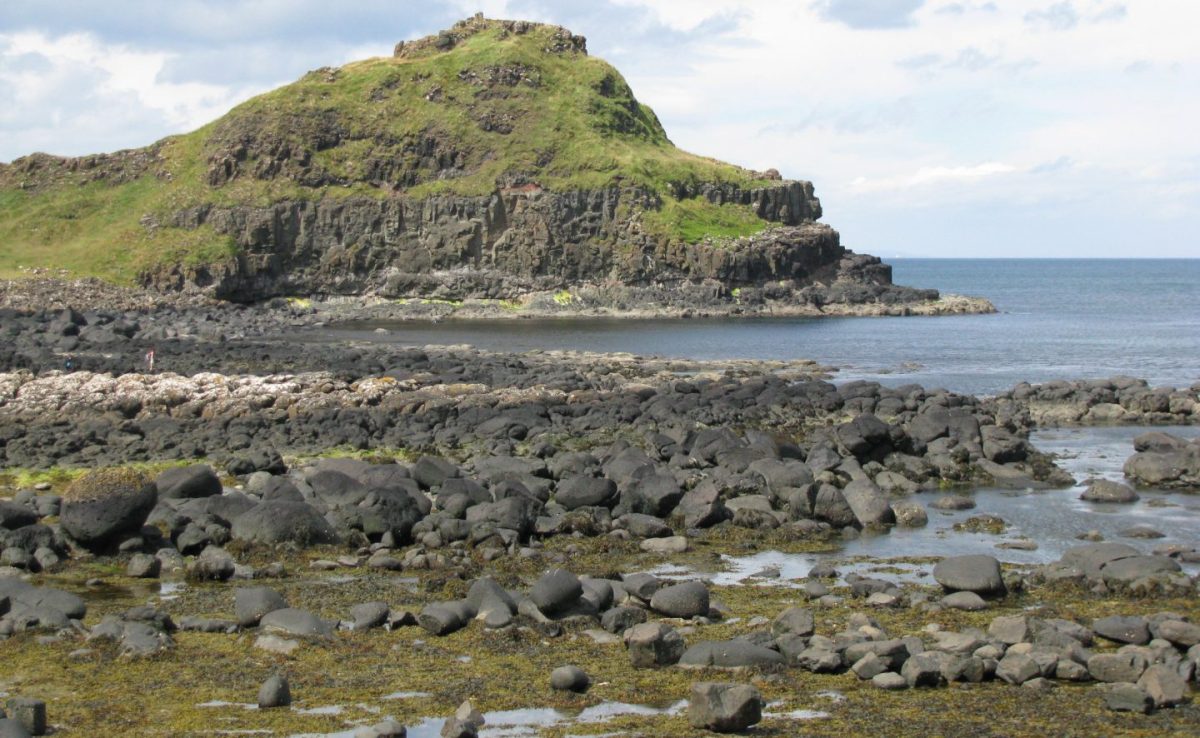
The photo is of Giant’s Causeway, taken in 2013. It’s a World Heritage Site and did not disappoint. Most people opt for the package bus tour, which includes a tour of the Bushmill’s Distillery. We hired a car for the day from Belfast, so no distillery for us.