Feels Like the First Time, All Over Again

I’ve been to Ireland so many times that I’ve lost track. Tough problem to have, I know, but there always seems to be something new to see or do.

This year, during Georgia State University’s spring break, I had the pleasure of accompanying Marilynn and 12 undergrads for five intensive days in Dublin on a James Joyce’s Dublin study abroad program. They had read “Dubliners,” “A Portrait of the Artist as a Young Man,” and two episodes of “Ulysses.” My unofficial job was mainly to count heads and make sure everyone was walking in the right direction or got on the right luas (tram).

For me, this experience recalled the first time we brought our sons to Ireland, although 12 times more intense. About half the students had never been out of the country, and none of them had been to Ireland.

Dublin is fairly compact, with a great interconnected bus/tram/train system that makes travel simple—especially if you have a transportation pass, which we all did. Jitters and general unease among the students about navigating a foreign city quickly gave way to groups of students shopping, attending a drag show, visiting bookstores, and shopping. Yes, shopping is mentioned twice, because that’s what most of them did during their free day.

Here’s a sampling of what we did:

  • Guided tour of the GPO Museum, headquarters of the Easter Rising in 1916. By the way, it still serves as a Post Office.
  • Literary and musical pub crawls (because, why not?)
  • Walking tour of James Joyce’s Dublin, from the James Joyce Center
  • Tour of the Museum of Literature Ireland (MoLi), pronounced the same as Leopold Bloom’s wife, Molly. Coincidence? We don’t think so.
  • Visit to Sweny’s Pharmacy, where Bloom buys a bar of lemon soap.
  • W. B. Yeats exhibit at the National Library of Ireland, which is worth a look even if you know nothing about Yeats because the building is gorgeous.
  • Talk by Lynne Parker, good friend and artistic director of the Rough Magic Theatre Company
  • Dined like locals in the café at Dunne’s department store and by grabbing meal deals (sandwich, snack and drink for about $6) at Tesco
  • Attended a play (that’s best not mentioned further)

The culminating event of the week was a visit to the Martello tower in Sandycove where Joyce “lived” for six days in 1904. He hated it so much he left in the middle of the night and walked back to Dublin, leaving the country within a month. He only returned to Ireland twice after that, the last time in 1912. He wrote “Ulysses” from memories of Dublin and answers to the pestering questions he sent to friends. The James Joyce Tower is one of a series of towers the British built along the Irish coast in the early 19th century to defend against invasion.

For those who haven’t read “Ulysses,” a scene in the tower opens the book.

Lessons Learned

I learned that students today (especially this group) don’t do much drinking, which suited chaperone Marilynn just fine. She and I definitely downed more pints than the rest of them combined, and a second beer is a big night for either of us. I also learned how to make a Girlie Guinness by adding blackcurrant liqueur to counteract the bitterness of the stout. (Don’t hate on me for the name—that’s what the barman called it).

Unfortunately, the students missed out on two of my favorite parts of being in Ireland: the splendor of the full Irish breakfast that’s only served in fine B&Bs (they could have made their own at the breakfast buffet, but it’s just not the same) and the Irish countryside, which features at least 10 colors of green you won’t find anywhere else.

But they took away fond memories of James Joyce’s Dublin, discovered the thrill of travel, and made friends that will last a lifetime. For Marilynn, it was the culmination of much planning and nearly flawless execution. And for me, hope for the future knowing that the world will soon be in the hands of students like these. While it was the first time visiting Dublin for the students, it won’t be the last time for many of them.

Potential Puking Aside, Real Irish Adventure on Aran Islands

I don’t know whether there is a god for those about to hurl, but I certainly prayed to some deity during a rough, 45-minute ferry ride from Doolin to Inishmore, the largest of the Aran Islands.

After arriving at Shannon Airport, we made our way to Doolin, a frequent stopping-off point for either the Aran Islands or the stunning Cliffs of Moher — or both. Marilynn hadn’t been on the islands since her first trip to the Emerald Isle 35 years earlier, and Declan and I had never been.

We stayed at Fisherman’s Rest, a great B&B run by Danny and Mairead Guerin. Danny was our main host and had adorned the breakfast area with pennants of various, mostly German, football teams. He and Declan had a long discussion about FC Kaiserslautern. We also had terrific meals and pints at Gus O’Connor’s pub, which Marilynn and I immediately recognized from a trip we took with Walker 25 years ago. Walker fell asleep during the music session, and a man named Paddy (naturally) gave him a Euro coin that I still have at home. My mussels were delicious and more than I could eat, so Marilynn helped.

Hurling (and Not the Irish Sport)

The next morning, after a full Irish breakfast and a Dramamine, it was off to the Doolin Ferry for the longest water leg of our trip. We thought we were fortunate to snag topside seats for the journey. The sky was blue with nary a cloud in the sky. Until it started to rain, and the seas began to roil. Or was that my stomach?

I don’t remember much about the trip, except for holding my umbrella just over my head to ward off the worst of the rain; the water washing over our luggage and splashing me; prayers to the anti-puking god; the single piece of someone’s luggage across the aisle I focused on while waiting for this interminable trip to end; the placebo power of many, many antacids; and the overwhelming desire to kiss the ground once we reached dry land.

More Time to Explore Inishmore

Most tourists do day trips to the islands, scurrying around for a couple of hours before hopping a ferry back. We took our time, spending two nights on Inishmore (Inis Mor) and one night on Inisheer (Inis Oirr), the smallest of the main islands.

We spent the first day orienting ourselves amid the continued spitting rain, checking out the dining options and making plans for our main day of visiting. The island empties at 4 p.m., leaving just 800 residents and however many intrepid visitors book rooms on a particular day.

Declan and I watched the opening Euro 2024 match at Tigh Joe Mac, where Declan made friends with a local named Tommy, who told his friends that Declan was a cousin from America when Declan returned to the pub the following evening.

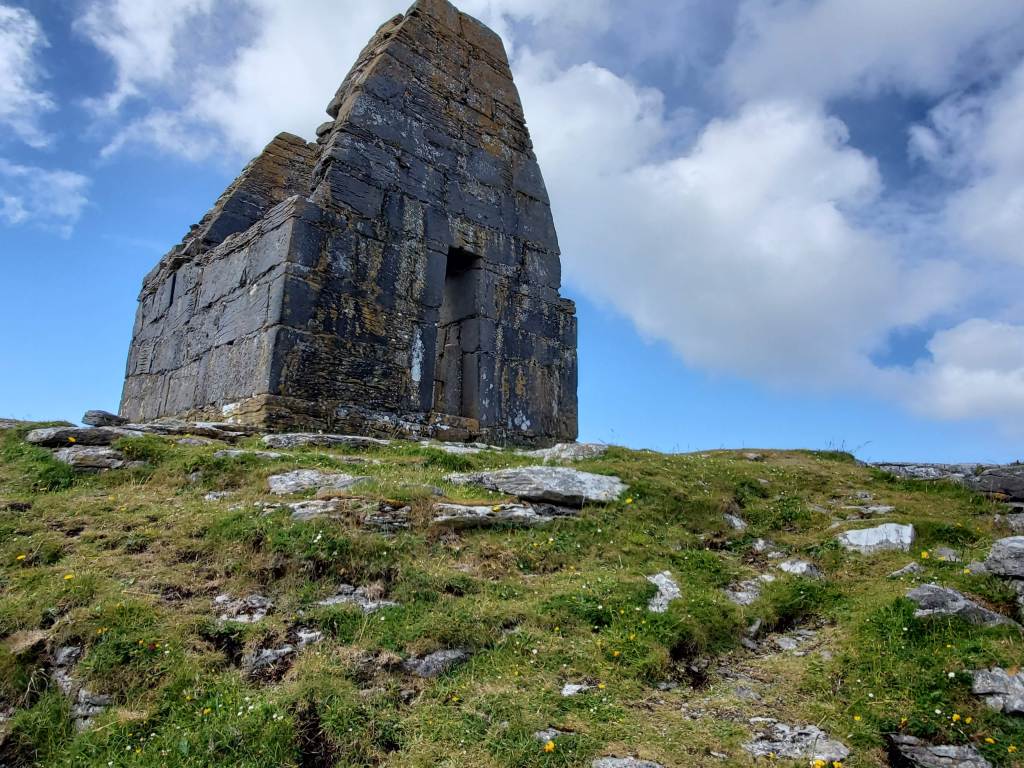
The following morning, after the rain finally stopped, we rented bikes, which are essential for exploring the island. We packed a lunch and made for the ruins of St. Benan’s Church, supposedly the smallest church in Ireland. After cycling for about 20 minutes, we ditched our bikes and headed through cow fields and broken walls to the highest point on the island. The church dates to the 7th century and measures 11×15. The grounds also include the remnants of a Celtic cross that the cows were lounging around and the base of a round tower about halfway up the hill.

After enjoying our lunch near the church on some flat rocks, we made our way back to the B&B via a graveyard near the shore that also contained the remains of St. Enda’s, a 6th-century monastery that had sunk into the ground.

When we got back on our bikes that afternoon, backsides burning from sitting on tiny seats, we pedaled against near gale-force winds to the ruins of St. Ciaran’s, an 8th- or 9th-century church. Our ultimate destination was the Wormhole, a supposed naturally rectangular blowhole that sits on land reportedly posted as “no trespassing.” Amid spotty cell service that made navigation treacherous, tired asses, and a desire for dinner, we gave up our search for the wormhole and settled for a glimpse of Dun Eochla, a large hilltop ringfort that is free to visit and not as crowded as nearby Dun Aonghasa.

Music Session and Nighttime Church Visit

The next morning after breakfast, it was back to the ferry (!!!) for a smooth 20-minute journey to Inisheer. We beat most of the day-trippers, dropping our bags and snagging a donkey cart ride around the island before the general tumult of the day.

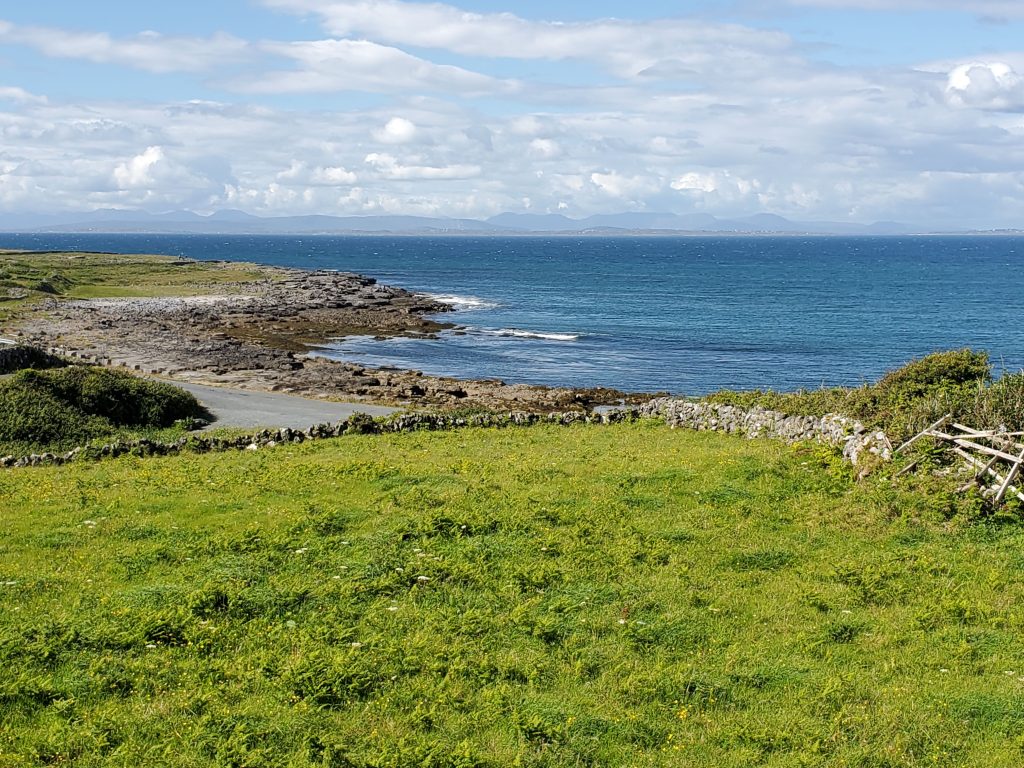
The donkey ride is a great orientation to the island, winding through narrow roads bounded by dry stone walls at every turn. The first stop was the wrecked ship Plassey, which went aground on the island in the 1960s, its cargo of yarn, stained glass, and whiskey lost to the elements. Then it was on to O’Brien’s Castle, the remains of a 15th-century tower house that’s now a national monument. The castle offers stunning views of the Atlantic Ocean on one side and the island itself on the other.

After lunch, we lounged in our room at Tigh Ruairi, a pub/B&B. At one point, Marilynn and Declan checked out the sunken church a short walk away. In the evening, we went to a music session at a local hotel. While Marilynn stayed there, Declan and I retraced his steps from earlier to visit Teampall Caomhán, which dates from the 10th century. Despite it being past 10 p.m., the church was perfectly visible.

The church is dedicated to St. Caomhán (Cavan), the patron saint of the island. We visited just after his feast day (June 14), and candles still burned in his honor. Over time, the church fell into disuse, and drifting sands covered what remained of the church. Dedicated islanders dug out the chancel area of the church and continue to keep it clear.

With the Aran Islands behind us, it’s now on to Limerick.

Up Close to Oxford’s Bridge of Sighs and Other Bits from Abroad

Random observations from two weeks in England…

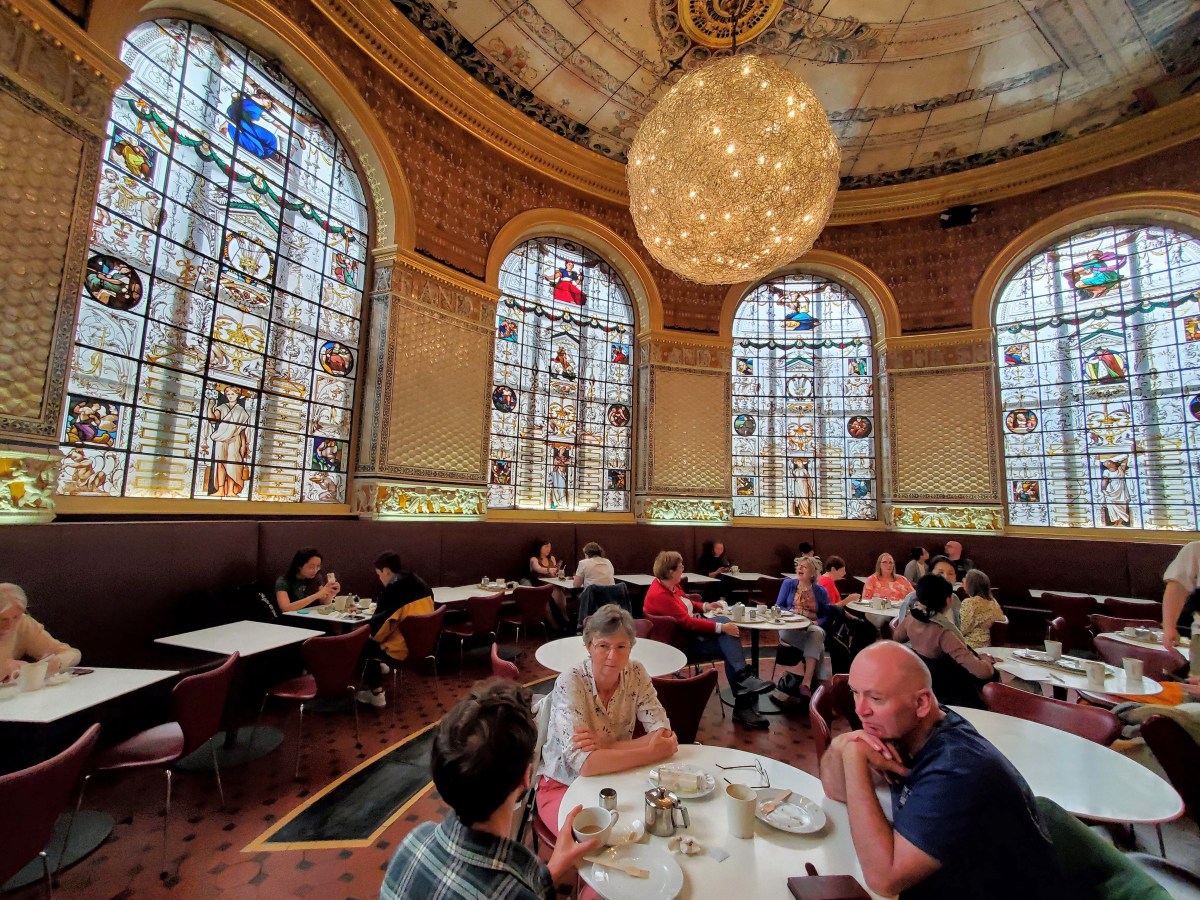
We spent an educational afternoon at the Victoria and Albert Museum in London, taking in the exhibits. One highlight was tea and dessert amid the opulent surroundings of the world’s first museum café, built in 1852. Europe has America beat hands down in terms of offering plenty of places for folks to gather, with varied food and drink offerings at reasonable prices.

***

Bridge of Sighs

We were fortunate to spend two nights in guest quarters at Hertford College in Oxford, where Marilynn gave a talk. We stayed about 15 feet from the Bridge of Sighs, a famous decorative bridge that connects two parts of the college and is modelled on a similar (and older) structure in Venice. That was the good news. The bad news is that from about 8:30 a.m., tour groups gathered under our bedroom windows for a history lesson. Then from about 10 p.m., loud students spilled from the alley leading to the Turf Tavern, a semi-famous pub that offers “an Education in Intoxication.”

***

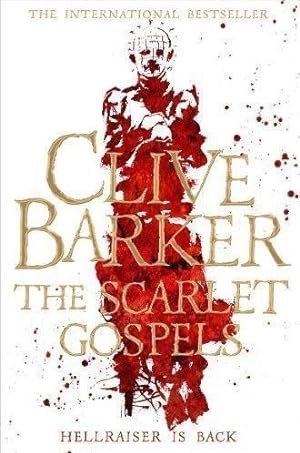
My apologies to the young woman on the train from Birmingham to Oxford who was either copying passages from the New Testament or writing her impressions of scripture while I was reading horror master Clive Barker’s novel “The Scarlet Gospels” about Pinhead, the demon from the “Hellraiser” movies. Heaven and hell, indeed!

***

Many European hotels still don’t have air conditioning, including the hotel in Birmingham the Friday we attended the Elbow concert. I couldn’t figure out how to defeat the device that only allowed opened the window about two inches until we got back at past 11. Consequently, we kept the windows wide open that night. By 6 a.m., however, we felt like we were sleeping rough by the motorway, the traffic noise was so bad.

***

When traveling, we always find something to climb, something to ride, and a drunkie cab. Fortunately, we saw no drunkie cab in Oxford, but Marilynn and I did climb Carfax Tower, which dates to the 13th century and offers nice views of the city. I was most impressed it wasn’t named for the company that sells wreck reports on used cars. According to displays in the tower, “carfax” is derived from the Latin word “quadrifurcus,” meaning four. The tower is still near the intersection of four central roads in Oxford.

***

We traveled many miles during our two weeks in England, much of it to catch up with colleagues and old friends. Our sincere thanks to everyone who hosted us, met us for a meal, or let us stay the weekend in the Cotswolds (thinking of you, Michael and Aleksandra!).

A ‘Fine Mess’ of a Time at Elbow Concert

Rock concert or Laurel and Hardy convention? Across a two-week adventure, I only had one request of Marilynn: to see one of my favorite bands, Elbow, which released its 10th studio album in March and was touring the UK while we were in country.

If you haven’t heard of Elbow, I highly recommend a listen (or two, or three). The Manchester-based band has been together since the members were teenagers, and I became aware of them by listening to the totally free and eclectic Internet radio station Radio Paradise (more on that later). Elbow is, in a word, magnificent, something you will understand figuratively and literally after clicking the link in this sentence.

We traveled by train from Oxford to Birmingham, walked from the station to our hotel near the venue, entered the lobby—and saw a bunch of people in fezzes and brightly colored tropical apparel. We had unwittingly intruded on the England convention of Sons of the Desert, an appreciation society for the comedy duo of Stan Laurel and Oliver Hardy, who made 107 film appearances from the late 1920s to the mid-1950s.

Although Laurel has the English connection from his birth in the Lake District, apparently it was the American Hardy who approved creating the society. He didn’t want it called a fan club, according to my new friend Bob, who was nursing a pint in the hotel lounge when I peppered him and his mates with questions about these odd-looking people.

“Sons of the Desert” is their 1933 film where they join a lodge (hence those fezzes), and each chapter of the society, named after one of their films, is called a “tent.” Hardy was born in Harlem, Georgia, where the Laurel and Hardy Museum of Georgia is located. Harlem, about 20 miles west of Augusta, also hosts an annual Oliver Hardy Festival. The next festival is on Oct. 5.

Elbow Not to Be Missed

Meanwhile, back in Birmingham, we relaxed at the aquatics facility attached to the hotel and had a quick dinner before heading to the venue, a short walk away along a footpath next to the motorway.

While the opening act wasn’t to our taste, Elbow delivered a hit-packed, audience-friendly two-hour set that left everyone fully sated and breathless after singing the refrain from their biggest hit, “One Day Like This.” Despite the limited tour, Elbow created a full rock ‘n’ roll experience for the 8,500 or so people in attendance.

Elbow is the third performer we have traveled to listen to as a direct result of listing to Radio Paradise, a listener-supported internet radio station. We also are great fans of Vienna Teng (we saw her in D.C. before she played at Eddie’s Attic in Decatur), and Mindy Smith (ditto Eddie’s Attic but also saw her at City Winery in Nashville). I’m still waiting for Dengue Fever or Zola Blood to play in Atlanta, though.

Radio Paradise is programmed by a former FM radio station disc jockey from a time when DJs played whatever the hell they wanted. He has great taste in music across a wide variety of genres, so you’ll hear Kings of Leon, then Billie Holiday, First Aid Kit, Mozart, and world music you likely won’t hear anywhere else. It all works beautifully, but if something isn’t to your liking, you hit a button and something else plays. The station has a mainstream rock mix, mellow mix, world mix, and a favorites mix if you register and rate at least 100 songs. It’s great, it’s free, and you should check it out.

As the RP T-shirt says: Eclectic as F**k.

Journey to London Fraught with Delays

Half-day trip turns into all-day adventure.

A clusterfuck enclosed in a shit sandwich and baked in a sardine tin. That aptly describes what should have been a routine train journey from Penrith in the Lake District of England, where we visited friends, to London, our next destination.

Yes, another end-of-semester and another European adventure, this time two weeks in England for Marilynn and me. She’s giving talks in Oxford and Manchester and meeting up with literature colleagues and friends. I’m along for the ride, but after this day I may want to just stay put.

Little did we know when planning our itinerary that the national railway would want to work on nearly 500 train projects over a long weekend, what’s called a bank holiday here. It’s the equivalent of closing I-75 during spring break.

A direct train from Penrith to London became four separate legs, starting with a bus to our first stop. The 60-seater bus to Oxenholme traversed the M6 motorway before exiting on a goat-trail-sized roadway that corkscrewed its way through sheep fields into a sleepy town on an early Sunday morning. Although I wasn’t driving, it was clear this route wasn’t meant for a large bus. I dubbed the road Beelzebub’s Bunghole, which our driver handled with aplomb.

An Oxymoron, Or Just a Moron?

We successfully made the first transfer to a train bound for Manchester, where the trip we’d planned (and made reservations for) fell apart quickly. At least we’d packed a lunch, but the next train was cancelled due to “overcrowding.” Isn’t it an oxymoron (or just a moron) to run fewer trains because there is an excess of demand?

Marilynn handles the travel planning, checking the national rail journey planner on her phone while muttering under her breath about scheduled trains that suddenly get cancelled or the app showing trains the day before the date she’s specified.

After an hour’s wait, the train that had been sitting on the tracks the entire time suddenly became the next train on our journey, and we exited at Sheffield. With apologies to the fine people of Sheffield, I’ll always remember the city from a previous journey when Marilynn, Declan, and I were eating an early morning breakfast at a Wetherspoon’s pub, where four blokes were having pints — apparently before a day’s work. Gotta love pre-work drinkies!

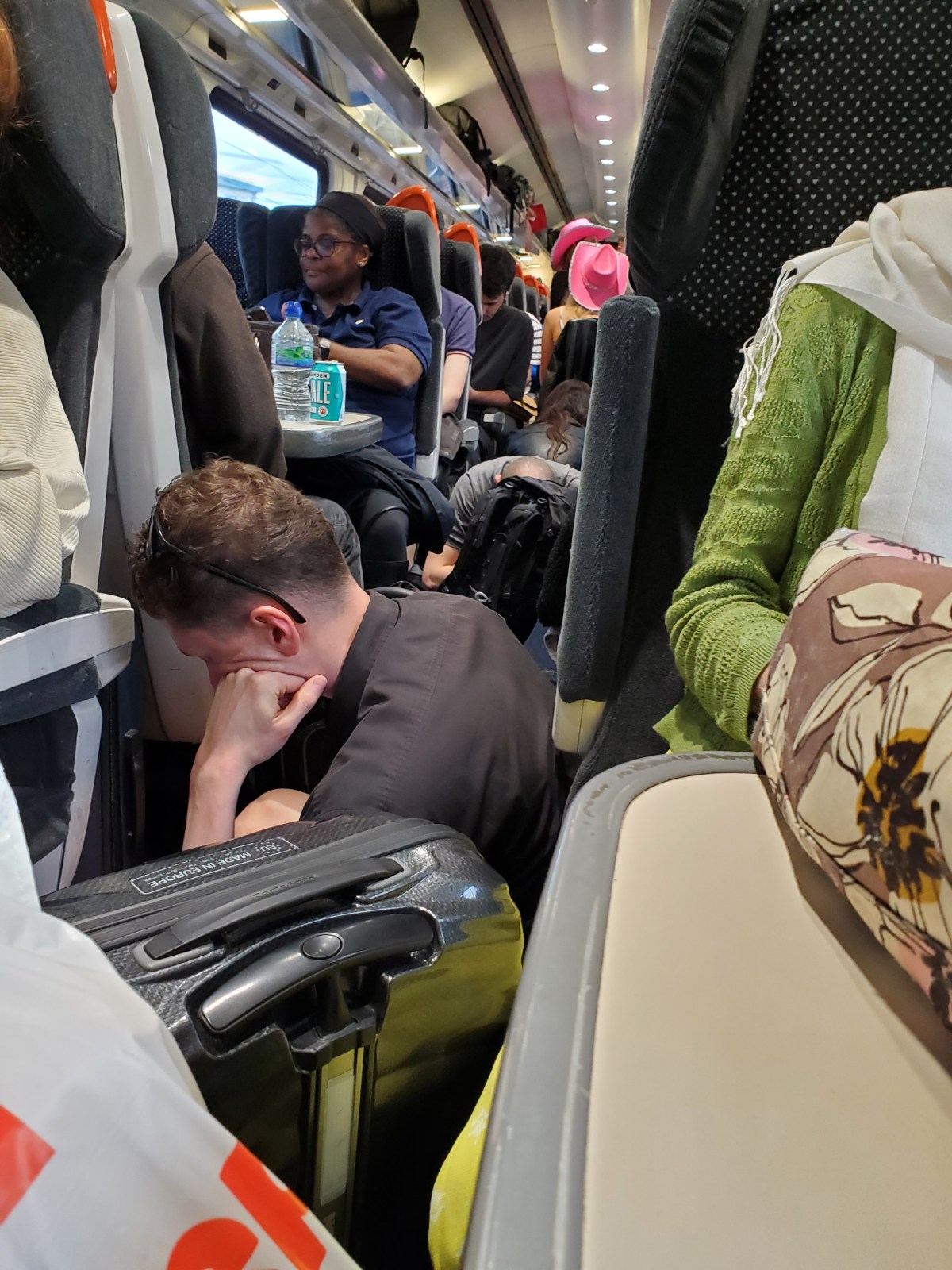
Following another wait, we managed seats on a direct train to London, even snagging unreserved seats in a carriage where 90% of the seats were reserved for some part of the journey. We shared a carriage with far too many others, including a hen party of women in bright pink cowboy hats and some bloke directly behind us who apparently had been in a stage production of “Shawshank Redemption” because he wouldn’t shut the fuck up about it.

Although this train journey was crowded, it didn’t compare to the trip we took last summer from Belfast to Derry, full of fans from the North who were travelling to Croke Park to root for their favorite hurling teams. People were jammed into the carriage with little room to move. Again, we all managed seats, and Declan and I shared Moretti beers with a couple of hurling fans who had come prepared.

Nearly 10 hours after we started (and five hours later than planned), we finally reached our hotel, tired but ready for our next European adventure.

You’d think at this point that our travel troubles would be over. But we also didn’t know that various train operators were planning an industrial action (British for labor strike) for various days next week. Given our travel luck so far, there will be more to this tale soon.