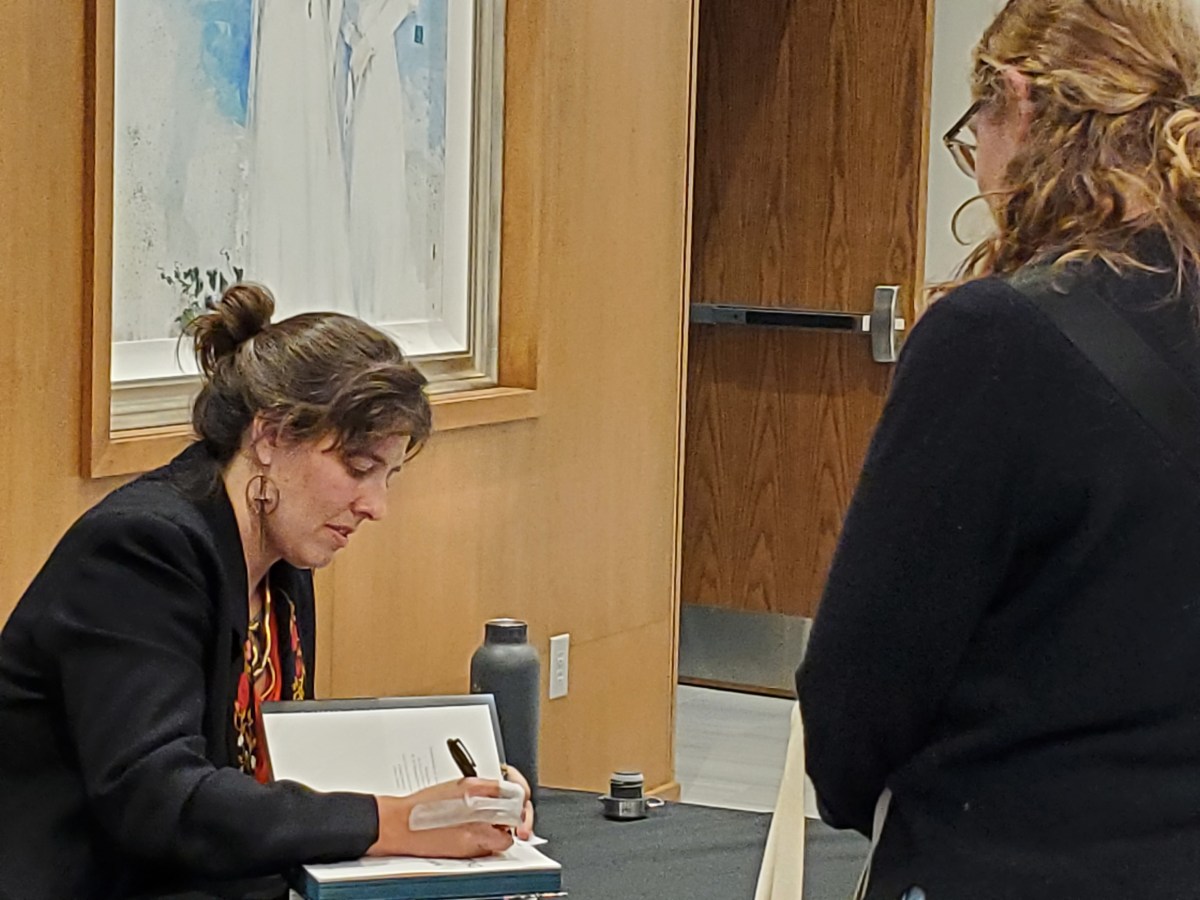
It took an overnight trip to Chattanooga to see one of my favorite authors, Alix E. Harrow, promote her latest novel, “The Everlasting,” to make me realize that I’m a fanboy, pure and simple. There was no other reason for the trip: no business conference, client interaction or friends to visit. The trip consisted of a two-hour drive either way, a night in an Airbnb, a bento box at a local Japanese restaurant and being one of the few male faces in a crowd of about 150 people.
Why didn’t I realize this before?
You would have thought that flying to Washington, D.C. — twice — to see my favorite Radio Paradise artists Vienna Teng and Elbow perform would have been a huge clue. But hey, in D.C., we get to see friends and the occasional historic site.
Maybe staying up late on a Friday in New York after Marilynn gave a talk at Columbia University’s Irish Studies Seminar to see our favorite Irish band The Prodigals would have provided that spark of recognition. When Declan was small, we drove from Atlanta to Tampa to see The Prodigals, but the fanboy thing didn’t some up because we visited family. In other words, just part of a vacation. Same thing when we saw them in Chattanooga several years ago (Tennessee Aquarium) or drove four hours to see Mindy Smith at City Winery in Nashville (friends).
The biggest clue should have been last year when Marilynn and I interrupted a trip to Oxford, England, to travel to Birmingham overnight to see Elbow for the first time before returning to Oxford. You can read about that adventure here.
I can’t remember whether the fanboy recognition manifested itself while fighting rush-hour traffic in Chattanooga, trying to follow the accurate (yet confusing) directions to the flat or realizing that this could have been an out-and-back day trip. But it did.
In some ways, I guess we’re all fanboys (and fangirls, naturally), whether that be Irish literature (Marilynn), all things football (Declan) or favorite bands (and spas, definitely spas of both the clothed and textile-free kind — me). My family definitely are fans of travel, especially in Western Europe or visiting friends in Ireland, Northern Ireland, England and Scotland.
What gets you excited probably doesn’t work for me, and vice versa. And that’s perfectly fine — as long as what you’re into isn’t illegal and doesn’t impinge on the enjoyment of those around you. Despite the travel time and overnight nature of the visit, I’m glad I made the trip. It was nice to support an author I admire and get my book signed. When I told her about driving up from Atlanta, she inscribed my book “to the person who drove the greatest distance.”
Although I appreciate a well-planned trip, I’m particularly fond of those unexpected encounters that turn truly remarkable. And that’s what happened in Baden-Baden.
In between the relaxing spa visits, we had a fair amount of time to kill. Marilynn wanted to visit City Museum, located at the end of the Lichtentaler Allee Park, an expansive greenway that skirts the River Oos. While we were wending our way there, we passed Museum Frieder Burda, which was advertising a temporary exhibit by Richard Pousette-Dart.
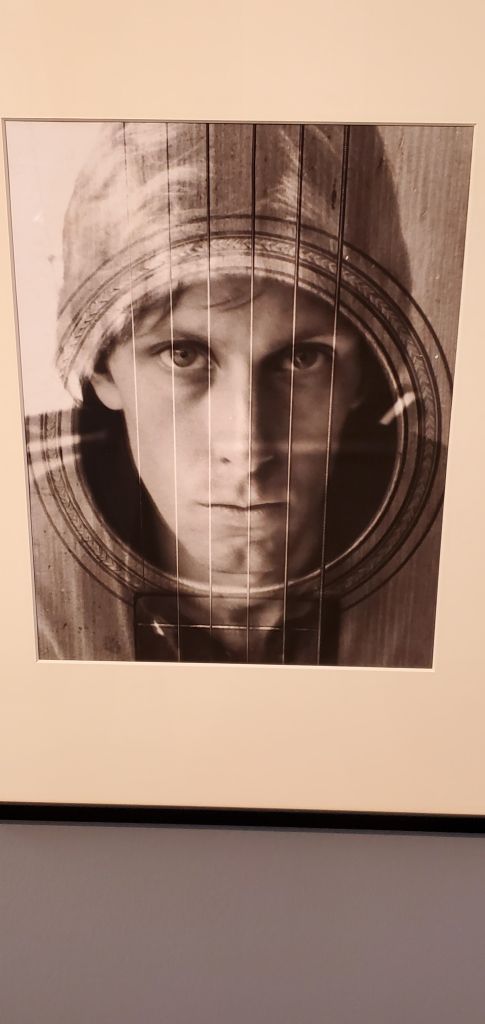
Jon Pousette-Dart
I knew virtually nothing about the artist, except that his son, Jon, founded a rock band in the ‘70s, the aptly named Pousette-Dart Band. One of my siblings had their 1977 album “Amnesia,” and I still remember the lyrics to the title track and my other favorite “County Line.”
We finished up at City Museum, and I suggested we visit Frieder Burda to see the Pousette-Dart exhibition. I don’t like to waste money and tickets were 15 Euro each, but we took a chance. All I can say is, “Wow!”
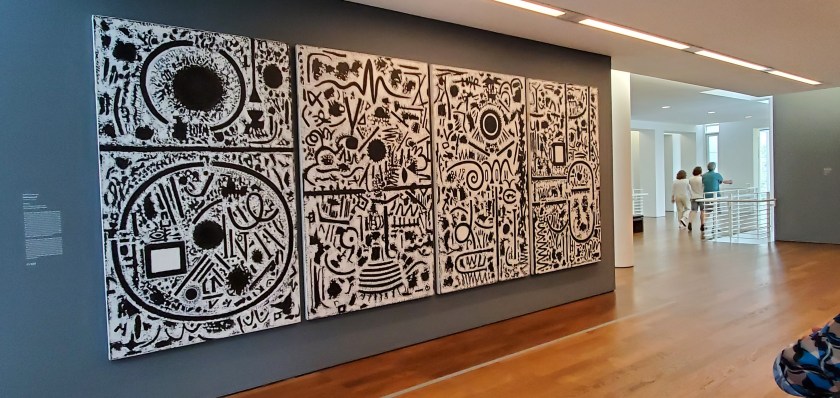
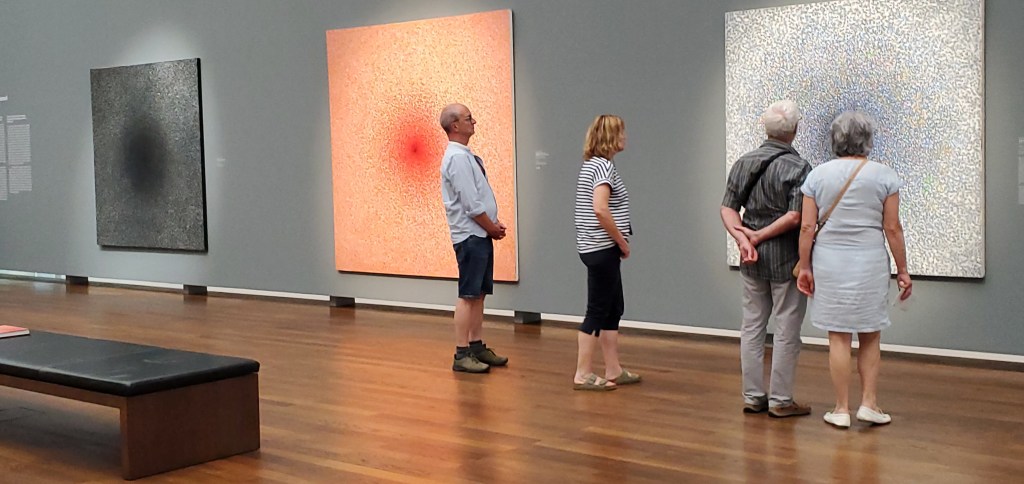
The entire museum was given over to more than 140 pieces of his art, which is mainly abstract and impressionist. However, he was also an accomplished photographer, sculptor and metal worker. Pousette-Dart is mentioned in the same breath as Jackson Pollock and Mark Rothko, fellow founders of the New York School that brought free abstraction to the forefront in the 1940s.
While you can see a few pictures here, his paintings have a depth and vibrancy that photographs cannot convey. I audibly gasped after turning a corner and glimpsing a gallery of black-and-white abstract art.
If you get a chance to see any of Richard Pousette-Dart’s art in person, go, just go. You will thank me.
About the museum: Frieder Burda was a German publisher and art collector who lived in Baden-Baden. The museum was designed by Richard Meier, who won a Pritzker Architecture Prize in 1984, the year after the Meier-designed High Museum in Atlanta opened. I knew immediately the designer was the same, because both museums feature circular, off-white ramps between floors.
Alsatian Cuisine and Cathedrals in Strasbourg
After Baden-Baden, we popped over to Strasbourg, France, for two days. I’m not sure whether it was the fourth week of our trip or the fact that it was nearing the end, but we didn’t do much in the city besides partake of the cuisine. Marilynn enjoyed her city tour, but I ducked out after about 10 minutes, preferring a nap to history.
But from my minimal history lesson, I did learn that Strasbourg Cathedral was the tallest building in the world for more than two centuries until a taller German church opened in 1874. The Great Pyramids long held the title, but the removal of the limestone casings at the top for other building projects over the millennia and inevitable erosion shortened the pyramids by 26 feet.
The cathedral is truly impressive both inside and out, although our free visit to the interior was cut short by a mid-day shutdown we didn’t anticipate.
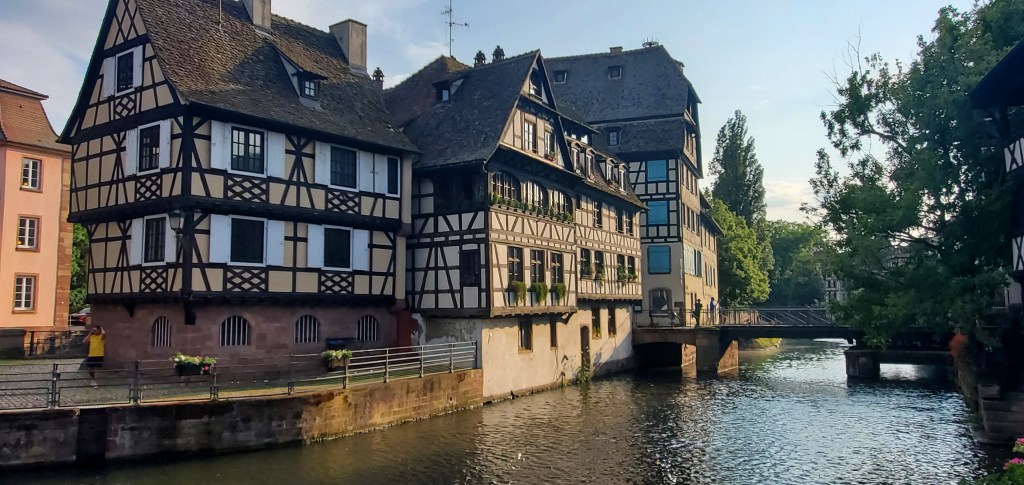
Marilynn tells me that the region moved freely between French and German influence throughout the centuries, reflecting design features from both cultures, including half-timbered houses that would be totally at home in Bavaria.
But there was food, glorious food to consume. We particularly enjoy French pastry, so Marilynn hunted up breakfast at a local patisserie each morning, returning with a heaping bagful of flaky goodness that cost less than $10. Our hotel wanted 20 bucks a head for what I’m sure was an inferior meal.
Because of my onion allergy, I couldn’t partake fully in the Alsatian dining experience, although I did grow to enjoy a cold glass of Alsace pinot noir, the only red grape allowed to be grown in the region best-known for white wine varieties. At La Fignette, Marilynn had the beef bourgignon (made with local pinot noir), while I had a hamburger. We both enjoyed lunch at Le Troquet des Kneckes, part of a small chain of 10 bars, restaurants and a hotel(!) in Strasbourg. And I contented myself with a meat-and-cheese platter at a restaurant we found along the waterway.
Visit Mainz for Chagall Stained Glass
Georgia State University has reciprocal agreements or partnerships with 16 European universities, including Johannes Gutenberg University of Mainz in Germany. Two of Marilynn’s colleagues were based at the university in the spring, so we added an overnight stay in Mainz, about a 30-minute train ride to Frankfurt, where we would fly back to Dublin before returning home.
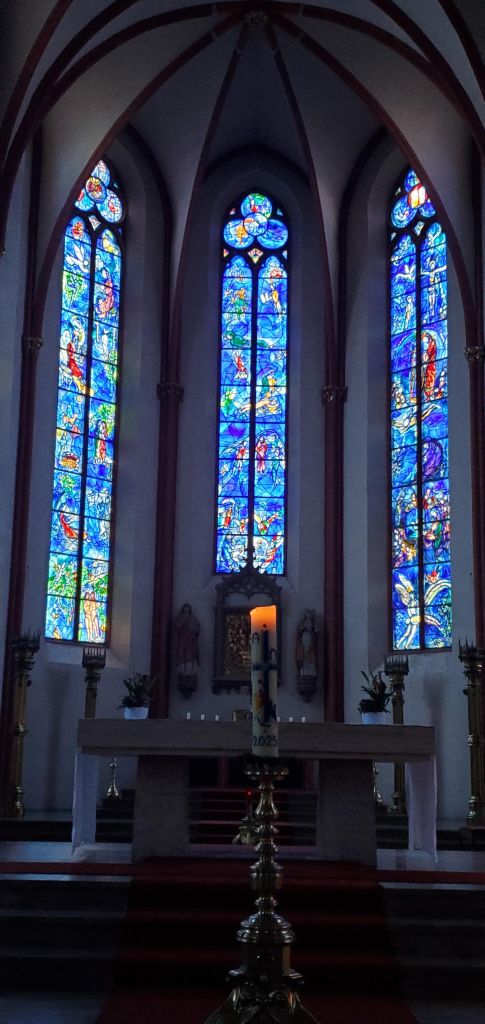
Unfortunately, her colleagues were out of town when we visited. But we stayed one night anyway, mainly to trek to St. Stephen’s Church to glimpse the exquisite stained glass windows created by Marc Chagall, best known as a modernist painter. Those windows were, in a hyphenated word, breath-taking, as soft, blue light filtered into the sanctuary while afternoon gave way to early evening.
It was quite a hike to get there from our hotel, but definitely worth the effort. Another successful European odyssey complete, we were more than ready to get back to Atlanta.
“You know, this is the naked spa,” the German woman said to Marilynn and me in perfect English. While she probably spoke perfect English anyway, I like to think her flawless pronunciation was the result of having to remind dozens of tourists during each shift that the Friedrichsbad spa in Baden-Baden, Germany, is what they call “textile-free” every day except for Wednesday and Saturday.
The swimsuit option only became available last summer, because the Victorians bathed au naturel, just like God intended. There are no separate rooms (or days) for men and women. You drop 38 Euro for the privilege of dropping trou and getting your 17-station Roman-Irish bathing experience on. The apparent highlight is the soap and brush massage where someone soaps your body for 10 minutes. Those slots fill up quickly, though, and getting naked in front of other people was adventure enough for us.
And it was an experience that everyone should try, at least once.
Relaxation (and nudity) await at Friedrichsbad Spa.
Getting Beyond the Buff
During our first trip to Baden-Baden in 2023 with Declan, we enjoyed a fantastic, relaxing day out at Caracalla Spa, which shares ownership with Friedrichsbad. We knew the latter spa was “textile-free,” and there was no way we’d be doing that with our then 18-year-old. Because I’m a bit of a smart arse, I even made up my own German word for textile-free bathing: “donge-swingen.”
At that time, I said it wasn’t for me. But two years older and with no son in sight, Marilynn convinced me to give it a try. Although the naked part did take some getting used to, it was a truly relaxing experience, and I slept better that night than I had in a long time.
After paying for your experience, you don a plastic wristband that opens your locker and doff everything else. In your locker, you’ll find a “towel” that feels more like a white tablecloth and that could have encircled me twice. After an initial shower, you leave the tablecloth behind and get a pair of flip-flops to wear as you walk among the relaxation stations.
You don a plastic wristband that opens your locker and doff everything else.
In each room, you’ll see a sign that tells you how long you’re supposed to spend for maximum benefit. The recommended time for the whole circuit is three hours. Because the clock was far away and my eyesight is near, I should have brought the stopwatch I use to monitor my sauna time, which was back in our hotel room. You move from dry heat to wet heat: saunas, whirlpools, plunge pools, and something I called the “cold-as-hell frolic pool,” which is probably the closest to sea bathing I ever want to get. We did stay for the recommended time in that pool, though, splashing around to ward off hypothermia.
We did skip one of the last stations, a large room filled with what looked like massage tables, where we were supposed to stay, lying down, for 30 minutes. After a final shower, you get another tablecloth and the opportunity to lotion up (no kidding) before spending time in the reading room, where you can enjoy a hot beverage in a chaise lounge while perusing a very limited number of magazines, mainly in German. One guy (of course it was a guy!) didn’t get the memo to wear a tablecloth. Also of course, he was the one who walked back and forth several times getting successive cups of tea.
Caracalla Spa at night
Maybe ‘Donge-Swingen’ IS for Me
Even before writing this blog, I had already compiled a short list of pithy things I wanted to say, including that I saw more bush than in a botanical garden and more dong than you’d glimpse in a handbell choir. The reality, however, was very different. Because the recommended experience takes three hours, the spa halts entry three hours before closing. We got there 30 minutes before that time and experienced the spa with fewer than two dozen other people. The nudity thing became a non-issue by the time we entered the second room (apart from that dude in the reading room).
Quick side note: Designed in Renaissance style, the Friedrichsbad opened in 1877, as part of Baden-Baden’s effort to find a new tourism avenue to replace casino gambling, which had been outlawed in the country. The bathing style replicated that developed in the 1850s by a physician in County Cork, Ireland, for health and relaxation. Dr. Richard Barter opened the first such spa in 1856 near Blarney (and no, I didn’t make that up).
We book-ended our visit to the Friedrichsbad with visits to the fabulous Caracalla Spa next door, where you can enjoy the thermal baths wearing as many swimsuits as you’d like — except for upstairs. Because Caracalla’s textile-free areas are mainly saunas, which Marilynn doesn’t particularly enjoy, we kept our bathing suits on.
Our first week, in Ulster, was the prelude to the main event — two weeks in Dublin. For Marilynn, that meant going to the National Library of Ireland from 9-5 on weekdays (plus one Saturday morning) and conducting archival research on the Brian Friel play “Faith Healer.”
My days were filled with grocery shopping, occasional work, laundry, general housekeeping and finding a gym. The first gym I researched wanted 100 Euro for a month. The gym recommended by our host was in a hoity-toity hotel that made the 150 Euro offer they made me for two weeks sound like a great deal. On my own, I found a gym at a nearby Clayton Hotel, which features a clean and uncrowded five-lane pool, a steam room, sauna, whirlpool and a large gym with machine and free weights, exercise bikes and other workout gear.
For those over 55 (and yes, I qualify — barely, he says with a straight face), it was only 46 Euro a month. What’s more, that was prorated to the 5th of the month, so it was only 25. I went every day except for a particularly blustery Saturday morning, making my daily outlay less than I’d pay for a cup of tea.
All good trips in Dublin start with a train trip!
2.5 Degrees of Separation — Tops
But Marilynn’s work schedule still allowed for a bit of fun. On the first Sunday, we dropped our bags at our flat near Grand Canal Dock and hopped a train to Dún Laoghaire to see a Rough Magic/Gate Theatre production of “The Loved Ones” by Erica Murray.
While trying to find the theatre, we heard someone calling Marilynn’s name (it happens so often here, I’m no longer surprised). An American academic from a liberal arts school in Virginia had brought a Maymester class to see the show, which included a pre-show talk by the playwright and the director, and she recognized Marilynn. Of course, we were invited to the talk. After 25 years of visiting the island, I’ve learned that the 6 degrees of separation we’re familiar with in the U.S. is more like 2.5 degrees in Ireland, especially if you’re married to an Irish literature scholar.
We also caught up with Lynne Parker, co-founder and longtime artistic director of Rough Magic. She’s the niece of the late Belfast playwright Stewart Parker (Marilynn’s second book was a critical biography of him) and a great friend. In fact, she was the first person connected with Marilynn’s research I ever met, in spring 2000 in Washington, D.C., when Rough Magic brought a production of Parker’s “Pentecost” to the Kennedy Center.
Rough Magic is at the forefront of bringing new plays to the stage and mentoring emerging talent across theater disciplines. The company commissioned the play, and the director honed his skills with the company.
Dublin Castle
Dublin Castle, EPIC, and the Custom House
To be honest, we didn’t get out much, a combination of Marilynn’s work and our familiarity with Dublin. Most of the things we wanted to see we’ve already seen. We ate out more than we should have, especially at Yoi Ramen, a block from our flat. We also found a new local at Slattery’s, which serves beautiful pints amid a friendly, welcoming atmosphere.
On a dank Saturday afternoon, we toured Dublin Castle, first constructed in the 13th century and long the headquarters of English and British administration in Ireland. It’s not a castle in the traditional sense, but large public buildings that have been in constant use for centuries.
A guided tour grants access to the underground areas of the expansive building. The confluence of the Poddle and Liffey rivers formed Dubh Linn, or “black pool,” where Dublin later derived its name. The Poddle flows north to south, mainly underground, and was once part of an expansive moat that surrounded Dublin Castle.
One of the more famous employees of Dublin Castle was Bram Stoker, best known for his Gothic novel “Dracula.” His first published book, “The Duties of Clerks of the Petty Sessions of Ireland,” was based on his experiences as a civil servant there. Even he admitted that one was boring.
Visitors on the guided tour also see the Chapel Royal, a small Gothic Revival church opened in 1814 and designed by Francis Johnston, who also designed the General Post Office. Over its history, it has been both a Protestant and Catholic worship space, but it has been deconsecrated and now hosts community events and concerts.
The tour also visits the State Apartments, open to the public. Highlights include Saint Patrick’s Hall, where Ireland’s presidents are inaugurated, and the James Connolly Room, where the injured and near-death leader of the Irish rebellion in 1916 spent his last days (the building was a hospital then) before being taken to Kilmainham Gaol and executed.
I also visited EPIC, The Irish Emigration Museum founded by Neville Isdell, a former chairman and CEO of The Coca-Cola Company – so it does have an Atlanta connection. The basic premise is that Irish people are everywhere.
Maybe it’s the extensive travel we’ve done in Ireland or the lack of actual exhibits, but EPIC doesn’t do it for me. However, I may be in the minority — the venue was supposedly rated Europe’s top tourist attraction between 2019-2021, and it has a 4.8 rating on Tripadvisor. I do appreciate that there are free public toilets in the center where EPIC is housed, however.
I also had a peek inside the Custom House Visitor Centre (top photo). At the time of our trip, tickets were free within 48 hours of visiting Dublin Castle or heavily discounted with a receipt from EPIC. If you’re an architecture buff, the Custom House should be near the top of your to-visit list. Designed by James Gandon in 1791, it served as the import/export portal for Dublin for over 100 years. The building was heavily damaged by fire in 1921 during the Irish War of Independence but later mostly rebuilt. Exhibits in the center encompass the building’s history and presentations related to the war of independence.
If time is limited, you can certainly glimpse the grandeur of the building for free. Pay close attention to the 14 figurines carved into the building’s keystones. They represent Ireland’s rivers. You can also see where the dome is differently colored from the rest of the building. The dome was rebuilt after the war, using local stone instead of the Portland stone used during initial construction.
Following the conclusion of the Dublin leg of our journey, our adventures next take us to Germany and France.
Old friends, new sights, Irish-famous and not-so-Irish-famous folks and the unlikeliest reality TV star you can imagine.
Another summer, and another Irish adventure for Marilynn and me. She received a grant (two, actually) to conduct research in the National Library of Ireland, and we bookended those two weeks with a week in the north and a week in Germany and France. Declan is home this time, getting work experience as he moves closer to completing his Business degree.
We landed in Dublin on our 24th wedding anniversary. After a quick breakfast and the purchase of Dublin travel cards, we caught a bus for Belfast, which delivered us to Belfast Grand Central, the new multimodal facility that replaced the Europa Bus Center. It certainly is grand, but the facility is blocks from the main street, and the toilets are as far as possible from the bus and train bays. I’d hate to be a disabled person in Belfast.
Rediscovering Derry
Not any men’s room, but a good-looking and good-smelling men’s room in Derry. Believe, me, they are a rarity on the island.
After recovering for two nights in Tara Lodge and walking the streets of my adopted second hometown, we rented a car and headed to Derry, a 90-minute drive along (thankfully) good roads. We stayed with friends who happen to own a B&B, but they are in the process of retiring. They had just returned from five months in Malaga, and this will be their last year as hosts.
While in Derry, we enjoyed starters and pints at Trinity Pub, which I declare has the cleanest and sweetest-smelling toilets on the island. We also reacquainted ourselves with the historic Guildhall and walked Derry’s historic city walls. The following morning, we visited the Tower Museum, which traces Derry’s story from medieval times to the present.
The museum recently installed a multiroom “Derry Girls” exhibit that I bet stays there for many years. While we thoroughly enjoyed the program, I’m good-naturedly miffed that the show’s third series won the Ewart-Biggs Memorial Prize, which recognizes works that promote peace and reconciliation in Ireland. Marilynn’s book “Getting to Good Friday” was one of six on the short list for the award — and she was the only non-European nominated. But if you have to lose, who better to lose to than Derry Girls?
Exploring Ireland’s Past at Ulster American Folk Park
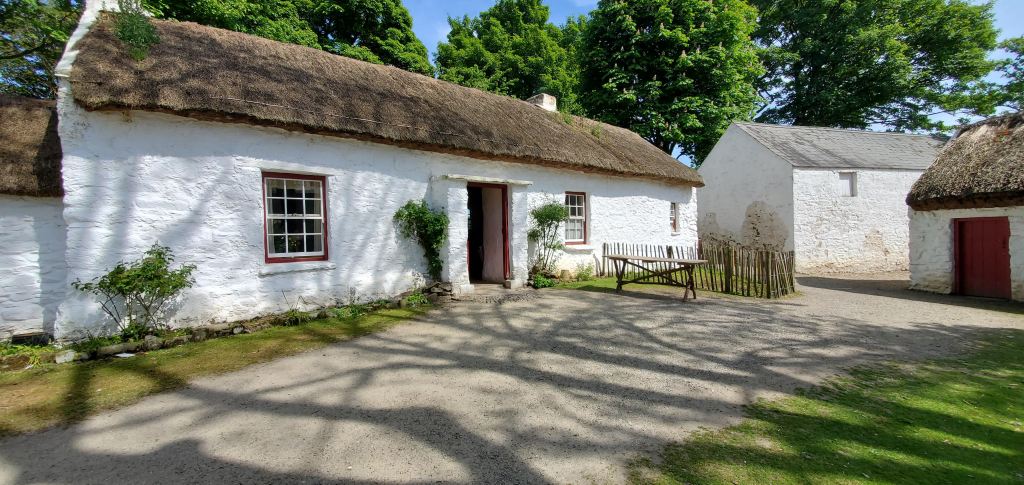
Mellon farmhouse at Ulster American Folk Park
While we’ve visited the Ulster Folk Museum just outside Belfast several times, we hadn’t been to the Ulster American Folk Park near Omagh before this trip. The concept is similar — exploring Ulster’s past through historic buildings — but the Folk Park takes a linear approach, from oldest building to newest, including an “ocean voyage” that brought immigrants to America. The park was developed around the birthplace of Irish-American banker and lawyer Thomas Mellon, founder of the Mellon banking dynasty (which remains in its original location).
We were surprised to learn that people (even the rich ones) slept upright, which is one reason why beds from olden times look so short. Poor people wanted as many kids as possible, even hanging fertility charms above the single bed in a one-room shack. How Mom and Dad found time, energy and privacy to make so many kids is puzzling, but the knowledgeable docent in the first dwelling assured us that procreation didn’t have to happen in a bed.
To access the American part of the park, you enter a large wooden building and “board” a replica immigrant ship. On the journey to Ireland, the ship transported goods for sale or trade. For the return journey, rough bunk beds were constructed belowdecks, where passengers were expected to remain for the duration of the journey. You were fed once a day and had to rely on provisions you brought with you the rest of the time. Sunshine? Forget it. Toilet? Try the bucket on the floor. No wonder they were called “coffin ships.”
After passage to the American side, you will find mostly buildings transported from the States, including an 18th-century stone house, a log cabin and a house from Pennsylvania, a West Virginia farmhouse and a Tennessee brick plantation house. The latter’s bricks still show marks where they were carefully numbered, disassembled, transported to the Folk Park and painstakingly reconstructed.
Castle Ward Without Game of Thrones Connotations
View of Portaferry from Strangford Lough car ferry
That night, we stayed in the Goldenhill Guesthouse, a B&B with beautiful views about four miles outside Omagh. After a frustrating day sitting in a traffic jam caused by an overturned cattle lorry (can’t they just shoot the cattle and eat them?), we made our way to Castle Ward, a National Trust site best known as representing Winterfell from Game of Thrones.
When we lived in Belfast in 2017, we tried to visit Castle Ward several times, but it was always closed for filming. So we count ourselves lucky for a chance to visit the historic house (although we did not make it to the older part of the grounds where GoT was filmed).
From an architectural standpoint, the 18th-century building reflects the differing styles of the owners. The husband’s style was classical Palladian, while the wife preferred Georgian Gothic. The differences are evident throughout the building, which is split in two by those styles. The husband’s preferences won out on the entrance side of the building, while the wife’s Gothic touches can be seen from Strangford Lough, which the back of the building overlooks.
The most interesting factoid from the house tour was the “cat pantry” on the lower level, next to the wine cellar. During the day, dozens of cats were kept in the pantry. They were let out at night to catch rats, then lured back to the pantry with food early in the morning. Of course, a scullery maid was responsible for cleaning the cat pantry daily at a time when a litter box was unthinkable.
Our penultimate night in the north was spent in Portaferry, which we reached via a small car ferry — my first time taking this particular form of transportation.
Visiting Friends the Main Reason for the Journey
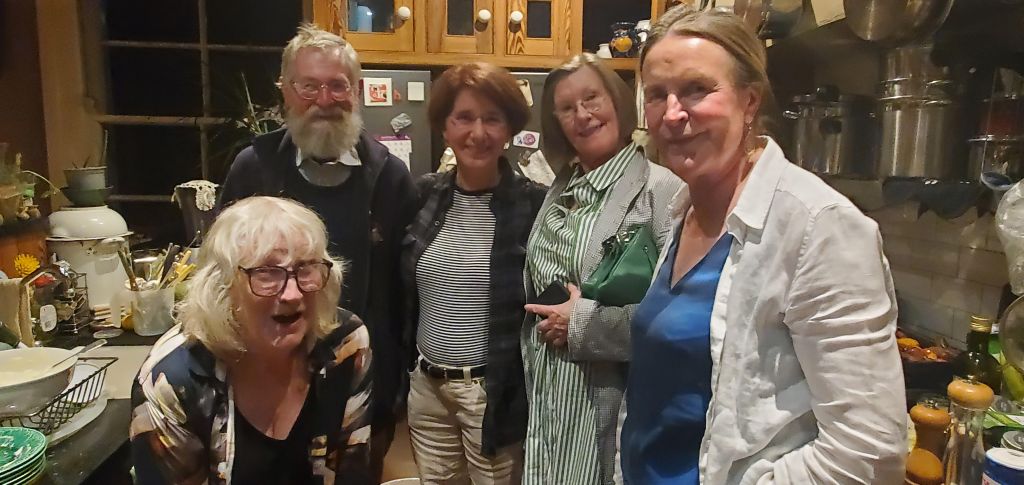
Joanna (from left), Marcus, Mary and Eileen with Marilynn
At each stop along the way, we visited friends, some of whom Marilynn has known for decades. She’s known our Derry friends since the last ‘80s, when she researched her first book in the formerly war-torn city. Friends from Belfast we shared dinner with on our last night date from her work on Belfast playwright Stewart Parker. We also visited colleagues and writers including playwright Anne Devlin and novelist David Park, whose new novel “Ghost Wedding” was released in May to positive reviews.
The most surprising visit was with our friend Eileen. We met her in 2017 and became fast friends, enjoying great adventures such as glimpsing puffins and seals on Rathlin Island and a weekend visit to National Trust properties including the Crom Estate, where I got to drive a boat for the first time. It was a big deal for me — trust me.
Anyway, she casually mentioned that she was currently on an RTÉ One reality show called “Super Garden,” where a handful of gardeners compete for fame and glory. She’s always been an avid gardener and recently completed a horticultural degree. She applied for the competition as part of the degree process, never imagining she would be chosen. When we lived in Belfast, there was a nearby road named Eileen Gardens. I took a picture of the road sign and had a metal sign made for her garden.
Bound by confidentiality, she couldn’t tell us whether she had won, but we certainly hope she did for several reasons. One, she’s a fantastic person and probably an underdog. Two, she was the only one whose age features prominently in her profile for the show.
File this under, “No rest for the weary.” Barely a week after returning from our spring break trip to Dublin and Budapest, we found ourselves in New York, where Marilynn gave talks sponsored by NYU and Columbia.
Academic speaking engagements for anyone who’s not a best-selling author are not high-dollar affairs. In fact, they’re usually no-dollar affairs, apart from the occasional hotel room, a train transfer, or a meal after the talk. I compare it to the itinerant educators who traveled from rural village to rural village, sharing ciphering and basic reading skills in exchange for a bundle of carrots, a few potatoes, perhaps a chicken — enough sustenance to get them to the next village.
In New York, however, Marilynn received enough for a fine meal. Airfare. Two nights apiece in Greenwich Village and the Upper West Side. Chauffeured car to/from the airport and several meals. Of course, I accompanied her to explore parts of New York we hadn’t seen yet, visit friends, and bask in the glow of her considerable accomplishments.
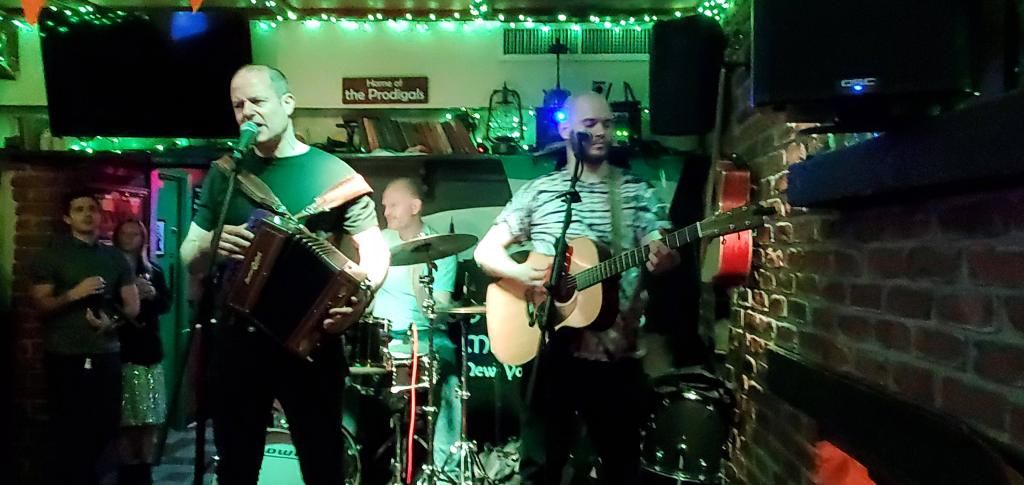
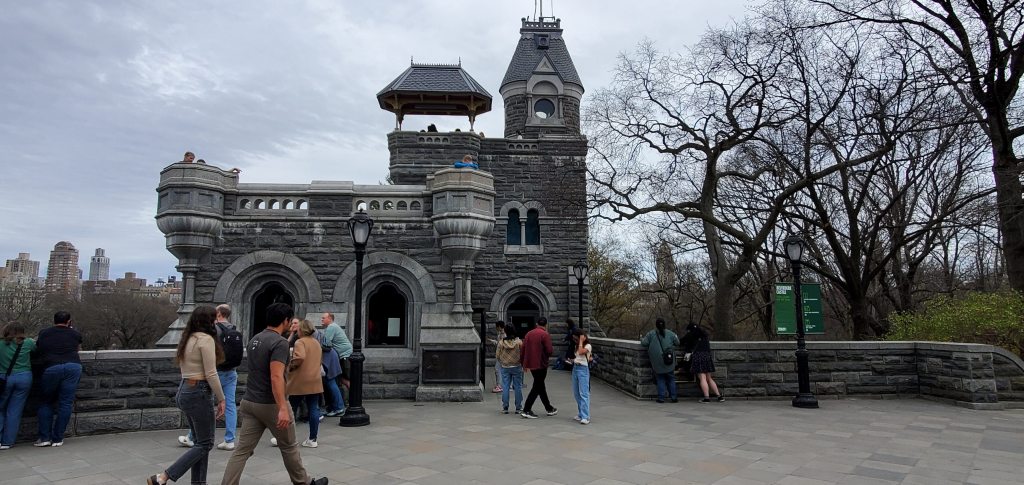
StonewallThe ProdigalsMarilynn with her bookBelvedere Castle
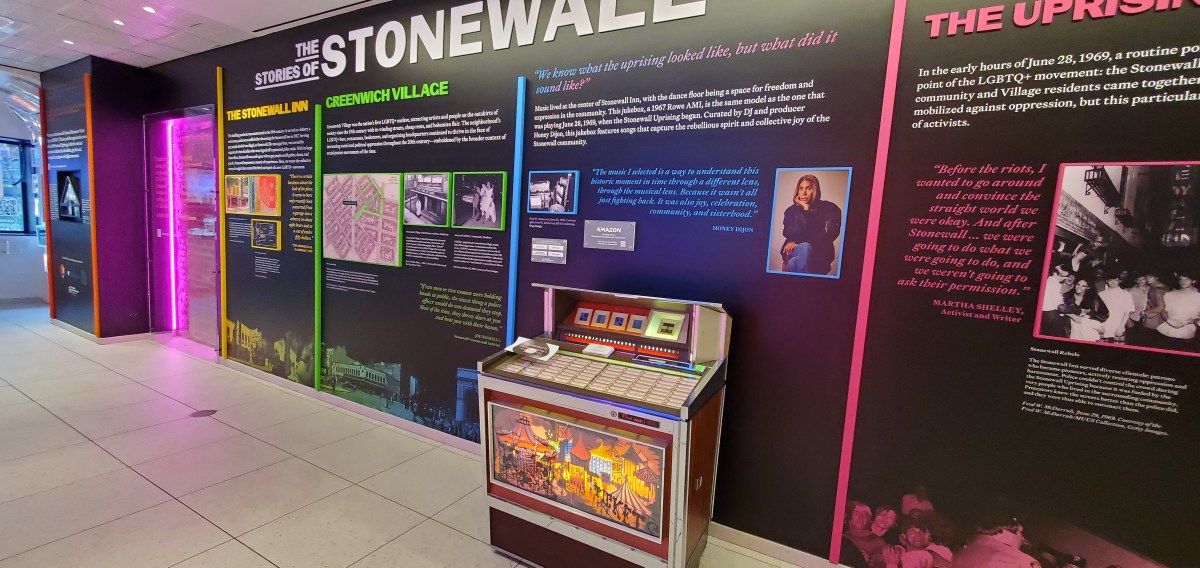
Our first stop was the visitor center at the Stonewall Inn, site of the 1969 riots that eventually led to greater rights for the LGBTQ+ community. Fortunately, the visitor center is not administered by the National Park Service, where mentions of trans people have been scrubbed from its website. It would be impossible to understand Stonewall without mentioning trans woman, because they led the protests.
We also spent an hour or so in Central Park, wandering along the paths and visiting Belvedere Castle, built on a high point where visitors can look over the park and surrounding environs.
Marilynn’s talk at Glucksman Irish House at NYU was well-attended and led to many lively discussions afterward. Following her talk to the Columbia Irish Studies Seminar at the CUNY Graduate Center, we decamped for a meal and conversation at a nearby Irish pub, leaving just in time to walk to Paddy Reilly’s Music Bar, where we caught two sets by our favorite Irish band, The Prodigals, who have been a weekend fixture at the bar for 25 years. If you’re ever in New York, hearing The Prodigals live should top your to-do list.
A highlight of Sunday was attending a matinee performance of “Gypsy.” Marilynn is fond of Stephen Sondheim’s, and I go ga-ga for Audra McDonald, so it was a perfect fit. It’s interesting to note that “Gypsy” was the first full production staged at the Majestic Theatre since “Phantom of the Opera” closed in 2023 after nearly 14,000 performances spanning 35 years.
The play was fabulous, made more so by the hundred or so members of Jack and Jill of America, an organization of African-American moms who promote cultural, educational, and civic awareness among their children and the community at large. Fortunately, I love the strong women in my life, so I fit right in.
Last year, we attended our first Broadway show, an overlooked Sondheim musical called, “Merrily We Roll Along,” which had not been on Broadway since its debut in 1981. Unlike the original staging, the revival was a smash hit, earning Tony Awards for best musical revival, orchestration, and lead actors Jonathan Groff and Daniel Radcliffe, best known as Harry Potter. We filled the rest of our time visiting academic friends and colleagues, former students, and even Marilynn’s sister, who was in town with her daughter to visit her son who works in the city. We enjoyed an activity-packed five days, although we were certainly glad to return home.
After Marilynn and I saw three cabs full of Georgia State students and their baggage off for Dublin Airport, we started the second part of our journey — a spa trip to Budapest.
Marilynn promised me a spa vacation after the spring break trip, and our initial thought was to return to Baden-Baden, where we spent a glorious day two years ago. However, Baden-Baden is well off the beaten path, and German trains aren’t as timely as they’ve been in decades past.
She settled on Budapest because: a) the city has spas; and b) Aer Lingus flies there direct from Dublin.
Aside from the above, I had no impression about the Hungarian capital before our visit. After 72 hours there, I was taken with the superficial beauty of the city and the promptness of the expansive public transportation system that includes old-timey trams, new-fangled trams, buses, and several subway lines.
It’s like knowing a beauty queen who loves refried beans and farts prodigiously.
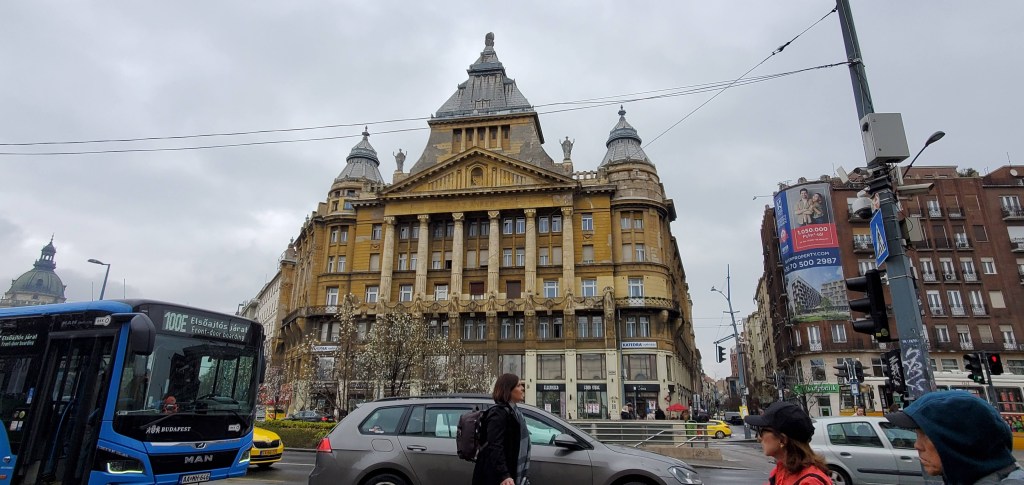
From a distance, the city is gorgeous. The Danube meanders between the former cities of Buda and Pest that rise majestically on either bank. We stayed on the Pest side, a stone’s throw from one of the many bridges that connect the cities.
During a walking tour of Pest, our guide revealed an unseemly underside of the city. When it was officially formed in 1873, civic leaders wanted to build a grand European city. However, they didn’t have European city building materials like granite and stone. So they built brick facades covered with stucco, which would be fine except that lack of maintenance is causing pieces of buildings to fall to the streets below, sometimes striking cars and pedestrians. Our guide had a large scar on her forehead from falling debris.
It’s like knowing a beauty queen who loves refried beans and farts prodigiously.
A Tale of Two Baths
Speaking of farts, the thermal baths we visited were reminiscent of Tampa Bay, which reeks like sulphur — albeit in a therapeutic way.
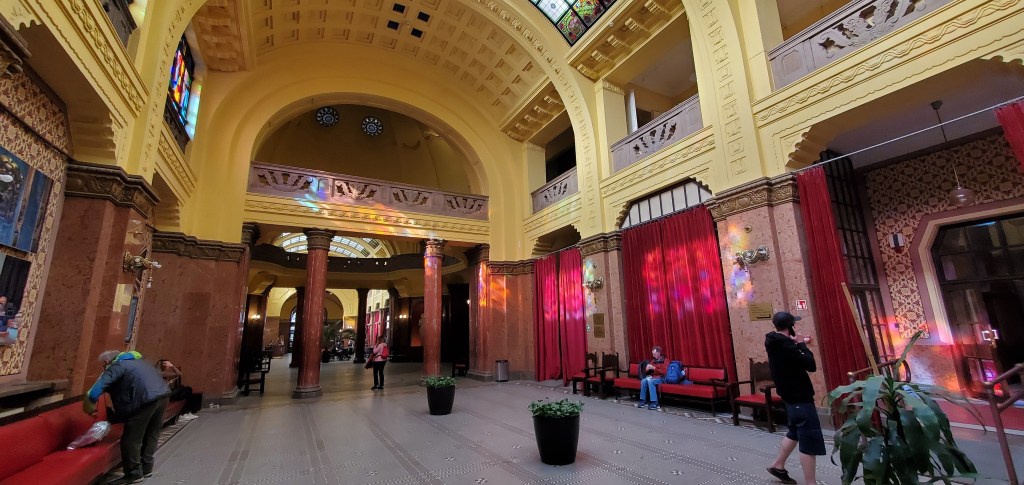
We first visited the Gellért Thermal Bath, a short tram ride across the Danube. Built in Art Noveau style in the 1910s, the baths were damaged but rebuilt after World War II and extensively remodeled in 2008. Tales of Gellért’s healing waters date to the 13th century. It features swimming areas, soaking areas, and saunas in a grand building that’s like a maze to navigate between areas. My fitness tracker wouldn’t attach to my bathing suit, but I must have walked a couple of miles trying to find my way around. We particularly enjoyed the outdoor soaking area, where we had an extensive conversation with a group of Canadians who were also visiting the city.
The following day we visited Széchenyi Thermal Bath, located several miles from the city center and near the zoo. It’s known as the largest medicinal bath in Europe, with a special soaking area for those with medical prescriptions. The huge outside area features a lazy river and several spouts where water cascades over what ails ya. This spa was built during the same period as Gellért, albeit in a Neo-Baroque style. Indoors are 15 soaking and/or swimming areas and several saunas. For those wishing to go “textile-free,” there was one sauna called Phoenix. Since we had no desire to see anything rising in there, we gave it a pass.
We easily could have spent more than a week visiting two spas a day throughout Budapest, but these were the largest and most representative. And although I enjoyed both experiences, I’m still eager to return to Baden-Baden and the Caracalla Spa.
I’ve been to Ireland so many times that I’ve lost track. Tough problem to have, I know, but there always seems to be something new to see or do.
This year, during Georgia State University’s spring break, I had the pleasure of accompanying Marilynn and 12 undergrads for five intensive days in Dublin on a James Joyce’s Dublin study abroad program. They had read “Dubliners,” “A Portrait of the Artist as a Young Man,” and two episodes of “Ulysses.” My unofficial job was mainly to count heads and make sure everyone was walking in the right direction or got on the right luas (tram).
For me, this experience recalled the first time we brought our sons to Ireland, although 12 times more intense. About half the students had never been out of the country, and none of them had been to Ireland.
Dublin is fairly compact, with a great interconnected bus/tram/train system that makes travel simple—especially if you have a transportation pass, which we all did. Jitters and general unease among the students about navigating a foreign city quickly gave way to groups of students shopping, attending a drag show, visiting bookstores, and shopping. Yes, shopping is mentioned twice, because that’s what most of them did during their free day.
Here’s a sampling of what we did:
Guided tour of the GPO Museum, headquarters of the Easter Rising in 1916. By the way, it still serves as a Post Office.
Literary and musical pub crawls (because, why not?)
Dined like locals in the café at Dunne’s department store and by grabbing meal deals (sandwich, snack and drink for about $6) at Tesco
Attended a play (that’s best not mentioned further)
The culminating event of the week was a visit to the Martello tower in Sandycove where Joyce “lived” for six days in 1904. He hated it so much he left in the middle of the night and walked back to Dublin, leaving the country within a month. He only returned to Ireland twice after that, the last time in 1912. He wrote “Ulysses” from memories of Dublin and answers to the pestering questions he sent to friends. The James Joyce Tower is one of a series of towers the British built along the Irish coast in the early 19th century to defend against invasion.
For those who haven’t read “Ulysses,” a scene in the tower opens the book.
Lessons Learned
I learned that students today (especially this group) don’t do much drinking, which suited chaperone Marilynn just fine. She and I definitely downed more pints than the rest of them combined, and a second beer is a big night for either of us. I also learned how to make a Girlie Guinness by adding blackcurrant liqueur to counteract the bitterness of the stout. (Don’t hate on me for the name—that’s what the barman called it).
Unfortunately, the students missed out on two of my favorite parts of being in Ireland: the splendor of the full Irish breakfast that’s only served in fine B&Bs (they could have made their own at the breakfast buffet, but it’s just not the same) and the Irish countryside, which features at least 10 colors of green you won’t find anywhere else.
But they took away fond memories of James Joyce’s Dublin, discovered the thrill of travel, and made friends that will last a lifetime. For Marilynn, it was the culmination of much planning and nearly flawless execution. And for me, hope for the future knowing that the world will soon be in the hands of students like these. While it was the first time visiting Dublin for the students, it won’t be the last time for many of them.
I don’t know whether there is a god for those about to hurl, but I certainly prayed to some deity during a rough, 45-minute ferry ride from Doolin to Inishmore, the largest of the Aran Islands.
After arriving at Shannon Airport, we made our way to Doolin, a frequent stopping-off point for either the Aran Islands or the stunning Cliffs of Moher — or both. Marilynn hadn’t been on the islands since her first trip to the Emerald Isle 35 years earlier, and Declan and I had never been.
We stayed at Fisherman’s Rest, a great B&B run by Danny and Mairead Guerin. Danny was our main host and had adorned the breakfast area with pennants of various, mostly German, football teams. He and Declan had a long discussion about FC Kaiserslautern. We also had terrific meals and pints at Gus O’Connor’s pub, which Marilynn and I immediately recognized from a trip we took with Walker 25 years ago. Walker fell asleep during the music session, and a man named Paddy (naturally) gave him a Euro coin that I still have at home. My mussels were delicious and more than I could eat, so Marilynn helped.
Hurling (and Not the Irish Sport)
The next morning, after a full Irish breakfast and a Dramamine, it was off to the Doolin Ferry for the longest water leg of our trip. We thought we were fortunate to snag topside seats for the journey. The sky was blue with nary a cloud in the sky. Until it started to rain, and the seas began to roil. Or was that my stomach?
I don’t remember much about the trip, except for holding my umbrella just over my head to ward off the worst of the rain; the water washing over our luggage and splashing me; prayers to the anti-puking god; the single piece of someone’s luggage across the aisle I focused on while waiting for this interminable trip to end; the placebo power of many, many antacids; and the overwhelming desire to kiss the ground once we reached dry land.
More Time to Explore Inishmore
Most tourists do day trips to the islands, scurrying around for a couple of hours before hopping a ferry back. We took our time, spending two nights on Inishmore (Inis Mor) and one night on Inisheer (Inis Oirr), the smallest of the main islands.
We spent the first day orienting ourselves amid the continued spitting rain, checking out the dining options and making plans for our main day of visiting. The island empties at 4 p.m., leaving just 800 residents and however many intrepid visitors book rooms on a particular day.
Declan and I watched the opening Euro 2024 match at Tigh Joe Mac, where Declan made friends with a local named Tommy, who told his friends that Declan was a cousin from America when Declan returned to the pub the following evening.
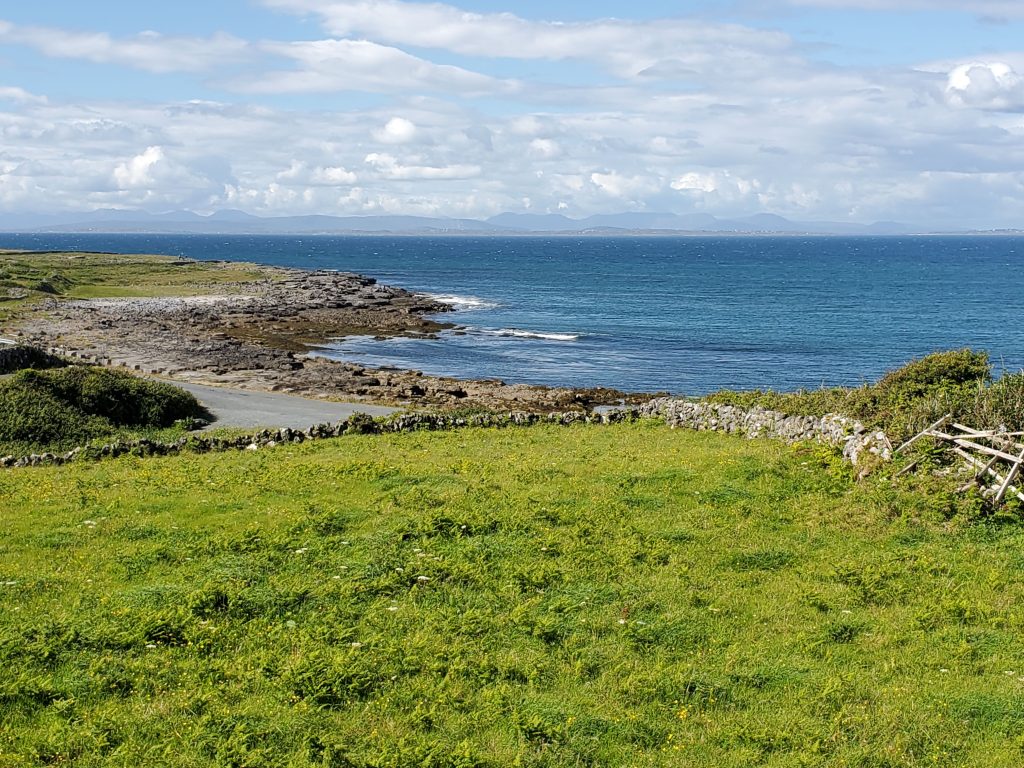
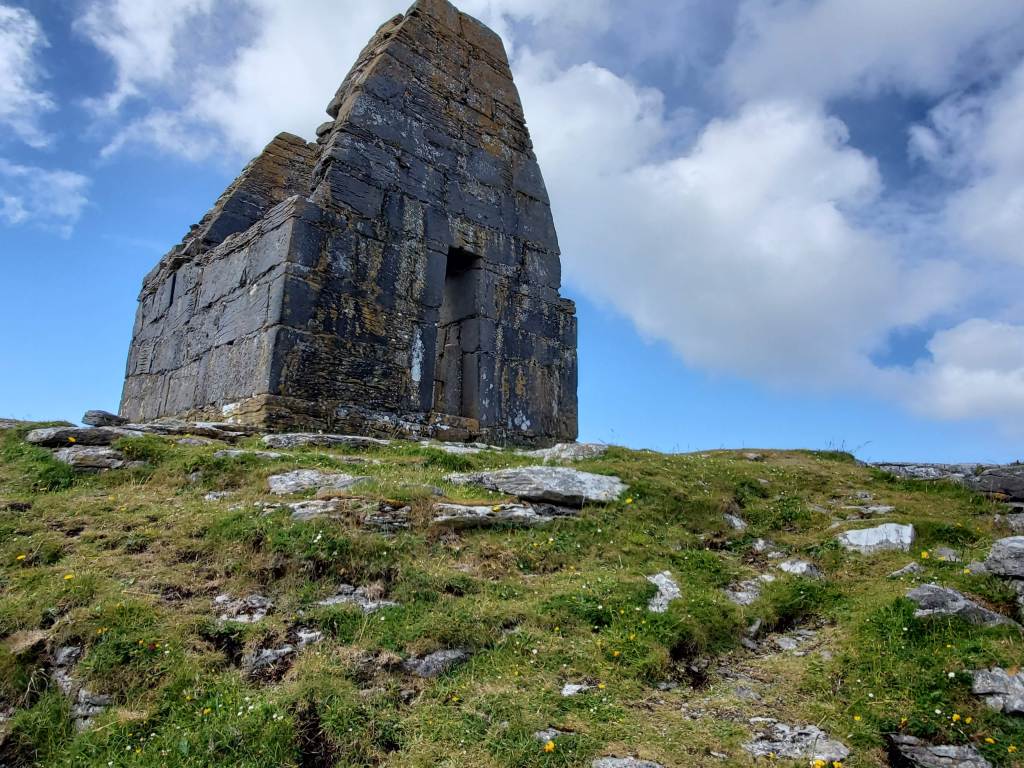
The following morning, after the rain finally stopped, we rented bikes, which are essential for exploring the island. We packed a lunch and made for the ruins of St. Benan’s Church, supposedly the smallest church in Ireland. After cycling for about 20 minutes, we ditched our bikes and headed through cow fields and broken walls to the highest point on the island. The church dates to the 7th century and measures 11×15. The grounds also include the remnants of a Celtic cross that the cows were lounging around and the base of a round tower about halfway up the hill.
After enjoying our lunch near the church on some flat rocks, we made our way back to the B&B via a graveyard near the shore that also contained the remains of St. Enda’s, a 6th-century monastery that had sunk into the ground.
When we got back on our bikes that afternoon, backsides burning from sitting on tiny seats, we pedaled against near gale-force winds to the ruins of St. Ciaran’s, an 8th- or 9th-century church. Our ultimate destination was the Wormhole, a supposed naturally rectangular blowhole that sits on land reportedly posted as “no trespassing.” Amid spotty cell service that made navigation treacherous, tired asses, and a desire for dinner, we gave up our search for the wormhole and settled for a glimpse of Dun Eochla, a large hilltop ringfort that is free to visit and not as crowded as nearby Dun Aonghasa.
Music Session and Nighttime Church Visit
The next morning after breakfast, it was back to the ferry (!!!) for a smooth 20-minute journey to Inisheer. We beat most of the day-trippers, dropping our bags and snagging a donkey cart ride around the island before the general tumult of the day.
The donkey ride is a great orientation to the island, winding through narrow roads bounded by dry stone walls at every turn. The first stop was the wrecked ship Plassey, which went aground on the island in the 1960s, its cargo of yarn, stained glass, and whiskey lost to the elements. Then it was on to O’Brien’s Castle, the remains of a 15th-century tower house that’s now a national monument. The castle offers stunning views of the Atlantic Ocean on one side and the island itself on the other.
After lunch, we lounged in our room at Tigh Ruairi, a pub/B&B. At one point, Marilynn and Declan checked out the sunken church a short walk away. In the evening, we went to a music session at a local hotel. While Marilynn stayed there, Declan and I retraced his steps from earlier to visit Teampall Caomhán, which dates from the 10th century. Despite it being past 10 p.m., the church was perfectly visible.
The church is dedicated to St. Caomhán (Cavan), the patron saint of the island. We visited just after his feast day (June 14), and candles still burned in his honor. Over time, the church fell into disuse, and drifting sands covered what remained of the church. Dedicated islanders dug out the chancel area of the church and continue to keep it clear.
With the Aran Islands behind us, it’s now on to Limerick.




















 To Europe ... and Back