
Certain sites and attractions in any city deserve a second look, and Dublin is no exception.
Staying in Dublin for two weeks means plenty of time to explore the new and the familiar — although these were new to Declan.
Come for the Crypt, Stay for the Bling
Our first stop is Christ Church Cathedral, an Anglican church that can trace its origins back nearly 1,000 years to the Vikings. In addition to the impressive vaulted ceilings and stained-glass windows, you’ll find cool medieval floor tiles. But the main feature is the crypt, reportedly the longest in Britain or Ireland. Dim lighting sets the mood as you walk beneath the curved arches and admire the artifacts and church bling from over the years.
You’ll find a rare copy of the Magna Carta, basically the Bill of Rights for Britain; the final resting place of Strongbow, a Norman-Welsh warlord from the 12th century; and the heart of St. Laurence O’Toole, the archbishop of Dublin during the Norman invasion. You also can see a mummified cat and rat, found in the bowels of the organ during a 19th century refurb. They apparently are mentioned in the James Joyce novel “Finnegan’s Wake,” but you’d have to put a gun to my head to get me to read it.
Christ Church plays a central role in the Bolch/Richtarik story, because Marilynn and I visited Christ Church on my very first day in Ireland, in 2000. I’d never traveled internationally and was unaccustomed both to trying to sleep during the overnight flight and to instantly adopting the time of the country one is visiting. A horrific breakfast and still being out at nearly 10 p.m. after a sleepless night didn’t help matters.
Marilynn wanted to show me the crypt, and the church appeared to still be open. There was a conference or something going on, and people were milling around. Since I was the newbie, I stood back while Marilynn approached a priest to find out what was going on. From that viewpoint, I could see the priest’s face as they talked. After about 30 seconds, his eyes grew wide, and he exclaimed, “Mar-lon!” That’s apparently the Irish pronunciation of “Marilynn,” which I now also use. She exclaimed, “Alan!” remembering that they attended the same college at Oxford.
Things like this happen time after time when we’re visiting Ireland, and I never get tired of it.
Historic Kilmainham Gaol Worth a Tour
Another site I hadn’t seen in more than two decades is Kilmainham Gaol, a former prison with a rich (and infamous) history of holding the prisoners of rebellion. Henry Joy McCracken, a leader of the failed 1798 insurgence, was held here for another offense several years before the rising. Leaders of the 1848 rebellion and the 1866 Fenian Uprising were also held in Kilmainham.
However, the gaol is most closely linked to the 1916 Easter Rising, a precursor to the Irish War of Independence that led to the establishment of the Irish Free State in 1922. The leaders of the 1916 revolution had no chance; they were outmanned and outgunned, and the rising lasted just a week. A dozen leaders of the rising were executed by firing squad at Kilmainham, including leader Patrick Pearse and James Connolly, who already was dying of his injuries at a local hospital but was transported to Kilmainham and shot.
Access to the gaol interior is through guided tour only, which was relatively cheap (12 Euro total) and surprisingly lively. Our guide traced the history of Kilmainham, outlining its role during the Potato Famine when as many as five people were crammed into a jail cell that had neither running water or windows. There were no separate quarters for men, women, and children, so you can imagine what prison life was like.
During the time of the Famine, laws were strengthened against begging, with people on the verge of starvation swept up. According to the guide, a 3-year-old served two weeks in Kilmainham for begging, with no parents or siblings to care for him. Talk about a tough life.
The gaol was decommissioned in 1924 and sat derelict for more than three decades until a community group received permission to renovate the facility with an eye to turning it into a historic landmark and community gathering space.
From its inception as a landmark, Kilmainham Gaol has been the site of many movies, TV shows, and videos, including 1965’s The Face of Fu Manchu (with Christopher Lee!), 1993’s In the Name of the Father (Daniel-Day Lewis), and 1996’s Michael Collins, which starred Liam Neeson, Aidan Quinn, Stephen Rea, and Alan Rickman. Younger tour guests might recognize Kilmainham from Paddington 2 (animated bear!). During my research, I also unearthed a U2 video (A Celebration) that was filmed at the gaol but does not appear on any U2 album.
The iconic image at the top of this column is the most famous feature of Kilmainham Gaol. But you’ll discover many more gems when you visit.
Other Sites Worth a Return Visit
Even with the top floors closed for a lengthy renovation, the Natural History Museum of Ireland (called the Dead Zoo by locals) is always worth a look. As you’d expect, you’ll find taxidermied critters large and small, including the always impressive Irish elk and a whale suspended from the ceiling. Unfortunately, you won’t be able to view the expansive upper floor that stretches 2.5 stories, featuring a central area for larger creatures and even more in cases along the wall.
Just around the corner you’ll find the National Museum of Archaeology. Declan and I always enjoy seeing the bog men who were trapped or buried in peat bogs over the ages. He especially enjoys the Viking bling on display, and there’s even a section of objects from Egypt(!).
Both museums are free to visit, so even if you’re only mildly interested in Irish animals or history, they are dry places to shelter from the rain.
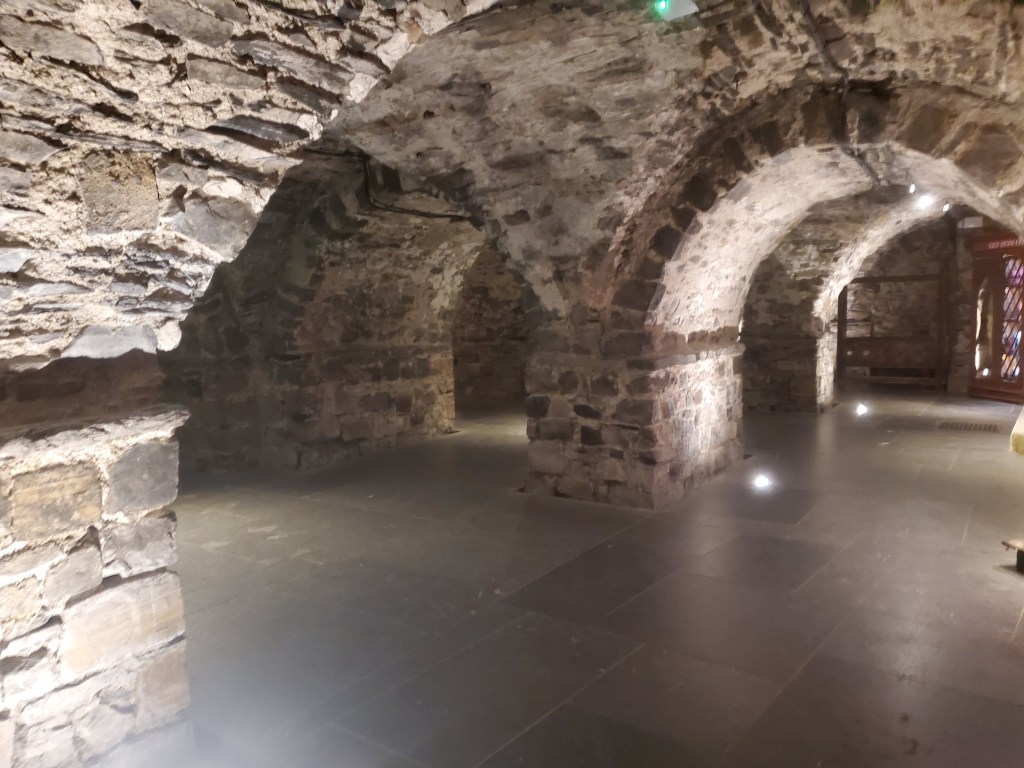
Crypt at Christ Church Dublin.
 To Europe ... and Back
Loved your comments on Kilmainham and the fabulous photo.
LikeLike