Visit to Tübingen Worth the Travel Hassles

Delights await those who are up to the challenges.

To say the trip Declan and I made to Manchester was part of a whirlwind tour is a vast understatement, because Tübingen, Germany, was our next stop. It’s been a university town since 1477, and Eberhard Karls University is one of the oldest universities in central Europe. Roughly one-third of its 90,000 residents are students, with most housed amid picturesque ancient buildings along cobbled streets embedded in the hills.

Marilynn was invited to give a paper at an Irish Studies conference at the university, so it was a no-brainer to add this stop to our itinerary. She flew directly to Frankfurt and took a mostly direct train there, but Declan and I weren’t so lucky.

We couldn’t find cheap flights into Frankfurt or Stuttgart from Manchester, so we flew on Ryanair to Cologne. The day started with a 4:35 a.m. wakeup call and a 7 a.m. flight, followed by at least four train transfers and most of the day. You must really want to get to Tübingen from Cologne.

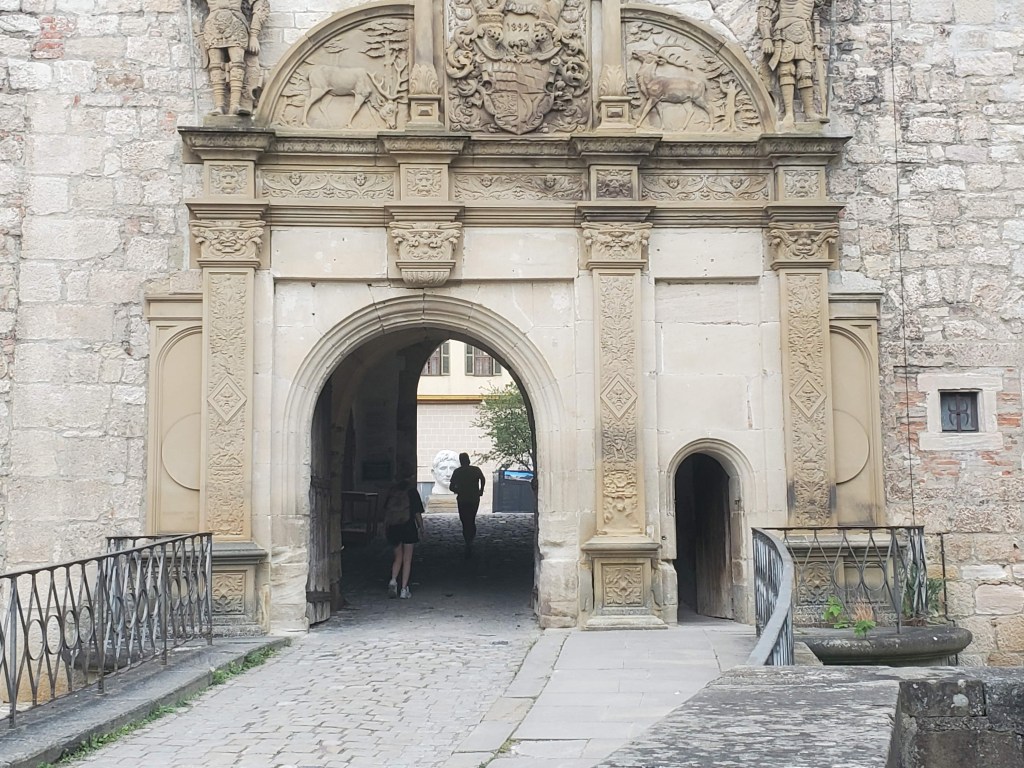
The silver lining is that the train traveled along the Rhine River Valley, with stunning mountain views and literally dozens of castles — both current and ruins — dotting the hilltop scenery. The arduous journey was worth it to see this quaint city, which grew up on both sides of the Neckar River from the 12th century.

Top sites include St. George’s Collegiate Church (Stiftskirche), built in the 15th century and a central feature of Tübingen’s skyline. The church was one of the first to convert from Catholicism to Martin Luther’s Protestantism, and the structure retains many features usually associated with the Catholic Church. If history isn’t your thing, stop in for the stained-glass windows.

One unexpected delight was the City Museum of Tübingen exhibit devoted to early film silhouette artist and director Lotte Reiniger. When you were a kid, you may have gone to a puppet show with moving shapes behind a backlit white screen. That’s silhouette artistry, and Reiniger was best known for her ambitious film “The Adventures of Prince Achmed” in the 1920s. We visited the museum to escape the rain, but we’re glad we went.

Walking the hilly streets of Tübingen and seeing the sights were the best parts of our adventure. The city escaped Allied bombing during World War II, so the city doesn’t have that discordant architecture from the ‘60s spoiling the view of the buildings that are hundreds of years old. Colorful side-by-side Bavarian-style timbered houses and quaint shops line the streets, delighting the senses.

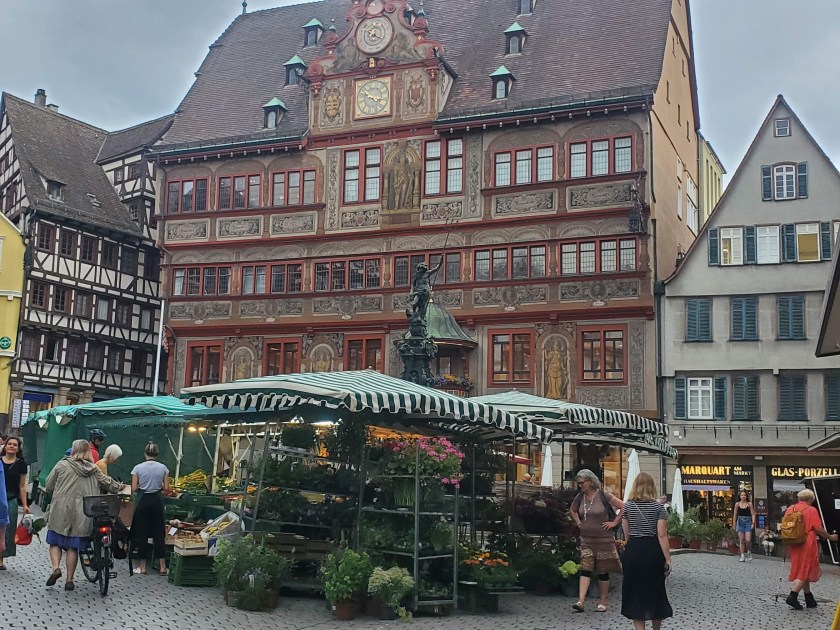
On the day we visited, a morning street market sprang up in front of the historic City Hall that featured local meats and cheeses, fruits and vegetables (including white asparagus), and other delights. Even a brief but torrid downpour could not stop market day, as people ducked under awnings or donned their rain jackets.

The river that flows through town at various points provides a great diversion. We particularly enjoyed watching eight baby ducks slalom through a set of rapids under mama duck’s watchful eyes, moving back and forth over the obstacles to reach the quiet pool at the bottom. Yes, it took 10 hours of travel time to reach Tubingen, but the views more than made up for the hassle.

Market day in front of historic Tubingen City Hall.

Declan’s Perfect Day Out in 8 Numbers

And Matt’s not-so-high highlights

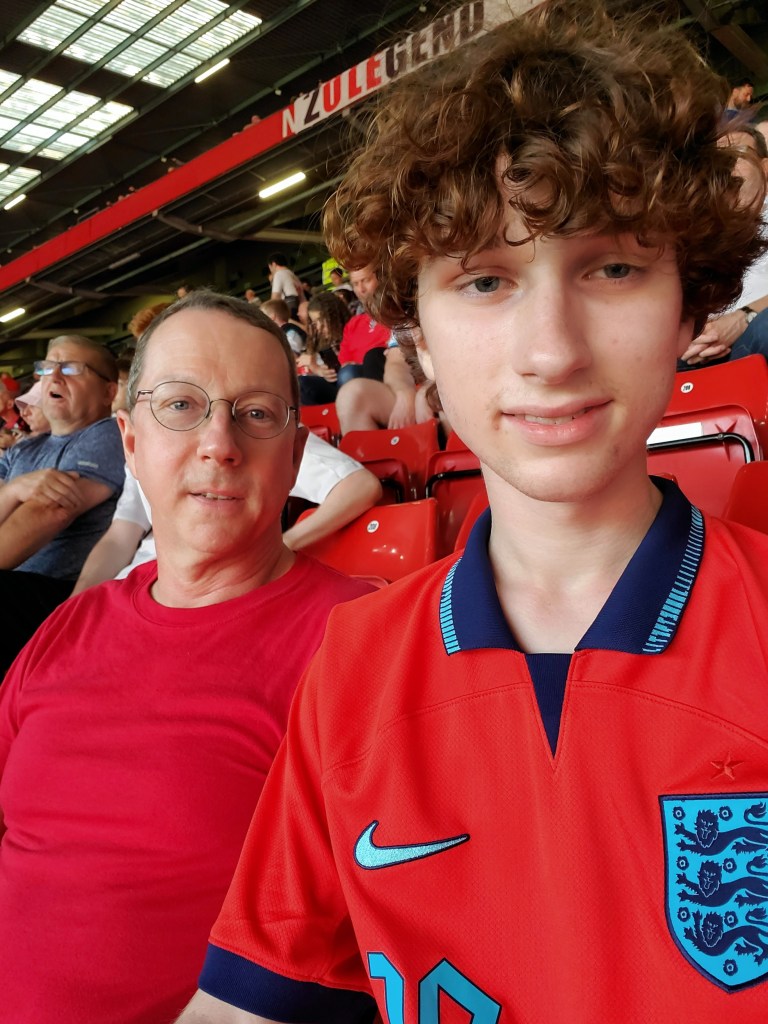
For just about as long as Declan’s been an Arsenal fan, he’s also been a fan of the England Men’s National Team. And from the moment Marilynn fixed the dates for our trip, Declan was on the web to see what games we could attend.

The England vs. North Macedonia match we saw on Monday was a qualifier for Euro 2024, a continental competition played every four years. In other words, a big deal to name the top national team in Europe. So here is my report from the day, with Declan’s highlights and my not-so-high highlights.

3 — Number of goals scored by Bukayo Saka, Declan’s favorite Arsenal player, for his first-ever hat trick. The game was 7-0 in favor of the good guys. Saka is England-born of Nigerian parents, and Bukayo means “adds to happiness” in the Yoruba language. Saka absolutely adds to our happiness when he’s on the pitch.

10.07 — Number of miles I walked that day, according to my Fitbit. We were up at the ass-crack of dawn to make the flight to Manchester, followed by walking to the off-airport hotel, back to the airport to catch tram/train to central Manchester (where we visited the National Football Museum and Classic Football Shirts and also saw North Macedonia fans making merry outside a local pub), tram back to our hotel, tram to within 1 mile of the football ground, walking to the ground, then repeating the last two steps in reverse to return to our hotel by 11 or so.

70,708 — Attendance at Old Trafford, the historic home of Manchester United that seats 74,310. Less than 4,000 under a sellout is a great turnout for a summer game for a team that already had clenched the top spot in the division.

20,125 — My estimation of the number of vuvuzelas we heard during the match. In case you don’t know, the sound these instruments make is annoying as hell, which after the 2010 World Cup led to bans at many international football events. They’re also banned at many Premier League stadiums, but apparently not at Old Trafford. It wasn’t so much the sound; it was that a group of kids (Lord, I hope they were just kids) right above us kept (badly) using their vuvuzelas to play the nine-note tune that exhorts the crowd to shout “Let’s Go!” Fun side note: in England matches, it’s not “let’s go,” but “England!” Second fun side note: If one cannot remember how to spell vuvuzela, just look up “annoying horn, World Cup,” and it comes up instantly.

£101.50 — The price of our two tickets, including fees, which I thought was extremely reasonable for a national match. Compared to major league American sports, European football is much less expensive.

£15.50 — The price I paid for a ham and cheese toastie (toasted sandwich) at the Clayton Hotel, Manchester Airport, where we stayed. While I do know that prices are higher at hotel restaurants, one expects meat and such on said sandwich. There weren’t more than two sad slices of ham on this toastie, which didn’t cover 60% of the bread. Waving a toastie in the air and thinking about hogs does not make ham magically appear between the bread slices. I did get that charge taken off the bill, but the audacity to charge so much for so little still galls.

1 — Declan’s rank for our day in Manchester among our first 10 days. We knew it would be a highlight of the trip, and it didn’t disappoint.

1 — Despite the long day, the 10 miles of walking, the 4-plus hours of public transport, and the bad food, I’ll have to agree. Making lifetime memories with your son far outweighs the inconvenience and sore legs that ambitious jaunts require — although I would like to have told those 20,125 fans where they should insert those vuvuzelas!

Beware the Seagulls as New Irish Adventure Begins

I didn’t realize that seagulls sound like children being tortured until this trip to Ireland. Not that I’ve tortured children or anything, but seagulls produce sounds that make my skin crawl.

I guess one doesn’t notice the seagulls much by the seaside or along the boardwalk amid the sounds of waves and crowds, but on the streets of Dublin, the caterwauling (or should I say, child-erwauling?) is unmistakable. That, and the dive bombing toward you, around you, in front of you and everywhere in between. Declan was sure he was going to get hit in the head as one headed straight toward him or that he’d get hit by an aerial, um, semi-solid projectile as they passed overhead.

Seagulls! Damn seagulls!

Many are large enough that I can easily see a plucked seagull atop the grill, beer can rammed into its cavity, the makings for beer can seagull. Yum!

Yes, we’re back in our adopted second home, this time for a month. We spent our first full day in Dublin so Marilynn could get her reader’s credentials for research in the National Library and National Archives. She’s researching Brian Friel’s 1975 play “Volunteers,” which I’m looking forward to reading. We’ll return to Dublin late in the month for the last two weeks of our stay.

We then took a train to Limerick to catch a preview of the great new play “Freefalling,” a fascinating true story written and performed by Georgina Miller. I’ll spare you the details, but Miller spends most of the 90-minute play strapped into an aerial harness, which illustrates beautifully the highs and lows of her life. It’s directed by our friend Lynne Parker, artistic director of Rough Magic in Dublin. The play will be featured at the Cork Midsummer Festival.

We’re currently in Belfast, catching up with friends for a few days. Our flat is somewhat off the beaten path, but still close enough to the action. Declan and I will be in Manchester on Monday for an England Men’s National Team football match versus North Macedonia. We’ll join Marilynn in Germany on Tuesday. She’s giving a keynote at an Irish studies conference, and we’ll spent a few days after it in Germany, with a brief side trip to France.

Belfast Badassery!

Enthusiastic audiences greet author and new book

Marilynn Richtarik’s talks in Belfast were the academic equivalent of a sold-out arena hosting a semi-famous rock band — albeit without cellphone flashlights aloft or the pungent smell of marijuana.

Audiences that require more than the fingers on two hands to count are considered good by scholarly standards, so it was quite refreshing to host 70 people Tuesday at Queen’s University Belfast’s Institute of Irish Studies (including 40+ online viewers) and about 40 on Thursday at the Linen Hall Library across from Belfast City Hall. The audiences were enthusiastic, and discussion after the presentations was lively.

Just like touring with that semi-famous rock band, celebrity sightings were also common. David Park’s novel “The Truth Commissioner” and Michael Longley’s poem “Ceasefire” both feature in Marilynn’s book. Park was on hand, as was Michael’s wife, Edna Longley, herself an accomplished scholar.

Anne Devlin and Rosemary Jenkinson, both playwrights and short story writers, attended the Thursday event, as did a journalist from Shared Future News and more than a dozen people from a cross-community initiative in north Belfast that strives to bridge the sectarian divide. That group asked particularly probing questions about how the Good Friday Agreement changed (or, rather, did not change) the lives of common folks in Northern Ireland, especially disaffected young men.

It was fantastic to see so many friends at both events and to make new ones along the way. We also are grateful to people at the Queen’s Institute of Irish Studies and the Linen Hall for making the necessary arrangements, and to No Alibis Bookstore in Belfast for selling copies of Marilynn’s book at both events.

Finally, while I wish I had come up with the headline for this post, that honor belongs to Dana Miller, a former grad student of Marilynn’s who tuned in while covering the SXSW Music Festival in Austin. She wrote, “What a brilliant talk you have given, and it is such a joy to watch you talk about your incredible work.”

I couldn’t have said it better myself.

Have Knowledge, Will Travel

Care for a few facts? Will you buy me lunch?

An academic book tour is much like the education system during colonial times. Then, itinerant educators traveled from village to village, trading their skills for a night or two in a barn, a bunch of carrots for the stew pot or the occasional piece of meat.

This is only a book tour because Marilynn wills it so. There is no budget from the publisher, so she called and wrote academics, booksellers, and friends to arrange five readings and public events in Ireland, north and south. This is in addition to the people she asked to review the book, the work she did creating a hit list of academic and general interest publications for the publisher, writing blogs and articles about the work, doing a radio interview for a Dublin book program, and — oh yeah — staying on top of the two classes she’s teaching this spring.

In return for those five readings and public events, we have accommodation in Belfast for two nights, Dublin for two nights, and Galway for one night. We’re staying with a friend outside Belfast both weekends and a friend near Galway for a night. There are still a couple of days unaccounted for, so we’re going to see what the weather’s like and where we’d like to visit.

Oh, the Places We’ve Stayed!

We promoted Marilynn’s Stewart Parker biography for three years of book tours during the Thanksgiving holiday 2012-2014. Declan was in elementary school, so we took him out a week early and jaunted for two whole weeks, visiting Ireland and England the first year, England the Scotland the second, and England and Wales in 2014.

Her pay included some lodging, a few rail or bus tickets, and many meals out following a lecture. Fortunately, Marilynn doesn’t do it for the pay but, rather, for exposure for the book and the chance for us to travel to interesting places:

  • When I said I’d never been to Wales, she arranged a visit to Aberystwyth, the westernmost point of Britain. We stayed in a terrific grand hotel that overlooked the sea and the town’s boardwalk. During dinner, a Welsh professor taught Declan a dozen or two words, which he promptly wrote down on a napkin (and still has).
  • The previous year, we stayed in college lodgings in Durham Castle, an 11th century building that’s a UNESCO World Heritage site and also serves as a student dorm for Durham University. We ate breakfast at the high table in the dining hall, which served as inspiration for the Hogwarts great hall in the Harry Potter films. I should also point out that the bathroom for our room was up about 20 uneven concrete steps to an unheated chamber that in November felt like it was two degrees above absolute zero.
  • We’ve also stayed in the dean’s quarters at Hertford College, Oxford. Oxford University is comprised of 44 colleges, and Hertford was founded in 1284, which makes Marilynn’s Jesus College a relative newcomer. The Welsh college, which she attended as a Rhodes Scholar, was founded in 1571.
  • And though we remember nothing about our room at the Radisson Blu in Galway, we all still fondly remember the breakfast bar, which was the largest and most elaborate we had ever seen before — or since.

It certainly beat a few carrots and a soup bone.

Farewell, Dr. Himebaugh

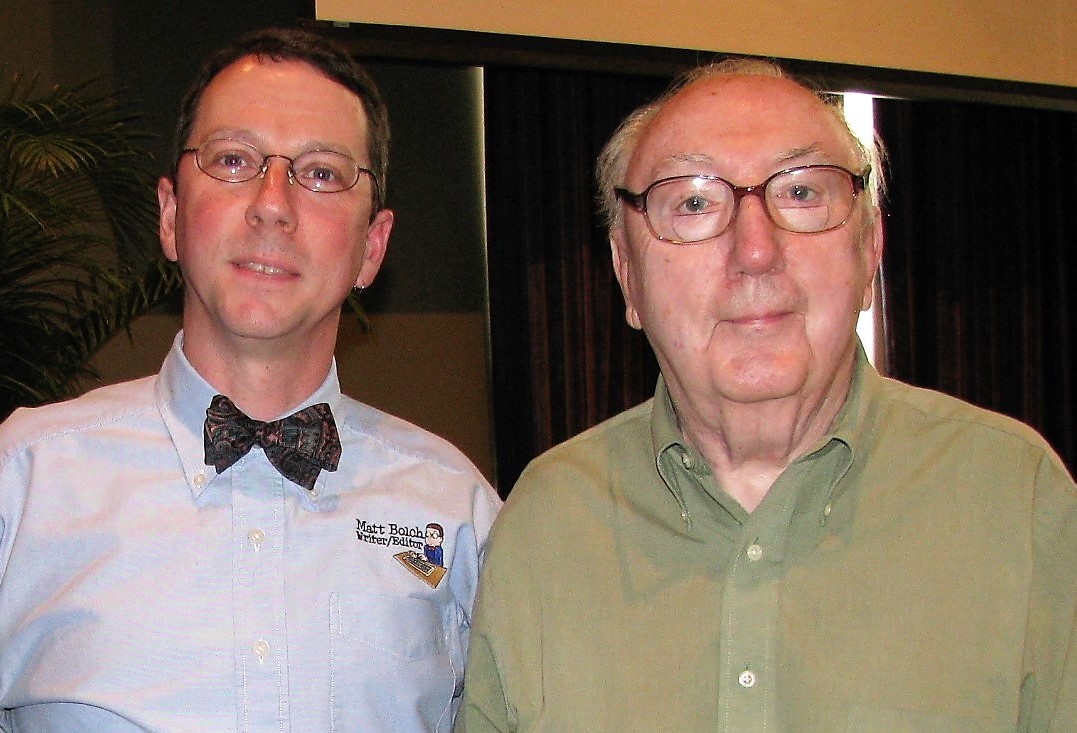
I trust that every person reading this has that one person, that business mentor, that guiding light you always can depend upon for counsel and support. For me, that was Glenn Himebaugh, my journalism professor at Middle Tennessee State University. However, he didn’t know it at the time.

Nearly three decades after college, I did reconnect with Dr. Himebaugh and his wife, Ellen, visiting them in Murfreesboro and taking them to dinner when I was in town for meetings. To honor the man who meant so much for me, I founded an endowed scholarship for him in 2010, which started helping students a few years later.

While his passing last month at the age of 86 certainly saddened me, that sadness was tempered by the knowledge there remained no unfinished business between us. He knew exactly the influence he had had on my nearly 40-year career as a working journalist.

You don’t have to start a scholarship to honor the mentors in your life, but you do owe it to yourself (and your mentor) to make your feelings known.

Influence Well Beyond the Classroom

Like many people attending state university, I was first generation and worked the entirety of my college career — often full time. Consequently, I didn’t make those deep connections that I envy my wife for making during her undergraduate studies.

But during my journalism career, I often recalled my time on campus and the intensive and real-world training I’d received at MTSU. Dr. Himebaugh formed the core of my learning experience, teaching three of the foundational journalism classes, including feature writing and copyediting. He undoubtedly was the heart of the Mass Comm program, which he co-founded in 1971 and served for 40 years — the last 10 as professor emeritus. He taught those small, writing-intensive classes where students are slowly, lesson after lesson, paper after paper, molded into budding journalists and writers with bright prospects.

I remember his wry sense of humor and the washes of red ink he left on about every article I ever turned in. He was responsible for getting me involved in the campus chapter of the Society of Professional Journalists, accompanying us to conventions in Mississippi and Atlanta, where an obviously inebriated Ted Turner delivered an incoherent keynote address. He also was indirectly responsible for one of my favorite personal stories, about how Mrs. Sarah Cannon (better known as country comedienne Minnie Pearl) insulted me in the backyard of the governor’s mansion in Nashville. But that’s a story for another day!

The Right Answer to a Big Question

After consulting the university foundation on the particulars of scholarship-founding, I invited the Himebaughs to lunch at a local Italian restaurant to ask his permission. I compare the experience to asking Marilynn to marry me, a joyful but stressful occasion filled with tears (mine) and much trepidation (also mine).

Somewhere through the main course, I brought up the subject, my voice breaking and a single tear falling from my left eye. When I popped the question to Dr. Himebaugh, he said, without hesitation, “As long as it’s not a memorial scholarship!”

Although Dr. Himebaugh is now in the newsroom in the sky, his legacy lives on in the thousands of students he taught over a long and distinguished career. It lives on in his scholarship that continues to grow and help fund the dreams of future journalists. But, per his wishes, the scholarship will never be “memorial.”

To support future generations of journalists, please consider a donation to the Dr. Glenn Himebaugh Scholarship at MTSU.

Notre Dame Fire Like Losing a Friend

The day dawned cool but clear, tendrils of fog drifting off the Seine. After a quick croissant breakfast, we made our way to Notre Dame Cathedral to be among the first to visit on a Paris morning two years ago.

The pre-opening crowd of about a dozen was split evenly between tourists like ourselves and penitents, including two nuns. Gothic cathedrals are a particular favorite of mine, and visiting Notre Dame was high on the list during our brief, two-day visit to Paris.

Like millions of others around the world, I experienced a profound feeling of loss when learning about the devastating fire at Notre Dame, which will cost billions to repair. According to French President Emmanuel Macron, there is no question that the 800-year-old cathedral will be rebuilt. Cries rang out from the yellow vests and others who believe that money would be better spent assuaging social ills in the republic.

Both sides have merits, but Notre Dame remains one of the most indelible icons of Paris, along with the Eiffel Tower, the Louvre and the Champs-Élysées. It’s more than a building and more than a religious relic. Failing to rebuild it would be like failing to rebuild the Lincoln Memorial or the Statue of Liberty. When the twin towers fell, there was no question that the World Trade Center would be rebuilt.

Memories linger

On the day of our visit, a prayer service began at 8 a.m., filling the cathedral with sweet singing, a perfect accompaniment to the early morning light filtering into the worship space.

More than 850 years in the making, the cathedral got its start in the 1160s before receiving its Gothic makeover in the 14th century. For many, Notre Dame represents the quintessential Gothic cathedral—massive rose windows, vaulted ceiling linked by capstones, massive pipe organ, stained glass aplenty and gargoyles that, fortunately for us, weren’t spitting water that morning.

Looking back, I feel fortunate to have had the opportunity to see Notre Dame in all of its glory. While I’m certain it will be restored, it will never be the same.

LA Fitness Follies: What shower curtain?

After being a silent-on-social-media member of a national fitness chain for several years, I can be silent no longer. I don’t want to name names, so let’s call this chain Lower Alabama Fitness, or LA Fitness for short.

curtainWho knew that shower curtains were optional? We’re not in middle school here, and I remember being surprised seeing open showers when Declan and I toured Emirates Stadium, home to Arsenal, a few years back.

On Friday, I reported to the front office staff there were only four shower curtains among the eight showers in the men’s locker room. Today, there were just two.

I reported it to staff (again) and then spoke to the manager, who said he’d check with the facility manager to see whether they had been ordered. “Shower curtains are basic amenities at fitness facilities, just like toilet paper and paper towels,” I said. “You should be ordering them by the case and reordering them when there are six or fewer.”

I even pointed out the Walmart in the same shopping center, which is open 18 hours a day and sells shower curtains. The manager apparently didn’t appreciate my helpful suggestion.

While I certainly hope this is my last installment of LA Fitness Follies, based on part experience, I’m pretty confident this will be the first of many.

@lafitness

Spanish and Cuban Influences in Tampa Bay Area

Making our way from “Waitee Longee” Springs, Declan said he wanted to see the Dali Museum in St. Petersburg.

We are traveling to Spain next month for an Irish conference, and Declan has immersed himself in all things Spain. Not only has he had Spanish language lessons in school since he was a kindergartner, he has been planning and plotting this adventure since we bought our tickets in December.

Although Salvador Dali is known the world over for his surrealistic paintings, the Spaniard also sculpted and made experimental films, among other creative pursuits. And, of course, he also was a flamboyant self-promoter, mustache waxed and curled into a big ol’ smiley face. Thinking about it, Dali was a walking emoji before they existed.

I had been to the former location of the Dali Museum a couple of times, leaving both times impressed by the depth and breadth of the man’s work. My favorite has always been the hologram of ‘70s rocker Alice Cooper that Dali did when both where at their artistic apexes. I only saw the hologram on my first visit, leading me to believe it was on loan.

Are you a stoner?

You can read about the hologram at Civilized, which apparently is a pro-pot website. Top-notch reporter that I am, I figured this out when the promoted items after the story

Hologramincluded a search box for cannabis dispensaries and a QA box that asked, “Are You a Stoner?” And apparently you can buy a photo at Walmart!

We enjoyed our visit to the new museum, but I think the ceilings aren’t as high, which limits the full effect of his insanely large masterworks. Although we put three hours’ worth of quarters into the parking meter, we were on our way after 75 minutes or so.

Best Cuban in Tampa

The day’s highlight undoubtedly was wrapping my lips around the best Cuban sandwich in Tampa, which you can find on the edge of Ybor City at Brocato’s Sandwich Shop. Real Cuban bread makes all the difference between an OK Cuban sandwich and the taste sensation that is Brocato’s.

The shop is located in a too-small cinderblock building that fills to overflowing every weekday lunch with people of all types, colors, sizes and professions. Like the Village People, if the band was co-ed. You’ll see a couple of guys in suits and ties waiting in line behind cops, construction workers, moms and “tourists” like us.

But the line moves fast, and you can glimpse seven decades of memorabilia while you wait. Sandwiches include chips you select from large, gray garbage cans on rollers on one end of the building, as well as a drink (including beer!). There is limited seating inside, which is too cozy for me, so we always sit under the covered awning out front.

In addition to a Cuban, get yourself a devil crab, which locals say is the best in the area. Unfortunately, I can’t eat them anymore after developing an extreme intolerance to onions several years. But when dining with a group, I’ll still order one, break off a smallish piece, dose it with a dash of Tabasco, pop it in my mouth and savor the creamy crab goodness before passing the rest over to everyone else. Because you don’t want the deviled crab—or anything else from Brocato’s, for that matter—to go to waste.

And if my stomach complains, it’s a small price to pay.