Up Close to Oxford’s Bridge of Sighs and Other Bits from Abroad

Random observations from two weeks in England…

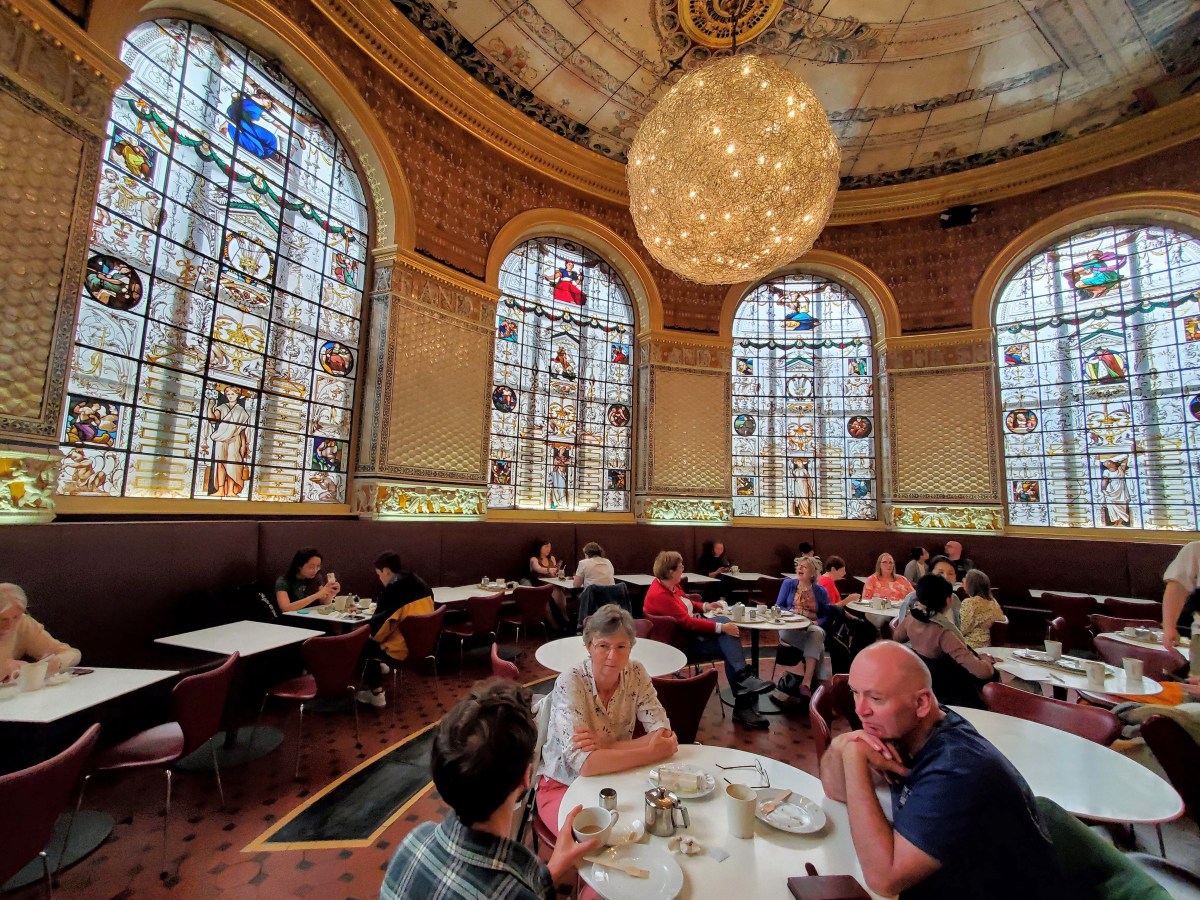
We spent an educational afternoon at the Victoria and Albert Museum in London, taking in the exhibits. One highlight was tea and dessert amid the opulent surroundings of the world’s first museum café, built in 1852. Europe has America beat hands down in terms of offering plenty of places for folks to gather, with varied food and drink offerings at reasonable prices.

***

Bridge of Sighs

We were fortunate to spend two nights in guest quarters at Hertford College in Oxford, where Marilynn gave a talk. We stayed about 15 feet from the Bridge of Sighs, a famous decorative bridge that connects two parts of the college and is modelled on a similar (and older) structure in Venice. That was the good news. The bad news is that from about 8:30 a.m., tour groups gathered under our bedroom windows for a history lesson. Then from about 10 p.m., loud students spilled from the alley leading to the Turf Tavern, a semi-famous pub that offers “an Education in Intoxication.”

***

My apologies to the young woman on the train from Birmingham to Oxford who was either copying passages from the New Testament or writing her impressions of scripture while I was reading horror master Clive Barker’s novel “The Scarlet Gospels” about Pinhead, the demon from the “Hellraiser” movies. Heaven and hell, indeed!

***

Many European hotels still don’t have air conditioning, including the hotel in Birmingham the Friday we attended the Elbow concert. I couldn’t figure out how to defeat the device that only allowed opened the window about two inches until we got back at past 11. Consequently, we kept the windows wide open that night. By 6 a.m., however, we felt like we were sleeping rough by the motorway, the traffic noise was so bad.

***

When traveling, we always find something to climb, something to ride, and a drunkie cab. Fortunately, we saw no drunkie cab in Oxford, but Marilynn and I did climb Carfax Tower, which dates to the 13th century and offers nice views of the city. I was most impressed it wasn’t named for the company that sells wreck reports on used cars. According to displays in the tower, “carfax” is derived from the Latin word “quadrifurcus,” meaning four. The tower is still near the intersection of four central roads in Oxford.

***

We traveled many miles during our two weeks in England, much of it to catch up with colleagues and old friends. Our sincere thanks to everyone who hosted us, met us for a meal, or let us stay the weekend in the Cotswolds (thinking of you, Michael and Aleksandra!).

A study in Contrasts: Imperial War Museum and Pitt Rivers

The Pitt Rivers Museum in Oxford has long been a family favorite, interesting as much for the building and display cases as it is for the artifacts contained within. Although the shrunken heads have been taken off display and some of the language on the exhibits has been updated to reflect current thinking, the museum retains its Victorian charm.

It contrasts nicely with the Imperial War Museum in London that Marilynn and I visited for the first time last week. Established just after the first world war, the museum grew in scope and size over the next century to cover British military engagements from WWI to the present and expanding to five sites. We visited the main museum, about a 15-minute walk from Waterloo Station.

Personal Tales Amid the Horrors of War

The War Museum intertwines the implements of war with the universal struggle for survival among combatants and civilians down to the individual level. Although I’ve seen plenty of fighter planes, guns, and grenades at other museums, I had never seen the family air raid shelters the government gave residents during WWII, including indoor ones for people who didn’t have land and an enclosed cage resembling a small iron lung used to protect pets from a gas attack.

Most interesting, to me at least, were the personal tales connected to items on display, such as a pack of “morale-boosting” cigarettes a woman sent to troops during the second great war (she sent 10,000) or the coat a U.S. Navy officer wore when storming Omaha Beach on D-Day.

The museum also does a great job explaining how the settlement of WWI and its aftermath inevitably led to WWII two decades later. The museum is free to visit, which is a great activity rain or shine.

Pitt Rivers a Throwback Museum Sure to Delight

I love what I call Man-and-His-Crap museums, rich dudes (and you know this type of collecting is dude-specific) who collect stuff that interests them and then put that stuff on display. The Barnes Foundation in Philadelphia (impressionist art) and the Mercer Museum in Doylestown, Pennsylvania (pre-Industrial Revolution tools) were my first glimpses into this subgenre of museums.

Technically, the Pitt Rivers in Oxford doesn’t fit my definition, because British Army officer, ethnologist, and archaeologist Augustus Pitt Rivers merely gave 22,000 items to the university in 1884, with the proviso that a permanent lecturer in anthropology be named. But, as in the Mercer Museum, items are arranged around a common theme, rather than the age of the artifacts.

Want to see sewing supplies from around the world? This is your place. How about opium-smoking equipment? Ditto. Visitors can investigate tools, foot-binding techniques, weaponry, locks, writing utensils, tattoos, surgical implements, and much (much!) more amid the museum’s 500,000 objects.

The Pitt Rivers is accessed through the Oxford University Museum of Natural History, which exudes modernity despite being constructed in the 1850s. The open floor plan and large central exhibit space contrast with the dim, tight quarters of the Pitt Rivers. When we visited the natural history museum a decade ago, it was undergoing refurbishment, with the walk of animals pushed to one side of the central hallway. In addition to the large display of articulated animal bones, young and old alike will enjoy the many cases of dinosaur fossils. Adults should take special notice of the evolution displays, as well as the columns around the building made of differing types of stone from around the region.