Old friends, new sights, Irish-famous and not-so-Irish-famous folks and the unlikeliest reality TV star you can imagine.
Another summer, and another Irish adventure for Marilynn and me. She received a grant (two, actually) to conduct research in the National Library of Ireland, and we bookended those two weeks with a week in the north and a week in Germany and France. Declan is home this time, getting work experience as he moves closer to completing his Business degree.
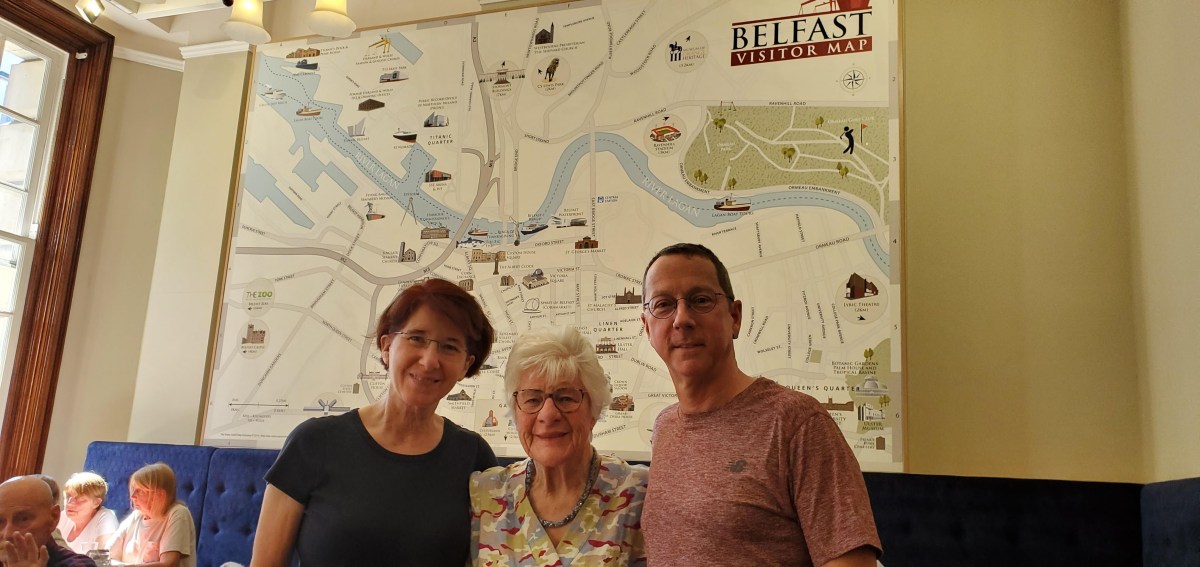
We landed in Dublin on our 24th wedding anniversary. After a quick breakfast and the purchase of Dublin travel cards, we caught a bus for Belfast, which delivered us to Belfast Grand Central, the new multimodal facility that replaced the Europa Bus Center. It certainly is grand, but the facility is blocks from the main street, and the toilets are as far as possible from the bus and train bays. I’d hate to be a disabled person in Belfast.
Rediscovering Derry

After recovering for two nights in Tara Lodge and walking the streets of my adopted second hometown, we rented a car and headed to Derry, a 90-minute drive along (thankfully) good roads. We stayed with friends who happen to own a B&B, but they are in the process of retiring. They had just returned from five months in Malaga, and this will be their last year as hosts.
While in Derry, we enjoyed starters and pints at Trinity Pub, which I declare has the cleanest and sweetest-smelling toilets on the island. We also reacquainted ourselves with the historic Guildhall and walked Derry’s historic city walls. The following morning, we visited the Tower Museum, which traces Derry’s story from medieval times to the present.
The museum recently installed a multiroom “Derry Girls” exhibit that I bet stays there for many years. While we thoroughly enjoyed the program, I’m good-naturedly miffed that the show’s third series won the Ewart-Biggs Memorial Prize, which recognizes works that promote peace and reconciliation in Ireland. Marilynn’s book “Getting to Good Friday” was one of six on the short list for the award — and she was the only non-European nominated. But if you have to lose, who better to lose to than Derry Girls?
Exploring Ireland’s Past at Ulster American Folk Park
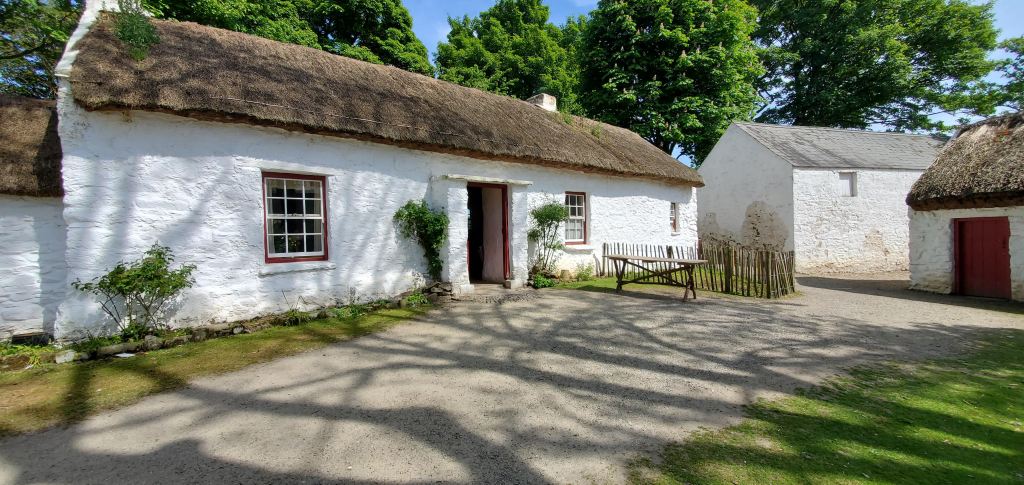
While we’ve visited the Ulster Folk Museum just outside Belfast several times, we hadn’t been to the Ulster American Folk Park near Omagh before this trip. The concept is similar — exploring Ulster’s past through historic buildings — but the Folk Park takes a linear approach, from oldest building to newest, including an “ocean voyage” that brought immigrants to America. The park was developed around the birthplace of Irish-American banker and lawyer Thomas Mellon, founder of the Mellon banking dynasty (which remains in its original location).
We were surprised to learn that people (even the rich ones) slept upright, which is one reason why beds from olden times look so short. Poor people wanted as many kids as possible, even hanging fertility charms above the single bed in a one-room shack. How Mom and Dad found time, energy and privacy to make so many kids is puzzling, but the knowledgeable docent in the first dwelling assured us that procreation didn’t have to happen in a bed.
To access the American part of the park, you enter a large wooden building and “board” a replica immigrant ship. On the journey to Ireland, the ship transported goods for sale or trade. For the return journey, rough bunk beds were constructed belowdecks, where passengers were expected to remain for the duration of the journey. You were fed once a day and had to rely on provisions you brought with you the rest of the time. Sunshine? Forget it. Toilet? Try the bucket on the floor. No wonder they were called “coffin ships.”
After passage to the American side, you will find mostly buildings transported from the States, including an 18th-century stone house, a log cabin and a house from Pennsylvania, a West Virginia farmhouse and a Tennessee brick plantation house. The latter’s bricks still show marks where they were carefully numbered, disassembled, transported to the Folk Park and painstakingly reconstructed.
Castle Ward Without Game of Thrones Connotations

That night, we stayed in the Goldenhill Guesthouse, a B&B with beautiful views about four miles outside Omagh. After a frustrating day sitting in a traffic jam caused by an overturned cattle lorry (can’t they just shoot the cattle and eat them?), we made our way to Castle Ward, a National Trust site best known as representing Winterfell from Game of Thrones.
When we lived in Belfast in 2017, we tried to visit Castle Ward several times, but it was always closed for filming. So we count ourselves lucky for a chance to visit the historic house (although we did not make it to the older part of the grounds where GoT was filmed).
From an architectural standpoint, the 18th-century building reflects the differing styles of the owners. The husband’s style was classical Palladian, while the wife preferred Georgian Gothic. The differences are evident throughout the building, which is split in two by those styles. The husband’s preferences won out on the entrance side of the building, while the wife’s Gothic touches can be seen from Strangford Lough, which the back of the building overlooks.
The most interesting factoid from the house tour was the “cat pantry” on the lower level, next to the wine cellar. During the day, dozens of cats were kept in the pantry. They were let out at night to catch rats, then lured back to the pantry with food early in the morning. Of course, a scullery maid was responsible for cleaning the cat pantry daily at a time when a litter box was unthinkable.
Our penultimate night in the north was spent in Portaferry, which we reached via a small car ferry — my first time taking this particular form of transportation.
Visiting Friends the Main Reason for the Journey
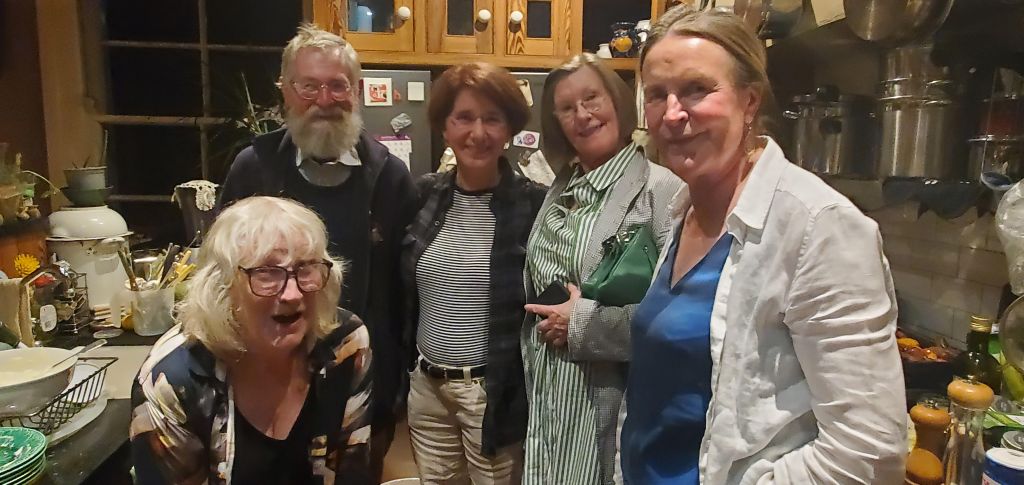
At each stop along the way, we visited friends, some of whom Marilynn has known for decades. She’s known our Derry friends since the last ‘80s, when she researched her first book in the formerly war-torn city. Friends from Belfast we shared dinner with on our last night date from her work on Belfast playwright Stewart Parker. We also visited colleagues and writers including playwright Anne Devlin and novelist David Park, whose new novel “Ghost Wedding” was released in May to positive reviews.
The most surprising visit was with our friend Eileen. We met her in 2017 and became fast friends, enjoying great adventures such as glimpsing puffins and seals on Rathlin Island and a weekend visit to National Trust properties including the Crom Estate, where I got to drive a boat for the first time. It was a big deal for me — trust me.
Anyway, she casually mentioned that she was currently on an RTÉ One reality show called “Super Garden,” where a handful of gardeners compete for fame and glory. She’s always been an avid gardener and recently completed a horticultural degree. She applied for the competition as part of the degree process, never imagining she would be chosen. When we lived in Belfast, there was a nearby road named Eileen Gardens. I took a picture of the road sign and had a metal sign made for her garden.
Bound by confidentiality, she couldn’t tell us whether she had won, but we certainly hope she did for several reasons. One, she’s a fantastic person and probably an underdog. Two, she was the only one whose age features prominently in her profile for the show.

 To Europe ... and Back