Aubergine What? Adventures of a Novice Foodie

Marilynn and I are definitely not foodies, so I was surprised when she wanted to dine at a particular Israeli restaurant in London. I had no idea what Israeli cooking entailed and no expectations whatsoever when we arrived at Bala Baya, located south of the Thames and a 10-minute walk from the Tate Modern and the Southwark Underground station.

But what a meal we had!

Bala Baya is tucked under a railway arch, and we walked past the alley entrance once before backtracking. After the hostess checked our reservation, we were directed upstairs to an expansive dining area that overlooks a spacious alcove where al fresco diners gathered.

I have an unusual allergy: onions and their cousins cause so much intestinal distress (no, you don’t want the specifics) that I have to declare them as an allergy. The staff was extremely helpful, conferring with the chef and producing a menu tailored to my needs. Unfortunately, all of the meats were marinated in vegetable stock that contained onions, so we had to limit ourselves to vegetable plates. But that was perfectly OK by us.

The highlight of the meal was a dish called aubergine mess that consisted of blackened aubergine (that’s eggplant, to us), oregano, tahini, pomegranate molasses, and lychee. It’s a dish best served cold, with explosive flavor combinations I’ve never experienced before. We devoured the dish, then soaked up the juices on the platter and our plates with soft, warm pita.

We also enjoyed the shawarma-rubbed Jerusalem artichoke, with labneh, harissa and rose, and chervil. Don’t ask me what any of these ingredients are besides the Jerusalem artichoke (which was HUGE, and nothing like what we had previously known as artichokes), but the combination was delicious. We also had fire-roasted cabbage and a selection of olives. Marilynn capped off her meal with a lemon and rose Israeli soda, while I had my first-ever glass of Israeli red wine.

Working together, three female waiters provided impeccable service, constantly running up and down the stairs, keeping us informed of any waits, and apologizing profusely when a dish deemed safe when we ordered it was later declared out of bounds for me. The service was every bit as good as the food.

We visited London twice this May. Two days of touristy pursuits in London early on was followed more than a week later by another night near the end of the trip when we met friends. We made sure to catch an early train from Oxfordshire to London so we could eat at Bala Baya a second time. We had aubergine mess (of course) and a round of hummus, delicious memories we will have to content ourselves with because we don’t get to London that often.

A study in Contrasts: Imperial War Museum and Pitt Rivers

The Pitt Rivers Museum in Oxford has long been a family favorite, interesting as much for the building and display cases as it is for the artifacts contained within. Although the shrunken heads have been taken off display and some of the language on the exhibits has been updated to reflect current thinking, the museum retains its Victorian charm.

It contrasts nicely with the Imperial War Museum in London that Marilynn and I visited for the first time last week. Established just after the first world war, the museum grew in scope and size over the next century to cover British military engagements from WWI to the present and expanding to five sites. We visited the main museum, about a 15-minute walk from Waterloo Station.

Personal Tales Amid the Horrors of War

The War Museum intertwines the implements of war with the universal struggle for survival among combatants and civilians down to the individual level. Although I’ve seen plenty of fighter planes, guns, and grenades at other museums, I had never seen the family air raid shelters the government gave residents during WWII, including indoor ones for people who didn’t have land and an enclosed cage resembling a small iron lung used to protect pets from a gas attack.

Most interesting, to me at least, were the personal tales connected to items on display, such as a pack of “morale-boosting” cigarettes a woman sent to troops during the second great war (she sent 10,000) or the coat a U.S. Navy officer wore when storming Omaha Beach on D-Day.

The museum also does a great job explaining how the settlement of WWI and its aftermath inevitably led to WWII two decades later. The museum is free to visit, which is a great activity rain or shine.

Pitt Rivers a Throwback Museum Sure to Delight

I love what I call Man-and-His-Crap museums, rich dudes (and you know this type of collecting is dude-specific) who collect stuff that interests them and then put that stuff on display. The Barnes Foundation in Philadelphia (impressionist art) and the Mercer Museum in Doylestown, Pennsylvania (pre-Industrial Revolution tools) were my first glimpses into this subgenre of museums.

Technically, the Pitt Rivers in Oxford doesn’t fit my definition, because British Army officer, ethnologist, and archaeologist Augustus Pitt Rivers merely gave 22,000 items to the university in 1884, with the proviso that a permanent lecturer in anthropology be named. But, as in the Mercer Museum, items are arranged around a common theme, rather than the age of the artifacts.

Want to see sewing supplies from around the world? This is your place. How about opium-smoking equipment? Ditto. Visitors can investigate tools, foot-binding techniques, weaponry, locks, writing utensils, tattoos, surgical implements, and much (much!) more amid the museum’s 500,000 objects.

The Pitt Rivers is accessed through the Oxford University Museum of Natural History, which exudes modernity despite being constructed in the 1850s. The open floor plan and large central exhibit space contrast with the dim, tight quarters of the Pitt Rivers. When we visited the natural history museum a decade ago, it was undergoing refurbishment, with the walk of animals pushed to one side of the central hallway. In addition to the large display of articulated animal bones, young and old alike will enjoy the many cases of dinosaur fossils. Adults should take special notice of the evolution displays, as well as the columns around the building made of differing types of stone from around the region.

Journey to London Fraught with Delays

Half-day trip turns into all-day adventure.

A clusterfuck enclosed in a shit sandwich and baked in a sardine tin. That aptly describes what should have been a routine train journey from Penrith in the Lake District of England, where we visited friends, to London, our next destination.

Yes, another end-of-semester and another European adventure, this time two weeks in England for Marilynn and me. She’s giving talks in Oxford and Manchester and meeting up with literature colleagues and friends. I’m along for the ride, but after this day I may want to just stay put.

Little did we know when planning our itinerary that the national railway would want to work on nearly 500 train projects over a long weekend, what’s called a bank holiday here. It’s the equivalent of closing I-75 during spring break.

A direct train from Penrith to London became four separate legs, starting with a bus to our first stop. The 60-seater bus to Oxenholme traversed the M6 motorway before exiting on a goat-trail-sized roadway that corkscrewed its way through sheep fields into a sleepy town on an early Sunday morning. Although I wasn’t driving, it was clear this route wasn’t meant for a large bus. I dubbed the road Beelzebub’s Bunghole, which our driver handled with aplomb.

An Oxymoron, Or Just a Moron?

We successfully made the first transfer to a train bound for Manchester, where the trip we’d planned (and made reservations for) fell apart quickly. At least we’d packed a lunch, but the next train was cancelled due to “overcrowding.” Isn’t it an oxymoron (or just a moron) to run fewer trains because there is an excess of demand?

Marilynn handles the travel planning, checking the national rail journey planner on her phone while muttering under her breath about scheduled trains that suddenly get cancelled or the app showing trains the day before the date she’s specified.

After an hour’s wait, the train that had been sitting on the tracks the entire time suddenly became the next train on our journey, and we exited at Sheffield. With apologies to the fine people of Sheffield, I’ll always remember the city from a previous journey when Marilynn, Declan, and I were eating an early morning breakfast at a Wetherspoon’s pub, where four blokes were having pints — apparently before a day’s work. Gotta love pre-work drinkies!

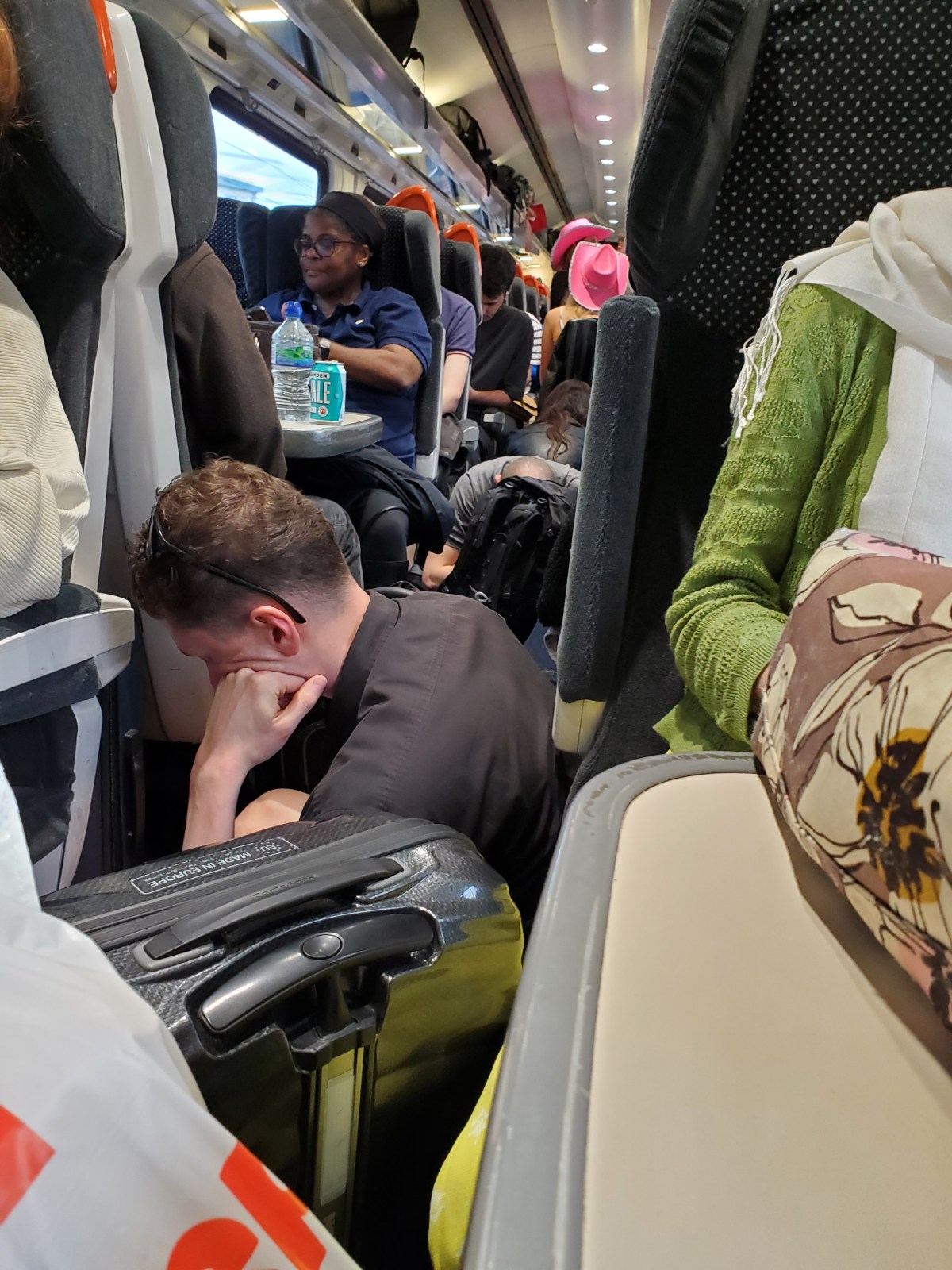
Following another wait, we managed seats on a direct train to London, even snagging unreserved seats in a carriage where 90% of the seats were reserved for some part of the journey. We shared a carriage with far too many others, including a hen party of women in bright pink cowboy hats and some bloke directly behind us who apparently had been in a stage production of “Shawshank Redemption” because he wouldn’t shut the fuck up about it.

Although this train journey was crowded, it didn’t compare to the trip we took last summer from Belfast to Derry, full of fans from the North who were travelling to Croke Park to root for their favorite hurling teams. People were jammed into the carriage with little room to move. Again, we all managed seats, and Declan and I shared Moretti beers with a couple of hurling fans who had come prepared.

Nearly 10 hours after we started (and five hours later than planned), we finally reached our hotel, tired but ready for our next European adventure.

You’d think at this point that our travel troubles would be over. But we also didn’t know that various train operators were planning an industrial action (British for labor strike) for various days next week. Given our travel luck so far, there will be more to this tale soon.