

After Marilynn and I saw three cabs full of Georgia State students and their baggage off for Dublin Airport, we started the second part of our journey — a spa trip to Budapest.
Marilynn promised me a spa vacation after the spring break trip, and our initial thought was to return to Baden-Baden, where we spent a glorious day two years ago. However, Baden-Baden is well off the beaten path, and German trains aren’t as timely as they’ve been in decades past.
She settled on Budapest because: a) the city has spas; and b) Aer Lingus flies there direct from Dublin.
Aside from the above, I had no impression about the Hungarian capital before our visit. After 72 hours there, I was taken with the superficial beauty of the city and the promptness of the expansive public transportation system that includes old-timey trams, new-fangled trams, buses, and several subway lines.
It’s like knowing a beauty queen who loves refried beans and farts prodigiously.
From a distance, the city is gorgeous. The Danube meanders between the former cities of Buda and Pest that rise majestically on either bank. We stayed on the Pest side, a stone’s throw from one of the many bridges that connect the cities.

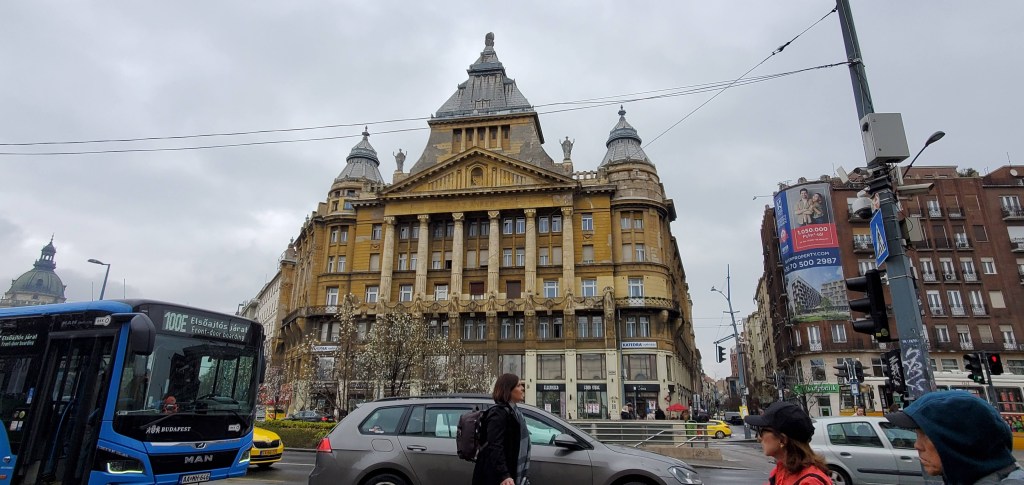
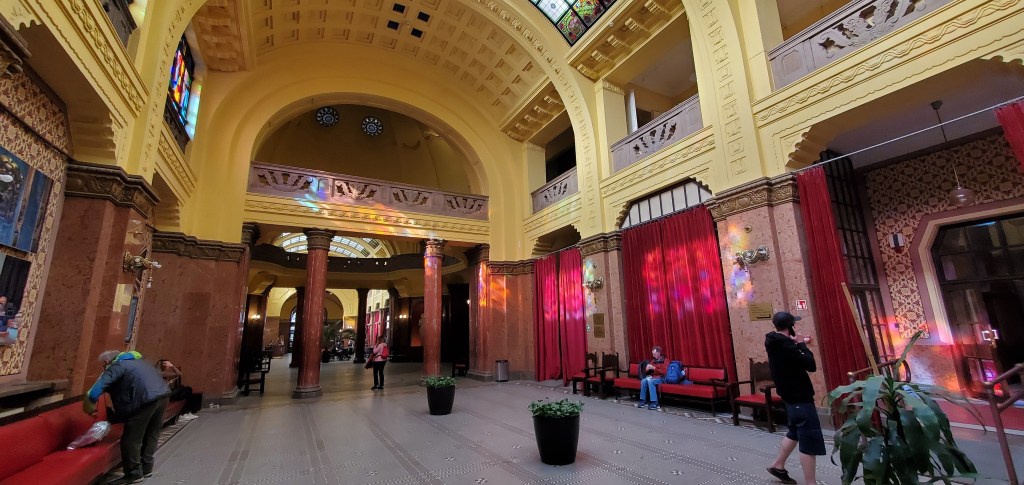
During a walking tour of Pest, our guide revealed an unseemly underside of the city. When it was officially formed in 1873, civic leaders wanted to build a grand European city. However, they didn’t have European city building materials like granite and stone. So they built brick facades covered with stucco, which would be fine except that lack of maintenance is causing pieces of buildings to fall to the streets below, sometimes striking cars and pedestrians. Our guide had a large scar on her forehead from falling debris.
It’s like knowing a beauty queen who loves refried beans and farts prodigiously.
A Tale of Two Baths
Speaking of farts, the thermal baths we visited were reminiscent of Tampa Bay, which reeks like sulphur — albeit in a therapeutic way.
We first visited the Gellért Thermal Bath, a short tram ride across the Danube. Built in Art Noveau style in the 1910s, the baths were damaged but rebuilt after World War II and extensively remodeled in 2008. Tales of Gellért’s healing waters date to the 13th century. It features swimming areas, soaking areas, and saunas in a grand building that’s like a maze to navigate between areas. My fitness tracker wouldn’t attach to my bathing suit, but I must have walked a couple of miles trying to find my way around. We particularly enjoyed the outdoor soaking area, where we had an extensive conversation with a group of Canadians who were also visiting the city.
The following day we visited Széchenyi Thermal Bath, located several miles from the city center and near the zoo. It’s known as the largest medicinal bath in Europe, with a special soaking area for those with medical prescriptions. The huge outside area features a lazy river and several spouts where water cascades over what ails ya. This spa was built during the same period as Gellért, albeit in a Neo-Baroque style. Indoors are 15 soaking and/or swimming areas and several saunas. For those wishing to go “textile-free,” there was one sauna called Phoenix. Since we had no desire to see anything rising in there, we gave it a pass.
We easily could have spent more than a week visiting two spas a day throughout Budapest, but these were the largest and most representative. And although I enjoyed both experiences, I’m still eager to return to Baden-Baden and the Caracalla Spa.
 To Europe ... and Back