
To say the trip Declan and I made to Manchester was part of a whirlwind tour is a vast understatement, because Tübingen, Germany, was our next stop. It’s been a university town since 1477, and Eberhard Karls University is one of the oldest universities in central Europe. Roughly one-third of its 90,000 residents are students, with most housed amid picturesque ancient buildings along cobbled streets embedded in the hills.
Marilynn was invited to give a paper at an Irish Studies conference at the university, so it was a no-brainer to add this stop to our itinerary. She flew directly to Frankfurt and took a mostly direct train there, but Declan and I weren’t so lucky.
We couldn’t find cheap flights into Frankfurt or Stuttgart from Manchester, so we flew on Ryanair to Cologne. The day started with a 4:35 a.m. wakeup call and a 7 a.m. flight, followed by at least four train transfers and most of the day. You must really want to get to Tübingen from Cologne.
The silver lining is that the train traveled along the Rhine River Valley, with stunning mountain views and literally dozens of castles — both current and ruins — dotting the hilltop scenery. The arduous journey was worth it to see this quaint city, which grew up on both sides of the Neckar River from the 12th century.
Top sites include St. George’s Collegiate Church (Stiftskirche), built in the 15th century and a central feature of Tübingen’s skyline. The church was one of the first to convert from Catholicism to Martin Luther’s Protestantism, and the structure retains many features usually associated with the Catholic Church. If history isn’t your thing, stop in for the stained-glass windows.
One unexpected delight was the City Museum of Tübingen exhibit devoted to early film silhouette artist and director Lotte Reiniger. When you were a kid, you may have gone to a puppet show with moving shapes behind a backlit white screen. That’s silhouette artistry, and Reiniger was best known for her ambitious film “The Adventures of Prince Achmed” in the 1920s. We visited the museum to escape the rain, but we’re glad we went.
Walking the hilly streets of Tübingen and seeing the sights were the best parts of our adventure. The city escaped Allied bombing during World War II, so the city doesn’t have that discordant architecture from the ‘60s spoiling the view of the buildings that are hundreds of years old. Colorful side-by-side Bavarian-style timbered houses and quaint shops line the streets, delighting the senses.
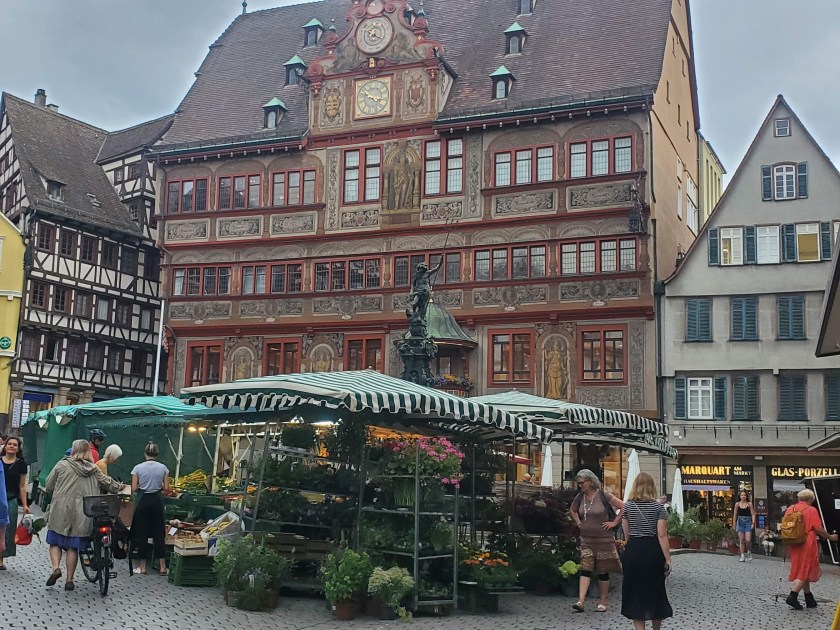
On the day we visited, a morning street market sprang up in front of the historic City Hall that featured local meats and cheeses, fruits and vegetables (including white asparagus), and other delights. Even a brief but torrid downpour could not stop market day, as people ducked under awnings or donned their rain jackets.
The river that flows through town at various points provides a great diversion. We particularly enjoyed watching eight baby ducks slalom through a set of rapids under mama duck’s watchful eyes, moving back and forth over the obstacles to reach the quiet pool at the bottom. Yes, it took 10 hours of travel time to reach Tubingen, but the views more than made up for the hassle.

 To Europe ... and Back
Weisse Spargel! I’m jealous! So glad you discovered Tübingen! It’s a
charmer!
Too bad you couldn’t spend more time in Köln. I studied there for a
year back in the day. The Cathedral is noteworthy only because of its
size, but next door is a fabulous museum of Roman mosaics et al.
uncovered only after WWII.
I had never seen Prince Achmed. What a treat!
Declan’s friend is as tall as he is! Ya can’t beat vitamins and good
nutrition. No telling how tall you and I would have been, Matt, if our
parents had had all the dining acumen we have.
How did Marilyn’s presentation go?
LikeLike
Presentation went well! Just wait for tomorrow’s adventure!
LikeLike