Declan Plans Portugal Adventure

For literally months, Declan has been planning this nine-day trip to Portugal. The last hurrah, if you will, to this wonderful seven-month European adventure that ends in just over two weeks.

When I told someone he had planned 85% of the trip, Declan looked at me sharply and said that the estimate was low. In retrospect, he’s probably correct. He first defined what cities we were going to visit after Marilynn and I said we should confine ourselves to the north of Portugal, where it was likely to be cooler in the middle of July.

Declan then researched plane tickets from both Belfast and Dublin to find the best (and cheapest) ones. He researched sights, hotels, transportation, restaurants and more, filling our days with activities while respecting our need to rest from time to time.

I’m writing about our first day in Coimbra on the fourth day of the trip (in Porto), and I can say that Declan has done a tremendous job so far.

Academic beauty in Coimbra

After flying in to Porto, we immediately headed to Coimbra, in the middle part of the country. Coimbra served as Portugal’s capital for more than 100 years (between 1139 and 1255, when it moved to Lisbon) and houses the country’s oldest university, founded in Lisbon in 1290 but relocated to Coimbra in 1537. So I guess Coimbra’s loss is Lisbon’s gain, and vice-versa. We stayed at the Hotel Vitória, a short walk from the train station and centrally located within the city.

Our first day was dominated by a visit to the Universidade de Coimbra, located in the highest part of the city and a UNESCO World Heritage site since 2013. Several of the buildings feature terrific city views, including the clock tower. One ticket allows entry into all of the buildings, and climbing the clock tower is an extra euro—the winding staircase gets tight and twisty at the top, but the views may well be worth the vertigo.

The Biblioteca Joanina (library) was deemed too distracting for student use, its 60,000 volumes housed amidst gilt, frescoes and lots of ornate woodwork. The 18th-century building remains too precious for tourist photos, so you’ll have to take my word that it ranks high on the audacious scale. Speaking of audacious, under the library is the Prisão Académica (academic prison). Misbehaving students were housed under the library until their grades got better, I suppose.

Student exams and important academic ceremonies take place in the Paço das Escolas (the original Royal Palace). We saw what appeared to be a Ph.D. defense take place in the Grand Hall, a high room with lots of dark wood, second-floor doors that can be opened from the two-sides balcony above, ornate ceiling and large portraits of Portuguese kings.

Saint Michael’s Chapel dates from the 16th century and replaced an older chapel from the 11th century. The 2,000-pipe organ dates from 1737 and remains in use today for music concerts, as well as weddings and baptisms at the still-consecrated chapel.

The central buildings of the university form three sides of a rectangle, with open views of the city from the fourth. With his back to the city, the statue of King João III overlooks the courtyard. The 16th-century king was responsible for moving the university to Coimbra and expanding it during his reign.

Several other historic buildings are included in the ticket price, including the Chemistry Laboratory, the Cabinet of Physics and the Cabinet of Natural History. The latter, created in 1772, is the oldest museum in Portugal that remains in its original location. These three buildings, with their science exhibits and displays, could easily have filled a day for those with an eye toward the history of invention, chemistry or natural history.

All I can say is that Declan knows what his parents like.

Bullocks Butt in on View of Bronze Age Standing Stone

Bronze Age religious symbol or bullock hindquarters scratching post? The Ardmore Gallan Standing Stone may have served the former purpose at some time during its 2,500-year history, but it’s definitely serving the latter purpose at present from its location in the middle of a field full of cattle.

The Ardmore Gallan Standing Stone is located a couple of miles outside a village with the great name of Muff. In fact, the stone is often called the Muff Stone. It dates from 2,500 BC, standing about six feet tall and half that in width and depth. Its distinct feature is 40 cup marks, or round indentions, about half of which are encircled by one, two or three rings. The stone evokes similar feelings to Newgrange, an ancient stone monument aligned with the winter solstice.

Finding the stone took a morning’s effort, several wrong turns and directions from a helpful older man cutting weeds along a remote roadside. None of us suspected it would be found a quarter mile off the main road, the concrete driveway winding behind a house before opening up in front of several farm buildings.

Grand adventure ahead

Declan read about the stone in a book our B&B host provided us, and it looked cool. We had no definite plans for Monday, and we all enjoy an adventure. Our host believed there was a historic marker that would make locating the Ardmore Stone a snap. But we didn’t see it on our way to Muff, so we inquired about the stone at a petrol station in town. However, no one there knew how to find it.

Heading back toward Moville, Marilynn remembered it was near Inishkeen, signs for which we’d seen along the way. So we left the main road and headed in that direction, only to wind up back on the main road at another sign for Inishkeen. So we’d basically traveled in a semi-circle.

A little ways back, an older man was weed-whacking his yard, so we turned around and asked him for directions. He was quite specific: pass the closed pub with the thatch roof, then a closed building supply company and take the next road to the right, a concrete driveway. He gave great directions, but it was obvious the concrete road was somebody’s private drive and not a public thoroughfare.

Preternatural bovines

As we wound up the road, we could see the stone in the middle of a field, looking like it was being protected by a herd of cows. The road wound uphill, past a residence and opened out to three large outbuildings, a truck with its door open in front of one of them. We got out and were immediately met by a large dog that, fortunately, turned out to be friendly.

The farmer then appeared from the building, and we asked permission to see the stone. He graciously agreed, cautioning us to watch out for cow patties and assuring us the bullocks would be no bother.

We couldn’t escape the feeling that the cows felt some sort of connection to the stone. They watched us intently, moving away from us in ones and twos, then en masse, but never getting too far away. As we approached the stone, they continued to watch us from turned heads. We spent a few minutes examining the stone and snapping a few pictures before making our way back to the car.

The cows started walking back around the stone as we moved away, again with intent stares that seemed preternatural. They gathered around the stone as if protecting it, one rubbing his butt contentedly across its face.

Farmer Dermot explained that he gets visitation requests quite frequently and is happy to share the stone. Apparently more happy to share than the cows appeared to be.

Donegal Beauty Is Like No Other

There’s Irish beautiful, and then there’s Donegal beautiful. County Donegal is in the Republic, but it abuts the north, like Michigan sticks up into the Great Lakes. We spent a four-day weekend in Derry and Donegal, exploring the wonders of the coast.

But first, Derry and thereabouts

Marilynn attended a conference in Derry most of last week, while Declan and I entertained a guest from Tennessee. On Friday afternoon, we drove the couple of hours to join Marilynn in Derry, where we stayed with our friends the Pynes, who own two wonderful B&Bs in the central part of the city.

After visiting with them on Friday evening and early Saturday, we set out to briefly explore Derry, which we’ve all visited many times before. Declan especially wanted to sit on the Lord Mayor’s throne in the Guildhall, which he’d done on a previous trip. We also walked the walls of Derry, a unique feature of the city that dates back hundreds of years. Derry’s walls are among the finest in Europe and should be part of any visit to Northern Ireland.


We descended the walls to the Bogside, the nationalist part of the city that features many murals to fallen protesters (especially victims of Bloody Sunday and those who died on hunger strike during the Troubles).

On our way out of town, we visited the Grianán of Aileach, a restored stone fort from the 8th or 9th century. Marilynn and I had visited here years ago, but it was Declan’s first time. From its hilltop perch, the Grianán offers fine views of the surrounding countryside. But having driven there directly from Derry, we now want to know how Seamus Deane walked there as a child, as he describes in his book “Reading in the Dark.”

Onward to Donegal

But the main event of this trip was County Donegal, where many from Belfast go on summer holiday. Fortunately, high season wasn’t in full swing, so we had many sites to ourselves. With a car, we could explore at our leisure.

We stayed at the Inishowen Lodge near Moville, where our host Irwin was extremely helpful with directions, a book on the area, general advice and the use of a detailed map and pair of binoculars during our two-day stay. The lodge is high above Lough Foyle, and the view from our room was truly spectacular. It almost rivaled the fantastic and varied breakfasts we enjoyed during our visit.

The first day, we visited the Cooley Cross, a cool Celtic cross allegedly put up by Saint Patrick. The high cross sits right along the roadside just outside a small cemetery with a small stone structure that formerly contained human bones, the skull house. During Druid times, marriages were supposedly performed here, with celebrants lifting the bride on one side of the cross and the groom on the other, the bride and groom joining hands through the hole at the top of the cross.

We also viewed the remains of the Green Castle and saw what we believed was a pod of dolphins frolicking in the waters off Shroove beach.

After a sumptuous breakfast on Sunday, we made straight toward Malin Head, the northernmost point on the island. We wound our way along back roads and country paths, guided by signposts and our desire to see as much nature as possible. A highlight Sunday was a walk along Kinnagoe Bay, a remote beach and the site of a 16th century wreck of a Spanish Armada ship. The color of the hills changed by the minute, the result of the late afternoon sun peeking out from behind clouds and the ability of Irish grass to change color as if on whim. On the way back, we discovered several fields where peat had been cut into logs and left to dry—teepee style—in the field.

On Monday, after staggering away from another great breakfast, we did a little more local sightseeing before heading to the Seamus Heaney Homeplace, a new museum in Bellaghy that celebrates the life and work of the late Nobel Prize-winning poet.

Then we made our way toward home, full of new memories of the beauty of Donegal.

Thinking of Home on Independence Day

In Belfast, the Fourth of July is … Tuesday. Just a Tuesday.

No fireworks. No smoked or grilled meat on the Big Green Egg. No bonfires (those happen next Tuesday when, thankfully, we’ll be in Portugal). Marilynn and I worked today after spending the weekend in Derry in the north and County Donegal in the Republic.

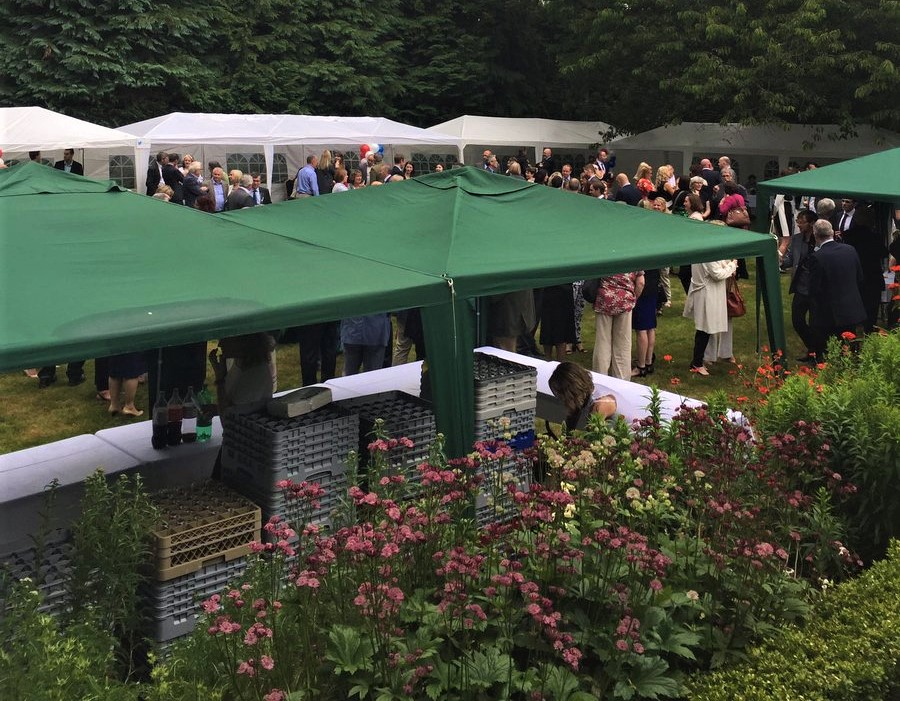
But that doesn’t mean that Declan and I didn’t get into the Independence Day spirit here in Belfast—albeit a couple of weeks early. Marilynn was at a conference in Scotland, but Declan and I attended the Independence Day celebration at the US Consulate General’s residence with about 500 other mainly Irish people and a smattering of Americans on June 23.

Even though it’s not a holiday here, Irish schools let out on June 30, so everyone goes on holiday right after, making a celebration on the actual day impractical. It was more networking than celebration, anyway, so think suits and ties rather than ballcaps and shorts.

Old friends and new

Declan and I immediately ran into author David Park and his wife, Alberta, who were talking to one of David’s former students and his American fiancée. The Parks have hosted us for dinner at their home in County Down, and we reciprocated with brunch on a spring Saturday. David attended Marilynn’s talk on “Hopdance,” and we all attended his reading at No Alibis promoting the paperback edition of his short story collection “Gods & Angels.”

Declan then wolfed down a hamburger and made a beeline to the back yard of the residence, where he played basketball with the consul general’s kids. With a growing thirst, I passed the Guinness booth in search of my new favorite Irish beer, Yardsman, brewed in Belfast by Hercules Brewing. I had seen a Yardsman glass and was determined to have a pint. Their booth was located in a corner of the yard.

Life, liberty, healthcare

Joining the queue, I overheard a few people on the side talking about healthcare. I joined that conversation, hoping to meet fellow Americans talking about Trump’s effort to undo the Affordable Care Act. Most were non-American officials from the Belfast Titans, the local ice hockey team whose mascot is Finn McCool, the mythical giant who created Giant’s Causeway. One, a former player who played in seven countries (including for the Gwinnett Gladiators in the north Atlanta ‘burbs), relayed the story of an American friend hit by high medical bills when his insurance ran out.

Say what you will about the National Health Service, but no one is turned away. Life, liberty and the pursuit of happiness are codified in the preamble of the US Constitution. But how can one have those things without health insurance? I posit that healthcare is a fundamental right and firmly believe that everyone should be covered.

So on this day of celebration, think about our country and how we treat the least among us. Is it with respect or with contempt? Then think about our country’s place in the wider world and Americans living outside the US, because we certainly are thinking about you on this day of independence.

Sun, Fun (and Birds) at Wetland Centre

Saturday was for the birds, literally. We did the major attractions of Belfast years ago and have visited many others during our nearly six months here. So what’s left to do?

With Marilynn at a Fulbright conference in Edinburgh, the weekend belonged to Declan and me. The nice folks at the Visit Belfast Visitor Centre suggested a day at Castle Espie Wetland Center in Comber, which none of us had heard of. But our road-trip friend Eileen and bird-watching friend Joanna both said it was great, so away we went.

First off, you have to want to get there. We rode into city centre (bypassing the close-by Europa Bus Centre), then walked 15 minutes to the Laganside Bus Terminal near the Titanic Quarter. A 25-minute bus ride landed us in Comber, where we had to find a taxi office and wait 15 minutes for a ride. Fortunately, on the way back, we could pre-book the taxi to arrive minutes before the bus. And, for some reason, the bus delivered us back to Europa, from where we could walk home.

Hides to seek birds

Although it sounds like another big house, Castle Espie has no house—although it once did. Its most significant history was as a limestone quarry and brickmaking works. A recently constructed visitor centre helps set the stage for the wetland centre on Strangford Lough.

After paying for admission and an additional 75 pence for a bag of bird food, off we went. Declan tried to feed the mostly ducks and geese in the captive bird area, but they weren’t having any of it–again, literally. We spent several minutes there before moving into the conservation area, where no bird feeding is allowed.

The meandering waterside pathway through the conservation area is dotted with observation areas and indoor hides where you can watch the birds unobserved while (given the Belfast weather) keeping dry. The first hide looked across the lough. Others looked across the saline lagoon and the limestone lake. The impressive Limekin observatory featured a large standing telescope where Declan could watch the cars on the nearby road.

Former home to limestone works

But from the raised observatory, you could see both across the wildlife centre and across the lough to nearby Scrabo Tower, built on a hill in 1857 to honor “Fighting Charlie,” the third marquess of Londonderry, Charles Stewart. These are the same Londonderrys that built and lived in Mount Stewart, an actual big house we visited last month.

From the observatory, the focus changed from birds to the limestone works, including water inlets, the remains of the brickworks and a pump house. Finally, the path wound through grassland and woods, with lots of areas for young’uns to play and explore.

Since the path through the conservation area begins and ends at the visitor centre, Declan had another opportunity at bird feeding, which was more successful this time. Declan said it tickles when birds feed out of your hand. I’ll take his word for it.

While waiting for the cab back to Comber, we enjoyed snacks in the Kingfisher Kitchen, which looks out over a pond and the lough. Ducks and geese roam freely and even come up to the windows.

I’m not a bird person, per se, so I have no idea what we saw. But I did enjoy them nesting and flying in a place I know is protected.

Puffins and Seals Highlight Trip to Rathlin Island

I never knew that puffins and seals spend part of their lives breeding (or lounging) in Northern Ireland—but they do—on Rathlin Island.

Last weekend was (relatively) warm and not too sunny, a perfect opportunity to visit Rathlin Island, a community of about 120. With our friend Eileen, we took the slow ferry over from Ballycastle, which takes about 45 minutes and provides ample opportunity to take in some beautiful scenery along the way. Rathlin Island is shaped like Italy, only in reverse and much smaller.

We immediately hopped on a bus to the Rathlin West Light Seabird Centre and Nature Reserve, where huge numbers of a variety of birds were nesting on large raised rocks or the cliff face. We smelled the birds before we saw them—something reminiscent of a pub toilet 15 minutes before closing time.

Once we became accustomed (?) to the stench, we grabbed binoculars and started looking for puffins. The rocks were swarming with black-and-white razorbills, auk family cousins to puffins, that from a distance resemble puffins. Only with the help of a docent did we glimpse the orange feet and beaks of the puffin. From our vantage point, they were few and far between, maybe 10 out of the thousands of razorbills, guillemots and two species of gulls (kittiwake and fulmar). The area is similar to the more famous Cliffs of Moher on the other side of the island, yet with far fewer tourists—even in high season.

The seabird centre is located around the Rathlin West Lighthouse, the country’s only “upside down lighthouse.” It took six years and a helluva lot of concrete to stabilize a cliff face and position the red light at precisely the right angle (62 metres above sea level) to warn ships on the horizon yet stay below the fog line.

And then, seals!

Our bus driver to and from the centre was a font of local knowledge and Irish humor. He said that Ireland and Scotland fought over ownership of Rathlin, which was decided by letting a snake out on the island to see if it could survive. It didn’t, which means it belonged to Ireland because it doesn’t have snakes either. He said the population was once as high as 1,200 but, like the rest of Ireland, people remain a big export.

We left the bus before it returned to the harbor and had a picnic lunch among the two dozen or so lounging seals who were soaking up the noonday sun. It was difficult to see them at first, they were so well-camouflaged against the rocks. You could get quite close, although no one wanted to disturb their sun-fueled dreams.

Before we took the fast ferry back, Marilynn and Eileen went for a walk while Declan and I checked out the HMS Drake exhibit at a local church. The Drake was hit by a German mine in the latter stages of World War I and limped along before sinking in the harbor. Although it was later exploded to reduce the chances of snagging other boats, the Drake remains a favorite spot for scuba divers.

On the way back, we went along the coast road through Cushendun to Torr Head, the closest point between Northern Ireland and Scotland. Torr means tall rock, and it was quite stark. We also treated Eileen to a meal before heading home as thanks for another fine road trip.

Pop-Up Pissoir Tames Wild Peeing

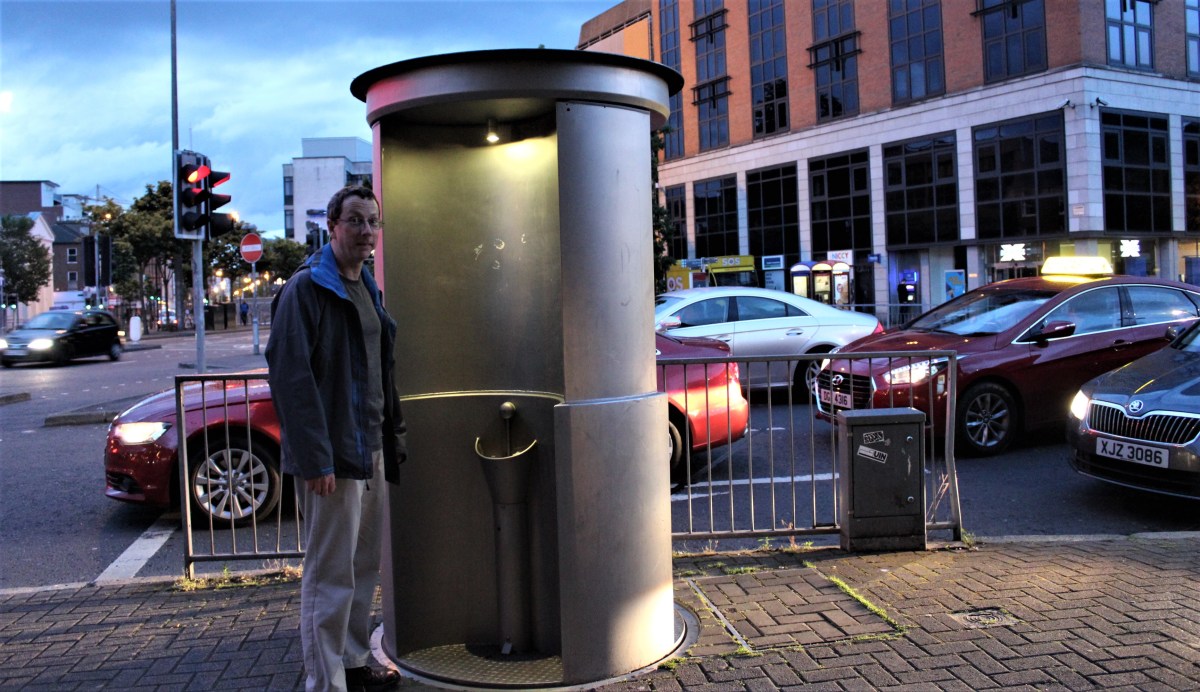
I thought it was a myth, this public urinal that rises gently each night from its underground cavern, ready to handle the No. 1 needs of passing punters. I had stood atop its daytime resting place, a slightly larger than normal manhole cover at the top of busy Shaftsbury Square, the intersection where Botanic Avenue meets the Dublin Road.

But at 10 o’clock each night, a curious transformation takes place as the three-man pissoir moves from its subterranean nest. I fail to push the iconic music from “2001: A Space Odyssey” out of my head. Daaa…DAaa…DAAA…PISSOIR! Kettle drums now beat a rhythm as the urinal locks into place, ready for Belfast’s passing drunks.

I feel the need, the need to pee

Drinking lots of tea in the mornings makes me appreciate such amenities as public toilets. I’ve written previously about how cities should provide more public toilets for tourists since we’re already paying taxes on our hotel rooms, transportation, food and attractions. There should be more toilets, and they should be free.

While discussing that initial column with a friend here, he casually mentioned the Shaftsbury Square pop-up pissoir, an entirely new concept for us. So, of course, we had to see it.

From the picture, you can see for yourself what it looks like, but it reminds me strongly of the upright cryogenic pods for space travel you see in the movies or the transporter room of the Starship Enterprise. Instead of “Beam me up,” however, it’s more “Pour me out.” But you’ll also notice there are no doors and no curtains. Two of the cubicles are fewer than five feet from vehicles waiting at the traffic light.

Belfast does a good job with public toilets, although I do object to the 20 pence it charges at standalone toilets. My motto is, “Free to Pee, You and Me.”

‘Urin-ing’ for the truth

I had to know more about the pop-up pissoir, so I called the Belfast City department of sanitation. It took several tries, but a man returned my call one recent morning. He declined to give his name because neither of us wanted to get the PR people involved, which an interview with a named city official would have necessitated.

The Urilift, as this particular model is known, is made by an English company called Healthmatic. It was installed more than five years ago in an area where many pubs are concentrated amid complaints about les pipis sauvages, or wild peeing.

This is verbatim from the Healthmatic website: “As men come out of the pub, the urinal is there in front of them tempting them away from shop windows and pavements.” So do they think men will pee anywhere and on anything? We will, but it’s impolite to point it out.

My friend in the sanitation department says that, anecdotally, the incidence of public urination in that area has dropped since the Urilift was installed. He also said it is moved into position each night by remote control once someone has checked to see whether any obstructions (bicycles, motorbikes, drunk punters looking to take a leak) are blocking the manhole cover.

Lavery’s is one of the pubs a pint’s throw from Shaftsbury Square. The night we went to see the pissoir up close at about 10:30, the sidewalk was overflowing in front of the pub, atmosphere that author Robert McLiam Wilson colorfully described in his 1996 novel, “Eureka Street,” set toward the end of the Troubles:

“I crossed Shaftsbury Square. Though early, the Lavery’s overspill was already out on the street. Groups of unusually dirty youths lounged on the pavement with beer glasses in their hands. As I passed the bar, stepping over their outstretched legs, a warm urinous waft hung in the air outside the doorway. I hated Lavery’s.”

While I have no opinion on Lavery’s, I can say we didn’t see anyone peeing in the streets, which apparently is progress.

Celebrating Father’s Day the Belfast Way

A cool card, a nifty tea mug and a literal walk in the park—what a way to celebrate Father’s Day. Unlike Mother’s Day, which in the UK occurs several months earlier than the US version, Father’s Day is celebrated on the same day on both sides of the pond.

First, Declan and Marilynn gave me a bicycle-themed card, a reminder of Belfast’s place in the annals of bicycling history. John Boyd Dunlop didn’t patent the air-filled tyre (that goes to some Scottish guy named Robert W. Thomson) but he is commonly credited with developing a practical tyre in 1888 to go with a new-fangled invention—the bicycle. Dunlop, who is also Scottish by the way, was a prosperous veterinarian.

Bicycles also play a role in our history with Marilynn’s playwright, Stewart Parker. His first play was “Spokesong,” a musical that takes place in a Belfast bike shop during the Troubles and also during the early years of the bicycle.

They also gave me a great tea mug, with Windsor Park emblazoned on it in the style of a Monopoly card (and one of the ritzy properties because the background colour is blue like Boardwalk and Park Place). We live on Windsor Park, although the post code on the mug indicates the Windsor Park in question is likely the national football stadium, a 10-minute walk away. Regardless, it will be a great reminder of our time here.

Botanic Gardens awaits

Thanks to fabulous weather, we got out and enjoyed the day in Botanic Gardens. We had a special Father’s Day “barbecue” in front of the Ulster Museum. Barbecue is in quotes because they were serving burgers and sausages. But I did discover a delicious new beer: Yardsman, a craft brew from local Hercules Brewing Co. that, according to the website, is filtered through Irish linen. Not sure what that adds to (or subtracts from) the beer, but it was quite tasty.

The 28-acre Botanic Gardens is where south Belfast congregates on nice days. We saw more white limbs than in an albino mannequin factory—there’s white skin, and then there’s Belfast white skin. Dogs playing fetch with their owners. A bridal party taking portraits in front of the Palm House, including two stretch limos I can’t figure out how they got inside the gardens. A woodwind band playing tunes in the gazebo. A line of people a dozen deep in front of the ice cream vendor.

Unfortunately, the bowling green is closed on Sunday. I’ve never lawn bowled, but it looks like fun and I want to try it. Instead, we walked through the gardens, including an out-of-the-way lane none of us had ever seen (where the photo was taken).

The city takes great pride in its parks, and for my money, Botanic Gardens is its crown jewel. Central Park is big and all, and Piedmont Park in Atlanta looks better than it has in the 25 years I’ve lived in Atlanta. But meter for meter, Botanic Gardens can’t be beat for its beauty, for the care city workers show it and for the appreciative, sun-seeking Belfast residents, students and tourists who enjoy it even on the cruddy, rainy days.

Many Trips Down, Many More to Go

Only 39 days left to our Belfast adventure. It seems like only yesterday we were on the front end of seven months in the UK. But now our thoughts already are starting to turn, half way at least, back to life in Decatur.

Restarting all those magazines we stopped. Arranging for our cleaner to go through the house to erase seven months of another family living there. Being reunited with Gunner, our beloved cat. Will she remember us? Will she leave us fecal presents to show her displeasure at our leaving? Going through seven months of junk mail. Reassembling my office. Wondering how many weeds have infiltrated the yard. Getting accustomed again to a humid Georgia summer.

A lot in the rear view

So far, including Northern Ireland, we’ve been in nine countries, seen four professional football matches and a similar number of big houses. We’ve glimpsed masterworks from Rembrandt, Picasso, van Gogh, Michelangelo. We’ve toured at least a half-dozen Gothic cathedrals and about that many scenic coastal towns. Paris, Berlin, Amsterdam and London. Doolin, St. Ives and Falmouth. We’ve seen henges great and small.

We pulled 220-million-year-old fossils out of the sand and muck at Lyme Regis. We still talk about the fantastic (and cheap) sushi dinner we had at a Berlin restaurant that had reopened just that week.

I haven’t had the fortitude to map how many miles we’ve traveled in the UK and continental Europe, but I know it’s an eye-popping number. I shudder to recall the many roundabouts where I went the wrong way and had to turn around—especially in Cork.

We’ve dined with several noted authors, including poet Michael Longley, literary critic Edna Longley, fiction writer David Park, playwright Ann Devlin and historian Jonathan Bardon. And we can’t forget Stephen Rea, who helped launch Marilynn’s edition of the Stewart Parker novel “Hopdance” in Dublin on our wedding anniversary.

And more to come

And with just 39 days to go, it seems like we have an impossibly long list of things yet to do that don’t include packing up the flat, getting rid of what we’ve accumulated and making our way home.

We’re going with our friend Eileen to see puffins on Rathlin Island tomorrow. Marilynn has a book reading Monday in Dublin, and another one in Edinburgh on Friday, where she’s going to attend a Fulbright Scholar conference. At the end of the month, she’s off to Derry for a Canadian Association for Irish Studies conference.

At the same time, a good friend of mine from Murfreesboro, Tenn., Karen, will be in Belfast to take in the sights for a few days. As Karen leaves us for Kilkenny, Declan and I will join Marilynn in Derry to visit friends and (at least) see the Grianan of Aileach, a prehistoric stone fort that’s around 10,000 years old. Derry’s a great city we’ve visited several times but is always worth a look. We’ll also spend a few days in Donegal, the county in the northwest corner of the island.

We return to Belfast and leave two days later for eight days in northern Portugal. I really don’t know much about that since Declan planned this trip with Marilynn’s help, but I do know it includes a tour of a football stadium in Braga built at the edge of a rock quarry. And in between our return from Portugal and the flight home, Marilynn’s Belgian friend Béné will be with us. She was a fantastic tour guide when we were in Antwerp, and we likely will be feeble imitators. We also hope to see Stewart Parker’s old friend Sam Fannin, who’ll be visiting Northern Ireland from Spain.

After all of that, once we’re back in Decatur, I think we may need a vacation.